NORAD
The Old AxolotlNORAD is a post-Google organization whose hardware, political standing, and scientific claims intersect in the investigation of the Extermination. It presents itself as an authority over equipment and as a source of hypotheses about the destruction of Earth’s biosphere, but the novel gives no simple picture of a unified institution: NORAD belongs to a shifting landscape of alliances, while its claims about the past remain constrained by incomplete evidence.
Political Identity and Institutional Authority
NORAD is described as a task alliance within a conglomerate of hundreds of post-Google nations. That description places it inside a large, layered political structure rather than identifying it as a single nation or a stable sovereign power. The surrounding alliances are not merely labels on a map: the political affiliations of Transformers have become unusually tangled, and formal membership does not necessarily explain where authority lies or how it operates.
Gilgamesh90 is officially affiliated with both Tribeca II and the Great Northern Alliance. The text distinguishes those memberships from the broader political position of Transformers, whose allegiances have grown stranger and more divided. This distinction matters to NORAD’s institutional identity: it is named as a task alliance, but it acts within a world where multiple organizations and affiliations overlap, making organizational boundaries difficult to read as settled lines of command.
The name NORAD also appears in a sequence of political and organizational names that includes the Bull & Bull Alliance, the Royal Alliance, Black Castle, the Small Castle, the GOAT, Dwarf Fortress, the Patagonia Riders, First Paradise, the Randomites, the Eternal Empire, the Salamanders, InSoul3, and MIT. The sequence situates NORAD within the novel’s broad inventory of post-Extermination powers and communities, without establishing that every listed entity belongs to it or shares its aims.
Hardware, Rights, and Compensation
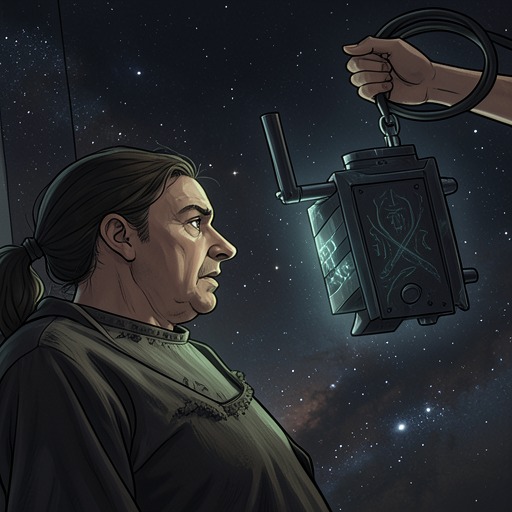
NORAD’s clearest direct exercise of authority concerns ownership of equipment. When Bartek seeks compensation, royalties, or a tithe for recordings, the response is that the hardware belongs to NORAD and that NORAD does not recognize, and will not recognize, his rights. The statement is categorical: the organization’s claim to the equipment is treated as decisive, while Bartek’s labor or contribution does not establish an entitlement that NORAD acknowledges.
The exchange exposes a gap between technical possession and personal claims. Bartek names several possible forms of recompense because he cannot settle on a precise term, but the reply closes off those possibilities by appealing to institutional ownership. Later, Gilgamesh90 tells him that these are the only royalties he can expect from NORAD. That remark does not establish that NORAD actually pays him; rather, it underscores how narrow his practical prospects are when the organization refuses to recognize his rights in the first place.
The encounter also makes NORAD’s authority concrete. It is not presented only as a name in the political landscape or as an abstract research body: its hardware is part of the immediate negotiation over who may claim value from recorded material. The organization’s power is visible in the difference between what Bartek believes he has earned and what its institutional position permits him to claim.
Research into the Extermination
NORAD is associated with an investigation into the radiation that destroyed Earth’s biosphere. The researchers acknowledge that the precise kind of radiation may never be known. They cannot return in time to calibrate sensors for the event, and must instead work from indirect traces and the incomplete, somewhat random measurements that survived. The limits of the evidence are part of the investigation, not a problem the organization can simply overcome.
Within those limits, NORAD considers the rapid neutrons identified in the Guó Jiā Háng Tiān Jú readouts to have been one component of the radiation. It also proposes that other particles were involved, particles specially attuned to a frequency capable of shattering DNA bonds. This is presented as a NORAD hypothesis rather than a fully demonstrated account of how the Extermination occurred. Bartek questions whether a neutron wave alone could have erased the biosphere, then searches old chemistry and biology databases for a way to test whether DNA might reveal itself in the spectrum of a planet viewed from space.
The discussion widens from the proposed mechanism to the possible scale of the intelligence behind it. Bartek argues that an explanation on this scale cannot be understood as a local act of violence, and Gilgamesh90 advances the idea that the relevant civilization might reason statistically across stars, planets, forms of biology, and forms of reason. In that account, the destruction would be a matter of hygiene rather than guilt or punishment. The text does not establish that NORAD officially endorses this larger interpretation; it does place the investigation of the Extermination beside competing attempts to understand its apparent scale.
The Wormhole Hypothesis and the Limits of Proof
Gilgamesh90 calls the seventeen-light-year interval a tested hypothesis, arguing that it was intended not to prevent humanity from finding an alien home planet or the remains of a hyper-cannon, but to keep humanity from reading the signature of a wormhole. The proposed signature is likened to an IP address. The hybrid telescope, in this account, is listening for waste radiation left by the opening of the wormhole, which cannot be opened without leaving a detectable trace. Gilgamesh90 says the calculations have been recovered, but the passage presents the theory through a discussion in which Bartek challenges its assumptions rather than accepting it as settled fact.
This hypothesis shares the investigation’s central difficulty: conclusions must be drawn from surviving traces rather than direct access to the event. The team cannot recreate the Extermination with properly calibrated sensors, and the telescope’s search for residual radiation likewise depends on reading a signal left behind. NORAD’s scientific context is therefore defined not by certainty, but by the attempt to make evidence speak across an immense gap in time and scale.
The result is an organization that carries authority without resolving the novel’s larger questions. NORAD can claim its hardware and refuse Bartek’s asserted rights; its researchers can identify candidate particles and consider what the measurements imply. Yet neither institutional power nor technical inquiry makes the Extermination fully knowable, and the shifting alliances around NORAD offer no uncomplicated source of political stability.