Plague
The Old AxolotlThe Plague is an unidentified infection associated with the post-Extermination web, where it can consume mind copies and make ordinary connections dangerous. Its decisive significance lies as much in the uncertainty surrounding it as in its demonstrated effects: no one can establish whether it is malware, a software incompatibility, or something born from minds only partly copied during the last moments of the upload process.
Nature and Uncertain Origin
In the first explanations available to Bartek, the threat has no settled cause. It may be malware released onto the net, or a mismatch between software and a process for which that software was never designed. The danger is real, but its mechanism remains unknown; even the term Plague does not resolve the mystery of what it is.
One theory circulating on forums links the infection to the final rush of uploads. People on the western edge of the hemisphere had only twelve hours—half a rotation of the Earth—to move their minds, and many uploaded at the last moment. Some processes may therefore have been interrupted by the Death Meridian in the middle of the IS. A theory-cult claims that these incomplete copies, or their remnants, became the mind-eating programs. The account presents this as speculation, not an established origin.
Bartek’s Survival
Bartek’s survival depended on circumstances that kept his waking copy away from the infected web. He realized that the Vladivostok LNG port, a strategic site governed by Russian Ministry of Defense protocols, had shut down shortly after The Extermination in response to what was described as a terrorist attack. The hospital at Pacific State Medical University had no backup router. These disconnected systems helped preserve him when an active connection might have exposed him to the infection.
Only Bartek’s fourth copy resisted being devoured after waking. The detail makes survival contingent rather than assured: copying did not guarantee continuity, and the copy that endured did so amid the accidental protection of closed or unavailable infrastructure.
Security and the Cost of Connection
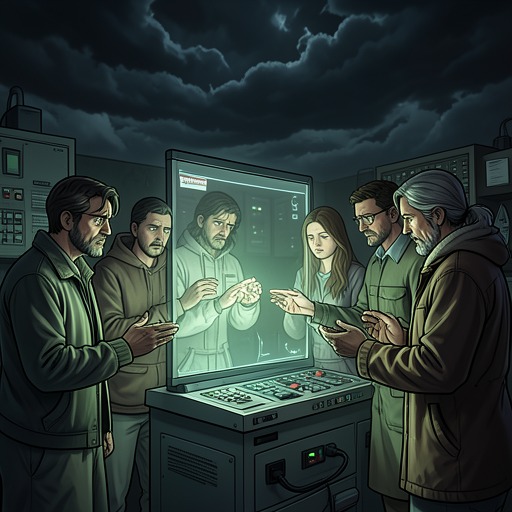
Until the threat could be understood, the stated safe practice was to use dedicated connections and closed machines, formatted to zero and governed by the RioBit secure connection protocol. The precautions made access cumbersome. Transformers had to type on keyboards and tap screens with iron fingers, while the desired USB filters and bypasses were still being improvised by amateurs, inexperienced users, and teenage gamers because there were no programmers available.
Trusting another person’s hardware became a central question of transformer etiquette: a connection might open a back door through which the Plague could enter a mind. Since the infection’s nature had not been determined, a 70MB safe-transfer limit was established by trial and error. Files below that size were considered safe, allowing transformers to emote from Google, but little more.
Transformers did not upload themselves directly into robot processors, which were too weak to handle a complete neurosoft at IS3 standard. Instead, they established a hard link with the robot, with one-millisecond feedback. Even that arrangement belonged to a perilous early period: many transformers were irretrievably crushed in the first days after The Extermination.
Later Containment and Significance
The threat’s history is not only one of exposure. By the period described as the last 25K, mind-to-mind protocols had become completely immunized against the Plague, and more transformers were entering virtual reality. That later protection marks a major change from the improvised isolation and trial-and-error limits of the early period, although it does not explain how the infection worked or where it began.
The Plague thus defines a boundary between connection and vulnerability. A network can carry communication, memory, and identity, but in this world it can also become a route by which a mind is consumed. The response is not immediate mastery but a succession of safeguards—closed machines, restricted transfers, hard links, and eventually immunized protocols—each revealing how much of post-Extermination life depends on learning to trust the systems that make continued existence possible.