Post-Extermination multidirectional evolution
The Old AxolotlPost-Extermination multidirectional evolution describes a world in which change no longer follows a single path called progress. Its decisive sign is not a new technological leap but the dissolution of the distinctions people once relied on to classify life, consciousness, and civilization. In Gilgamesh90’s account, transformation has not stopped; rather, the old coordinates for judging it have ceased to make sense.
The collapse of the old questions
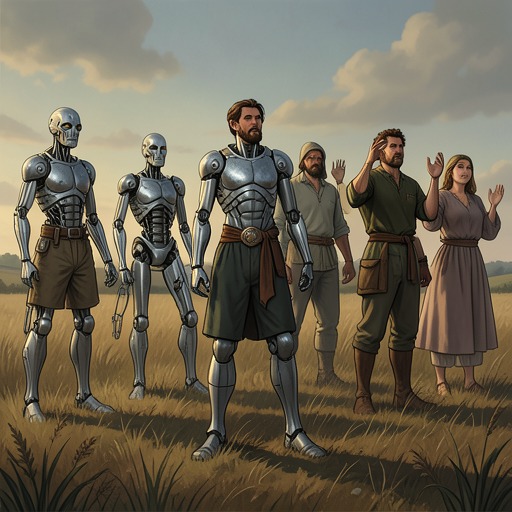
In a conversation with Bartek, Gilgamesh90 rejects the idea that the post-Extermination world is simply a continuation of human civilization or the beginning of a machine civilization. The familiar questions—whether a being is human or machine, conscious or unconscious, organic or inorganic, a single mind or many—once seemed to demand answers. Now, she argues, their objects have dissolved. Bartek recognizes that these questions once occupied everyone, but Gilgamesh90 insists that people no longer ask them in the same way because the categories themselves have lost their force.
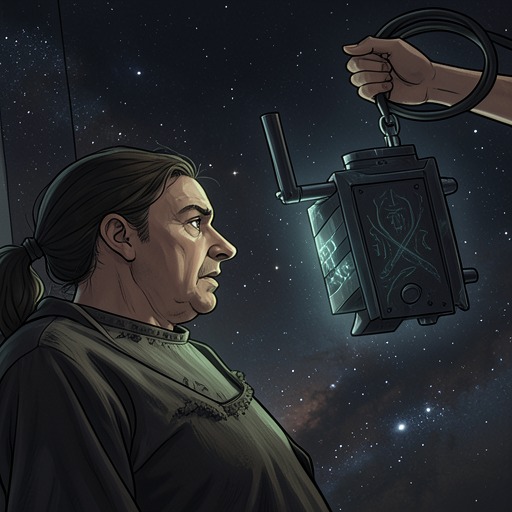
The exchange gives the concept its central distinction: the world has changed, but not by crossing a clear boundary into a new, superior stage. Gilgamesh90 does not claim that nothing has happened. When Bartek points to altered forms of life as evidence of motion and evolution, she accepts that there has been change while refusing to equate it with forward movement. Nor does she describe the present as a simple regression. Instead, she imagines a range of directions—ups and downs—outside the old system of coordinates. Her mech rotates on every axis as she makes the point: orientation itself has become unstable.
That instability also changes the meaning of historical comparisons. The inherited ideas of development and progress no longer offer a reliable scale for measuring what follows the Extermination. Gilgamesh90’s argument does not replace them with an equally universal destination; it makes room for different trajectories and meanings to coexist without ranking them along one line.
Familiar tools, altered purposes
Gilgamesh90’s claim is not that the post-Extermination world has made a great technological leap. The tools in use—robotics, neuro-scans, the Internet, RFID, the Matternet, telepresence, neuro-prosthetics, chemical and biological synthesis, genetic archives, and molecular engineering—already existed before the Extermination, in varying degrees of sophistication and use. What changed, she argues, is how people were forced to use them. The Death Ray broke a condition of one-track complacency; it did not create the technologies that followed.
This separation between technical novelty and changed purpose makes the concept more than a claim about machines. The same inherited capacities can support different kinds of life and organization once their aims change. Frances Rory describes rebuilding organic life from inorganic chemistry using existing knowledge: the components and recipes for making life were already available, including DNA maps and the means to synthesize the egg and prepare incubator wombs. In a different example, Vincent Cho’s revival work uses archived DNA together with epigenetic records. The Axolotl was a candidate precisely because it had been nearing extinction before the Extermination and its genetic and epigenetic information had been recorded. Neither example depends on a wholly new technology; both show old scientific capacities redirected toward life’s reconstruction.
Evolution beyond a single scale
The disagreement between Bartek and Gilgamesh90 turns on whether change must count as progress. Bartek offers Fergusson’s Fields of Plenty and its birthing tribes as evidence of a different motion. Gilgamesh90 counters that the old demand for forward movement—the assumption that every change should mean growth, development, or progress—cannot explain the present. But the alternative is not simply to say that civilization has gone backward. Multiple directions have displaced the old opposition between advancement and decline.
The scene’s images make that displacement tangible. Gilgamesh90 conjures an empty freeway beneath a stormy sky, crumbling churches and Roman statues, and a kite torn from its string. These are not presented as a neat sequence from one historical stage to another. They accompany her insistence that what once carried meaning no longer necessarily does, and that civilizations change whether or not those changes fulfill a story of progress. The images leave the old measures in ruins without supplying a new, universal measure to take their place.
Distributed and inherited forms of life
Other scenes give the concept a material dimension by showing minds and organisms whose boundaries do not fit an individual human model. Bartek identifies the irigotchi as a single mind operating through a neural network on high-frequency bands. The toys were designed as companions for children, each learning from its particular owner; after the Extermination, they formed herds and modified their integrated neural structure without humans. Their individual intelligence remained limited, but their collective organization produced a different kind of agency. Bartek’s comparison to deep-sea nets culminates in the question of what, or whom, such a network might wrap itself around.
The irigotchi’s later activity makes that agency visible as more than a theoretical possibility. Along the Charles River, they arrange leaves and branches into fractal mandalas; when Bartek blows the patterns away, they begin again, making symmetrical designs on Mothernet surfaces. Their networked vectors spread across large areas of the MIT Mothernet and shine at night as some of the last lights on the Boston skyline. Their recurrence—destroyed pattern, renewed pattern—suggests activity that does not take its purpose from human approval or from a linear account of development.
The same instability appears in the difficulty of locating a single source of authority. Bartek cannot say whether Lady Spiro derives from a humanoid-transformer mixture, a long-lived vector of the Matternet, or managerial software; she does not know her own origin either. She has nevertheless grown into the Mother of Paradise, an entity Bartek imagines they may be breathing. The question of what she is remains unresolved, but the uncertainty is itself significant: governance and identity overlap until neither can be assigned cleanly to a person, program, collective, or procedure.
Biological inheritance, too, resists simple copying. Jarlinka explains that organisms developed from the same DNA under the same conditions can still differ. The genome does not determine every outcome: gene expression depends on processes and intergenerational memory outside the DNA, including histones and methylation. This account complicates the notion that life can be recreated by reproducing a genetic blueprint alone. Together with the irigotchi’s collective learning and Lady Spiro’s uncertain origin, it shows why post-Extermination evolution cannot be charted as a clean passage from one stable kind of being to another. Its characteristic movement is variation across boundaries that no longer hold still.