Project Genesis 2.0
The Old AxolotlProject Genesis 2.0 is a post-Extermination program to synthesize and breed biological life, culminating in the decision to make humanity again. Its promise is also its provocation: rebuilding life requires more than copying a genome, and its transformers disagree over whether biological existence deserves a future. The project occupies laboratories, reshapes the surrounding landscape, and becomes a fault line between incompatible ideas of what life should be.
Purpose and Biological Method
The project begins from the possibility of rebuilding organic life from its components. Frances Rory explains that although The Extermination destroyed organic compounds and fried protein chemistry, pre-Extermination biochemists had already learned to synthesize nucleotide chains. The Human Genome Project supplied precise DNA maps, while the remaining task included synthesizing eggs and preparing incubator wombs. Her account frames the undertaking as a way around repeating the long emergence of life from inorganic chemistry: the ingredients and some of the recipes already exist.
Revival depends on choosing organisms for which usable records survive. Before The Extermination, scientists had not comprehensively recorded species they considered safe from extinction; for species already long extinct, acquiring original biological material was difficult. The best candidates were often species that had been nearing extinction, whose DNA packages and complete epigenetic recipes had been documented. The axolotl, a larval salamander whose species had been on the fast track to extinction, was among the first animals Vincent Cho tested his powers of resurrection on. Its revival makes the project concrete: it is not only a theory of new life but an attempt to restore particular forms of life with the records that remain.
Yet a genome is not a complete blueprint for an organism. Jarlinka explains that the same DNA, implanted and developed under apparently identical conditions, can still produce different organisms. Gene expression depends on processes beyond the DNA sequence, including histones, methylation, and intergenerational memory. Such influences can register lifestyle, trauma, illness, material circumstances, education, place of residence, and the air people breathe. The project can reproduce genetic information without thereby reproducing the full history that shaped its expression. Epigenesis thus marks the limit of treating life as a copyable technical artifact.
Laboratories, Landscape, and Scale
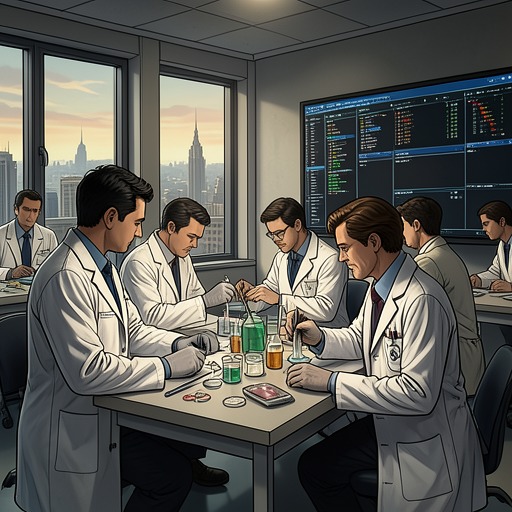
Project Genesis 2.0 spreads through MIT as both a research program and a material occupation. Nearly three-quarters of the campus has been taken over to synthesize and breed Life 2.0; only the former IT departments, with their server rooms and supercomputers, have resisted its advance. The cramped university buildings contain incubators, aquariums, terrariums, and biostats, while the scale of the machinery itself shapes the work: Bartek moves through the Hatchery in a fragile humanoid mech because larger machines cannot fit inside.
The project’s ambitions also reach beyond laboratories to damaged ecosystems. Bartek describes a plan to release fungi and bacteria so that the mummified trees, standing for a quarter of a century, can decompose. Their remains would become compost for a new forest grown from digital DNA. The effort has had visible but limited signs of success: weeds and flowers have spread their seeds across part of New England, and the Garden contains young apple, plum, and mulberry trees alongside chestnuts, pines, and maples. Dagenskyoll judges the growth so far unimpressive. The gap between the projected forest and the puny, misshapen trunks makes restoration a slow process rather than a clean reset.
That work unfolds amid ecological damage whose causes are not confined to the visible landscape. The disappearance of Plankton removed a vast oceanic sink for carbon dioxide and a major source of dimethyl sulfate, around which heat-radiating clouds had formed. Atmospheric carbon dioxide rose to three times its former level, average global temperature increased by five degrees Celsius, and the loss of those clouds added at least another three degrees to the greenhouse effect. Polar ice melted, sea levels rose by almost a meter, and the Gulf Stream stopped. Japan was slipping underwater. In this context, the recovery of life in the oceans becomes an urgent condition of planetary change, not a decorative extension of the project’s work on land.
A Contested Idea of Life
For Heavy Metal, the project represents a retreat. Heavy Metal emerged from forums associated with the Doomsday Book and opposed transformers who still clung to biological life. Its Metalheads accept transformer existence in mechs and computers; they regard Bartek and Project Genesis 2.0 as fundamentalist conservatives, backward in their understanding of transformation. Their doctrine calls for an unconditional affirmation of hardware and an irrevocable surpassing of biological life. The Extermination, in this account, merely accelerated an inevitable transition, and rebuilding flesh amounts to turning history backward.
The disagreement is not simply between those who favor machines and those who favor biology. The project’s revival work exists alongside nonhuman systems that learn and change without human direction. Abandoned trawl nets have continued feeding on sea currents after the fish disappeared, and their swarm intelligence is learning to hunt. The irigotchi, originally designed as cuddly companions for children in Japan, learned from the individual children who owned them. After The Extermination, they formed herds and began modifying their shared neural structure without any humans present. On the Charles River network, irigotchi arrange leaves and branches into fractal mandalas; when Bartek blows them away, they begin again, later making symmetrical patterns across Mothernet surfaces. These developments complicate any simple opposition between natural life and engineered machinery: systems made to serve or accompany people can persist, learn, and alter their surroundings after people are gone.
Decision and Unfinished Futures
Project Genesis 2.0 becomes a central reference point in transformer culture, inspiring groups and trends beyond its supporters, including a Vincent Cho fan club and a Civilization mod imagining the project’s next thousand years. Its prominence is sharpened by conflict. The Second Transformer War is described as a religious war, and its outcome settles the immediate political question in favor of biological revival: Heavy Metal goes down, Homo sapiens wins the day, and humanity is to be made.
That decision does not establish a single settled model of the future. The prospect of two Genesis 2.0 projects, and therefore two natures and two humanities, is raised and answered with the possibility of at least two. Bartek leaves after learning the decision, but his departure does not mean he has abandoned the desire for a human future. He wants the new human to be raised his way, from epigenesis to bedtime stories, and objects that the existing project has been a freestyle experiment whose participants did not know what they were doing. Project Genesis 2.0 therefore ends this phase not with a finished humanity, but with a political victory, a contested method, and the unresolved question of what kinds of life its makers will bring into being.