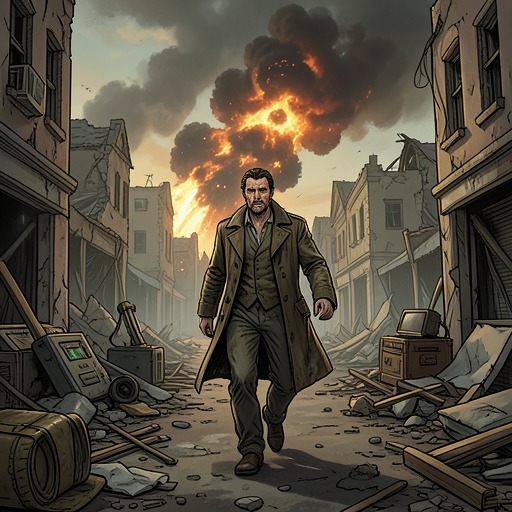
Rytka
The Old AxolotlRytka’s defining presence is in the IT room at the edge of the Extermination: she keeps working while the world’s collapse streams across the monitors, then joins Bartek in preparing an IS3 scan as the crisis closes around them. Her technical competence is concrete rather than ceremonial—keyboards, satellite feeds, raw measurements, and calibration—and the later report that she is gone gives that work a stark endpoint.
Identity and Work
Rytka appears as a colleague of Bartek in the IT workplace, where her skill is shown through action rather than a formal job title or biography. When Bartek returns from the bathroom, covered in grease and plumbing lubricants, he finds the room transformed: the boss is shouting into a mobile phone, while Rytka types at a side terminal with the speed of a mad jazz musician. Big Bird, Joey, and Tatar stare at news channels from Poland and abroad. Rytka’s keyboard work stands out amid the stunned spectatorship; she is not merely watching the catastrophe arrive but trying to do something with the information available.
Her manner combines urgency with precision. When others gather around her, she remains hunched over the keyboard and asks them to leave her alone before she loses concentration. The politeness of the request sits against its blunt warning. The scene makes concentration a scarce resource: Rytka is doing work that depends on keeping her attention, even as people crowd the terminal and the emergency intensifies.
Satellite Data and the Extermination
Rytka’s access to satellite information makes her work consequential beyond the immediate office. She reports that she has accessed Chinese satellites and is receiving a feed directly from Guó Jiā Háng Tiān Jú. The accompanying picture is immense in scale: Asia, and part of America, are already devastated, visible through live television cameras. Rather than stop at the spectacle, she wants raw data showing how the wave’s intensity changes as Earth rotates. The distinction matters. The live feeds show what is happening; the measurements might reveal how the destructive wave behaves.
This sequence presents Rytka as a participant in a technical response to catastrophe, not as someone who can prevent it. Satellite access gives the group a view across vast distances, but it does not restore control over the events on the ground. Her effort to obtain measurements is a practical attempt to extract knowledge from a disaster whose scale exceeds the room and its equipment. The novel gives that effort urgency without suggesting that data itself can reverse the damage.
The IS3 Scan
Rytka’s collaboration with Bartek shifts from monitoring the catastrophe to preparing a scan. They flip a coin, after which Rytka takes the keyboard and Bartek selects an IS3 scanner. The small, almost ordinary procedure is set against the boss’s visible agitation: he approaches with a clenched fist, spits out an offered joint, chatters his teeth, and cracks his knuckles. Rytka, by contrast, occupies the operational position at the terminal.
The scan requires repeated checking rather than a single dramatic gesture. Bartek puts on the skullcap while Rytka calibrates the equipment; he removes it, and they check the configuration again. The display remains green. These details establish a shared task with divided roles: Bartek is the person being scanned, while Rytka handles the keyboard and calibration. Their preparation is methodical even as the surrounding circumstances make the procedure feel like a wager against time. The coin toss, the skullcap, and the green configuration give the scene a sequence of tangible steps, each bringing the scan closer to readiness.
Loss and Narrative Significance
Rytka’s fate is conveyed later through Bartek’s search for family and friends after the Extermination. He looks them up and finds that Danka is gone, his brother and father are dead, and Rytka is gone as well. The account is brief and comes through Bartek’s search rather than a scene depicting Rytka’s death. It therefore fixes her absence without supplying a final moment, a body, or a separate explanation of what happened to her.
That later absence changes the meaning of the earlier technical scenes. The satellite feed and the scan preparation preserve Rytka as an active collaborator at the point when the catastrophe is still being met with work: she gathers information, protects her concentration, and helps carry out a procedure. Afterward, Bartek can recover recordings of some of the people he lost, but the supplied account does not give Rytka a comparable recorded farewell. Her arc consequently ends not with a stated last act, but with the abrupt fact of her disappearance from the surviving world—and with the contrast between her composed activity in the IT room and the irretrievable loss reported later.