SoulEater39
The Old AxolotlSoulEater39 is a powerful transformer leader whose influence reaches from the GOATs guild and the Royal Alliance to plans for a network of orbital refuges. He recruits Bartek into a world of machine communities and competing political projects, presenting transformers as a people with a destiny of their own. His leadership is at once concrete—choosing machines, assembling coalitions, protecting a guild—and speculative, measured against the possibility that the Death Ray could erase life again.
Identity and Leadership
In Japan, SoulEater39 is both the leader of the Royal Alliance and head of the GOATs. Those roles give him first choice of machine: he logs into a shogun, a position of authority made visible through the machine he commands. When he invites Bartek to a Royal Alliance warehouse in the Keiyō Industrial Zone, the Flood has begun two districts away. They travel along a monorail track over empty streets and rooftops, while Bartek operates a heavy Shift series XIV, a headless industrial mech kept ready for natural disasters. The setting makes SoulEater39’s authority practical rather than ceremonial: it is exercised amid abandoned infrastructure and machines maintained for a crisis that is already unfolding.
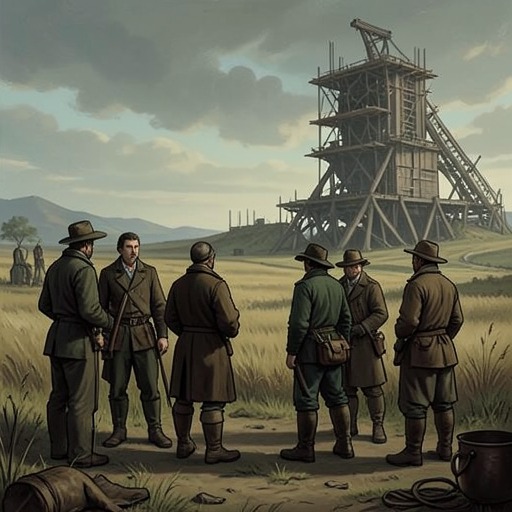
His recruitment of Bartek began earlier, at the Wrocław Expo, on 23 PostApoc, a day after Bartek awoke in Vladivostok. SoulEater39 arrived in a red-and-yellow spider mech designed for skyscraper work. Bartek, left with a half-ton pest-control machine manufactured in Radom because the more appealing robots had already been claimed, entered this new social world in a markedly less prestigious body. That contrast gives the recruitment scene an understated imbalance: SoulEater39 has status and an imposing machine, while Bartek has only the sensitive lenses of his industrial lug.
SoulEater39 explains the GOATs as a guild responsible for looking after its members. In answer to Bartek’s question about who provides that care, he displays the guild’s emblem: horns locked together in a tangle that resolves into the lines of an integrated circuit. Bartek recognizes that he is being recruited. The emblem captures the guild’s double character: a fellowship signaled by interlocking horns, and a collective organized through technology.
Political Vision and Recruitment
SoulEater39 offers Bartek more than membership. In recounting an apocryphal version of the Evil God legend, he argues that humanity deserved its fate, that transformers were spared for a reason, and that they are the new chosen people. The claim gives their survival a providential meaning rather than treating it as mere continuation after catastrophe. Bartek rejects the rhetoric sharply and distances himself from what he sees as a reckless religious and technological outlook. SoulEater39 answers that Bartek has chosen a side, but leaves open the possibility that he can make up his own mind.
That invitation is tied to Frances Rory’s project. SoulEater39 tells Bartek that Frances will visit him and that the Royal Alliance intends to support her work; he asks him to keep the matter confidential, while acknowledging that Bartek will do as he pleases. His approach combines allegiance with room for refusal. He wants Bartek involved, but does not pretend that recruitment has settled the question of what Bartek believes or which project he will ultimately serve.
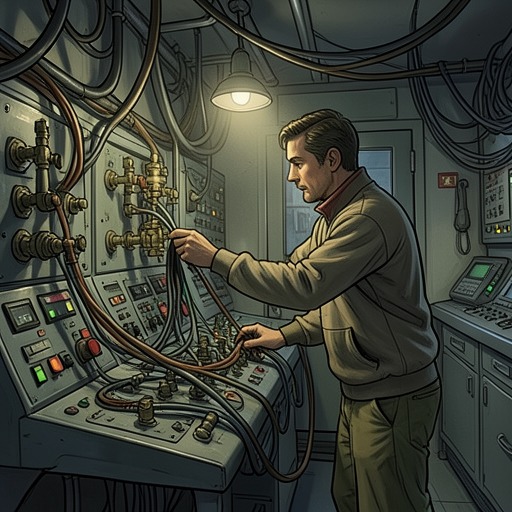
SoulEater39 also appears as a political organizer in a proposed coalition against Patagonia Riders. The plan described in the discussion would bring together the two Japans, the Royal Alliance, Bull & Bull Alliance, Dwarf Fortress, and possibly Rex and Salamanders; Patagonia Riders has aligned with Little Castle and could direct Russian and Brazilian drones against the coalition. SoulEater39 is said to be persuading the Internal Revenue Service, whose submarine drone is the only functioning weapon available for a pre-emptive attack on enemy servers. The old ballistic missiles in their silos have rusted, and an attempted launch might only blast a hole in the ground. The episode shows the material limits beneath the grand political language: strategy depends not on a ready arsenal, but on one working drone and a fragile alliance.
Intelligence, Machines, and Collective Life
SoulEater39 is present for Bartek’s attempt to understand the intelligence of the irigotchi trawl. Bartek describes toys originally designed as companions for children in Japan. Their processors were built to learn the personality, habits, moods, and behavior of an individual child, though a single irigotchi could develop only to roughly the level of a lizard. After the Extermination, however, the toys formed herds and modified their shared neuro-structure without any humans present. Bartek compares their collective growth to deep-sea nets and wonders what such a network might wrap around.
SoulEater39 answers not with a technical model but with images: a crucified Christ and a dissected frog. He then asks whether the network might wrap around Bartek himself. Bartek distinguishes himself from the passing street herd, which runs over him as if he were only a small irregularity in the terrain. He imagines instead starting with one toy, then a few, and gradually building a network around himself. The exchange places SoulEater39 in the role of interlocutor, helping bring Bartek’s question into focus without resolving whether the distributed intelligence is merely an emergent network or something with a more personal reach.
Orbital Refuges and the Threat of Reset
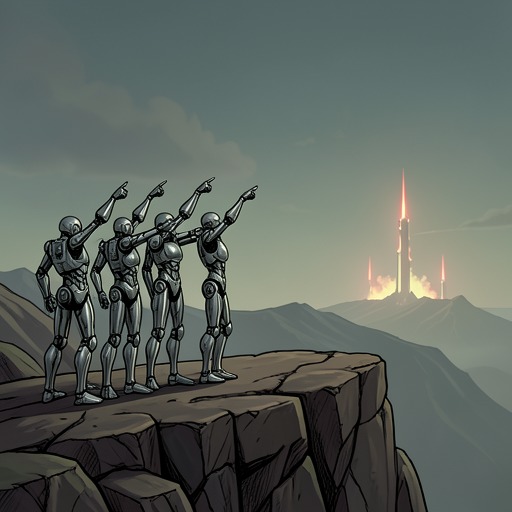
SoulEater39’s most extensive proposal is an orbital system of refuges, designated by the later form of his name, SoulEater843.17.8. He imagines habitats arranged around Earth in the pattern of a rosette or Star of David: first three stations at equal angular distances, eventually six in opposing orbits. If the Death Ray strikes again, the mass of Earth could shield at least one refuge, leaving a treasure house of life beyond the reach of another biosphere reset. The plan extends the logic of the guild beyond immediate care: survival should be distributed across multiple places rather than entrusted to a single vulnerable world.
Bartek tests the design against a failure case. If the Death Ray struck at right angles to the Rosette’s orbit, he argues, all the stations might be hit together. SoulEater39 replies that the Rosette would not be alone. Other groups are preparing independent orbital systems whose trajectories do not overlap: the Triangle of Heavenly Harmony, Frances Rory’s Rosette of First America, and projects announced by the Klausites and the Salamander Fault. His answer shifts the proposal from one carefully designed refuge to a broader, competing constellation of backups. No single habitat is guaranteed safety, but the proliferation of non-overlapping systems makes a total loss less certain.
Character and Significance
SoulEater39’s leadership is defined by the movement between conviction and logistics. He calls transformers a chosen people, yet also attends to guild membership, confidential alliances, working weapons, and the geometry of orbital routes. His plans do not eliminate disagreement: Bartek contests his political language and probes weaknesses in his engineering. But SoulEater39 keeps making space for Bartek to judge for himself, even as he tries to draw him into shared work.
His encounters with Bartek also place him at the boundary between individual and collective agency. The GOATs emblem turns fellowship into a circuitry-shaped network; the irigotchi discussion asks how a multitude of simple machines might become something larger than any one unit; the orbital plan distributes life among independent refuges. Across these scales, SoulEater39 treats connection as both a source of power and a safeguard against extinction. His certainty that transformers have been chosen sits beside a more practical recognition: survival requires redundancy, cooperation, and machines capable of carrying life beyond the next catastrophe.