The Extermination
The Old AxolotlThe Extermination is the abrupt planetary catastrophe that ends human biological civilization and makes possible the radically altered societies that follow. First encountered as an invisible, fast-moving wave that kills people across the world, it is initially explained through imperfect comparisons with nuclear weapons. Later investigators reconstruct a possible direction and point of origin, but cannot establish exactly what the attack consisted of or why it was carried out. The event’s decisive consequence is therefore both material and conceptual: humanity is devastated, while the beings who continue afterward must reckon with what their survival means.
Background and onset
The catastrophe begins during an ordinary day. Bartek is meant to meet his friends for lunch at a shopping mall, but a mundane domestic accident keeps him away: his upstairs neighbor’s jolting washing machine has broken through her bathroom wall, flooding exposed wiring and blowing the building’s fuses. Bartek, who has long been treated as the resident handyman because of his technical-college background, stays to deal with the problem until four in the afternoon. Since the interruption has already consumed his day off, he decides to go to work and catch up on unfinished tasks.
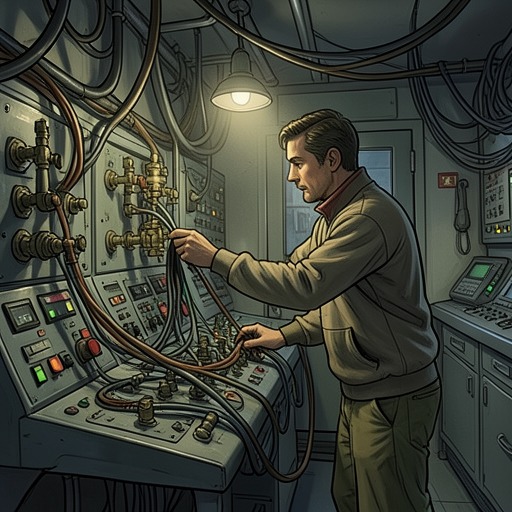
That detour places him in the cooler basement IT department when the catastrophe begins. The building’s outage, caused by the washing machine, has separated his immediate experience from the ordinary day unfolding elsewhere; the same broken household machine that seems merely to have delayed lunch may also have helped preserve him. The account is careful about that possibility, presenting his survival as conditional rather than certain. A trivial failure of domestic infrastructure thus becomes the hinge between an uneventful plan and the end of the world.
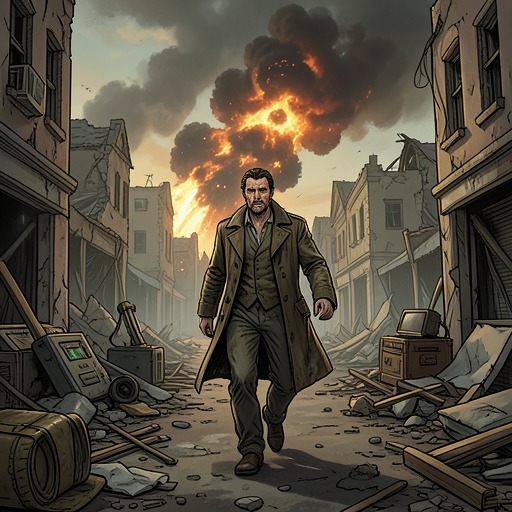
The first attempts to understand the event turn to the internet. As the world searches for answers, Wikipedia has already crashed. Lay explanations of a neutron bomb offer a provisional model: such a weapon could kill organic matter while leaving buildings and equipment comparatively intact. Yet the model does not fit the observed speed. A conventional neutron-bomb scenario would involve a limited range and a delay of hours or days before radiation exposure became fatal; the deaths now being reported are almost immediate. The destruction is not accompanied by the expected obliteration of cities, which makes the apparently simple explanation inadequate from the outset.
The wave across the planet
Bartek uses a BBC planetary simulation to estimate the wave’s movement. At 4:41:17 p.m., the apparent front stretches roughly from 123 degrees west to 57 degrees east, moving westward with the Earth’s rotation. From that reconstruction, he calculates that the remaining time is three hours and thirteen minutes. The estimate gives the disaster a terrifyingly measurable shape: not a single local strike, but a front advancing across the inhabited world. He nevertheless allows for the possibility that it might dissipate as inexplicably as it appeared.
The reports make the speed and reach of the attack concrete. Street-camera footage from Asian cities shows pedestrians dying in place, while Athens appears on television as tourists lie fallen beside cafés and monuments. These images suggest mass death across multiple regions, not damage confined to a military target or a single population. The wave’s course also has a consequential geographic asymmetry: because it begins moving across the planet from west to east in the reconstructed account, people in Asia have no time to respond. The later distribution of surviving transformers reflects that unequal window. Most of those who manage to scan themselves with IS3 come from Europe, Africa, the United States, and South America, with particularly high representation from Mexico and California, reached only at the end of the Death Meridian.
The event’s physical mechanism remains unresolved. Later researchers collect fragmentary Extermination archives, old robot registers, and timing data for the neutron wave, calculating its arrival down to the nanosecond. Their reconstruction places the suspected firing point 17.6 light-years from the Sun, in Ophiuchus, just beyond Barnard’s Star. The location is not a visible base or an identifiable inhabited system: it is described as an empty gravitational blank, more than two light-years from the nearest system, emitting nothing and exerting no detectable influence on matter. The distance makes the attack seem at once traceable and unnervingly inaccessible.
What the evidence can and cannot establish
The post-event inquiry does not settle on a single, fully understood weapon. The surviving measurements were not calibrated in advance for the catastrophe, and researchers acknowledge that they cannot return to set instruments to capture the right data. The evidence points toward a beam with multiple components, but its complete composition is unknowable from the records that remain. Rapid neutrons appear to have been one element; investigators also consider particles tuned to a frequency capable of breaking DNA bonds. That second component is an inference, not a verified account of the attack’s engineering.
The uncertainty matters because a neutron wave alone may not explain the annihilation of Earth’s biosphere. The original comparison with a neutron bomb helps people grasp the selective destruction of organic life while much of the built environment remains, but it cannot explain the instant deaths, the wave’s planetary reach, or all of the observed effects. The event is therefore named and remembered as the Death Ray, yet even that name risks suggesting a simpler and more comprehensible weapon than the evidence supports.
The suspected firing point also changes the scale of the question. If the attack was sent through a wormhole, the investigators reason, its makers would have needed access beyond the speed of light across the observable and non-observable universe. They extend that conditional premise into a hypothesis about a civilization capable of mapping possible trajectories of life and technology, and from there to the Gardener of the Universe hypothesis. This is an argument built from implications, not confirmation that such a civilization or gardener exists. The evidence locates an apparent direction and invites a cosmological explanation, but it does not reveal an attacker that can be identified or confronted.
Human extinction and the transformer aftermath
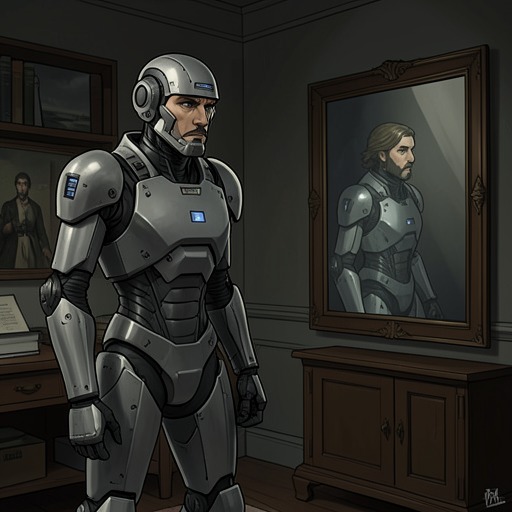
The Extermination’s immediate consequence is the death of humanity as an organic population. Twenty-three days afterward, SoulEater39 tells Bartek that all humans have died and that the transformers are all that remain. This does not mean that IS3 preserved complete human minds. The system could upload only surface currents and a shadow of brain structure, not a whole brain; no breakthrough had transformed it into a way of digitally transferring a person intact. The beings who survive through the scans are consequently neither straightforwardly the people they once were nor ordinary machines. Their existence begins in the gap between a human identity and an incomplete technological remnant.
The scale of the first transformer population is recorded in the Helsinki Transformer List. By the time Bartek checks it in Vladivostok, the list contains 17,946 names: the people who managed to upload through IS3. When the list is sorted by nationality, twenty-seven names appear beneath the Polish flag. These figures register survival as a narrow, technologically mediated exception, not as a preserved human majority. The lopsided geographic pattern is also a direct consequence of the attack’s speed: the opportunity to scan oneself depended on where a person was as the wave advanced and whether the necessary equipment was available.
The Extermination does not produce a new technological age in the sense of a fresh stock of inventions. The later account stresses that home and industrial robotics, superficial neural scans, the internet, RFID, the Matternet, telepresence, neuroprosthetics, biological and chemical synthesis, genetic archives, and molecular engineering all existed before the catastrophe. What changes is how those tools are used, and what purposes survivors attach to them. The Ray breaks the assumption that existing technologies and inherited social patterns form a natural, continuous path forward; it forces their users into altered arrangements without giving them new inventions to resolve the problems those arrangements create.
Historical and narrative significance
The event’s aftermath extends beyond the first deaths. The founders of First Paradise, mostly first-generation transformers from a loose faction of Black Castle, understood from the beginning that IS3 had not made full neural copies. Their project was to move beyond pre-Extermination lifestyle models, but the transformed beings continued to repeat patterns of human life. A later reflection describes them as unable to change, learn, or sleep, longing for bodies while reproducing familiar routines. In that account, the catastrophe has not simply transferred humanity into machines: it has left its successors uncertain what they are, equipped with inherited habits but unable to demonstrate that they are the same people who died.
The attack also opens a historical span whose consequences cannot be contained within the immediate catastrophe. After a career lasting a few hundred thousand years, the Seventeenth human species gives way to the Eighteenth, which is identified as the last. The Extermination is thus both an extinction event and a dividing line in a longer history of human forms. Its apparent precision contrasts with the uncertainty of its cause; its devastation contrasts with the technological continuity of its aftermath. The world does not begin again from nothing. Instead, incomplete survivors inherit old tools, broken assumptions, and the unanswered question of whether what endured can still be called human.