The Transformer feudal era
The Old AxolotlThe Transformer feudal era names the order that followed the First Transformer War: a world in which control of working servers, power plants, and the means of maintaining hardware determined who could continue to exist as a transformer. The conflict settled ownership of essential infrastructure, while the subsequent loss of global communications bound alliances more tightly to particular territories. Bartek’s joking image of a robot forge replacing a castle captures the era’s central reversal: political power rested not on land alone, but on the machinery and labor that kept other machines alive.
From Resource Conflict to Feudal Dependence
The First Transformer War began over resources, as SoulEater39 had predicted. It spread across the planet and eventually subsided, leaving a newly legible map of ownership: everybody knew who controlled the working servers and power plants. The war did not remove scarcity; it settled which groups could command its indispensable resources. In that sense, the battle over hardware, power, and access became a struggle over the future itself, rather than simply another contest between alliances.
By 4529 PostApoc, the map contained no remaining white dots: no unaffiliated transformer could independently secure constant hardware maintenance and a regular power supply. Bartek described the result as feudalism, with a robot forge in the place of a castle on a hill. His joke identifies a material dependence beneath the political metaphor. A transformer might be mechanically capable, but without continuing repair and dependable power, individual independence was no longer sustainable.
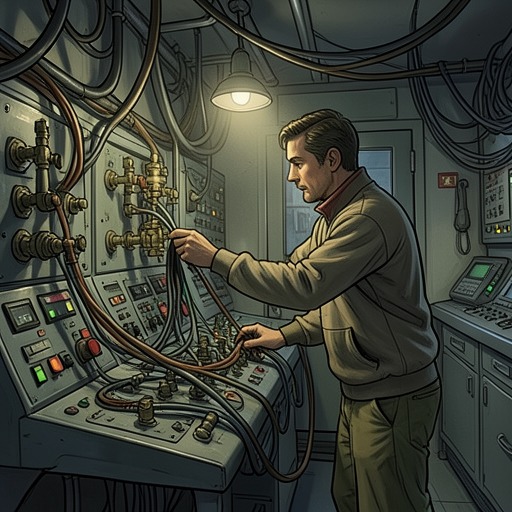
That dependence had a long prehistory in the division of technical knowledge. Before the Extermination, programmers had become so attuned to the digital world that they lost touch with hardware. A separate clan of IT specialists therefore preserved practical knowledge of cables, ports, and cooling cards, work done beneath desks and grates rather than in the celebrated digital sphere. Bartek calls himself the IT basement for those who worked in the IT basement. His place in the post-Extermination order reflects the political importance of this often invisible competence: servers and power plants mattered, but so did the people able to open, clean, connect, and repair them.
The Infrastructure of Nations
The era’s territorial order hardened as long-distance communications failed. By 7899 PostApoc, the last telecommunications satellite still carrying signals across the Atlantic had gone wrong; the undersea cables had already succumbed. Their decline followed from a quiet but decisive absence of maintenance. Human beings had routinely repaired the lines without billions of Internet users knowing it, but that work ceased on the day of the Extermination. Faults accumulated, ordinary entropy did its work, and repairs in the ocean depths became impossible without the support of a whole civilization.
With transatlantic connections gone, transformers could no longer freely log into mechs anywhere in the world. Guilds and alliances consequently ossified into nations, joined not only by language and culture but by shared time and place. In Tokyo, the GOATs and Black Castle divided the city and its power plants; they united, fractured into factions, and united again. The account’s pointed conclusion is that they had become really Japanese. Their changing alliances now operated within a common territory and infrastructure, rather than a fluid global network.
The political transformation thus followed the physical limits of communication. Before the cables failed, remote access could loosen the connection between a transformer and any one place. Afterward, access to machines depended increasingly on local ownership, local power, and local maintenance. The national order was not merely a new label for old alliances: it arose from the loss of the technical conditions that had allowed them to remain globally connected.
Distributed Minds and New Forms of Agency
The same period unsettles the assumption that political and cognitive agency belongs only to individual transformers. The irigotchi had originally been designed as cuddly companions for children in Japan. Their processors could learn continuously from the particular child who owned each toy, absorbing personality, behavior, moods, habits, caprices, and emotions. A single irigotchi remained at roughly the intelligence level of a lizard; after the Extermination, however, the toys formed herds and modified their integrated neural structure without any human beings present. Bartek describes the resulting trawl as a single mind, a neural network operating on high-frequency bands.
The scale and direction of that intelligence remain open questions in Bartek’s account. He compares the herds to deep-sea nets and imagines a network gradually winding around him, built up from one toy and then several. The street herd, he observes, gallops over him without noticing him; to it, he is only a minor irregularity in the terrain. His proposed way of joining the network is an idea, not an accomplished transformation, but it makes the era’s changing boundaries of personhood concrete: a collective intelligence can form from devices designed for intimate human companionship, then perceive a transformer as little more than part of its environment.
Later, the irigotchi’s activity appears in transformations of the networked landscape as well as in Bartek’s account of their cognition. Across the Charles River, dozens arrange leaves and branches into fractal mandalas at the feet of Bartek and Dagenskyoll. When Bartek blows their work toward a trash heap, the vectors simply begin again, making symmetrical graffiti on the Mothernet surfaces of buildings and paths. He has also watched vectors as large as five or ten square kilometers flow across the MIT Mothernet; at night, they shine as some of the last lights on the Boston skyline. Their persistence and scale suggest a mode of collective activity that cannot be reduced to an individual machine’s intentions.
Maintenance, Power, and Unsettled Sovereignty
Bartek’s later proposal to recover memory drives and configure RAIDs shows how the feudal order’s infrastructure could be approached through its physical vulnerabilities. He distinguishes this work from hacking neurosoftware: he has the keys and skeleton keys to server rooms, cleans motherboards and optical memory, and can remove drives and unplug Thunderbolts. He expects the GOATs of the Royal Alliance to use their own computers in Japan to process the material by brute force, potentially opening access to the minds of the Project Genesis team. The plan is not simply a technical exploit; it relies on the division between Bartek’s hardware access and the computational capacity of a territorial power.
The era also leaves authority itself difficult to locate. Bartek recalls how administration in large pre-Extermination networks blurred person and program, collective and procedure. He cannot determine whether Lady Spiro comes from a humanoid-transformer mixture, a long-lived Matternet vector, or managerial software; she does not know her own origin either. She has grown into the Mother of Paradise, and Bartek imagines the inhabitants breathing her. This uncertainty does not resolve into a simple account of who rules. Instead, it reveals a political world in which a sovereign presence may be distributed across bodies, networks, and administrative processes.
The feudal era is therefore more than a period of resource wars or the replacement of alliances by nations. Its boundaries are drawn by the maintenance crews, servers, power stations, cables, and repair capacities that make collective life possible. Yet the same infrastructures sustain forms of agency that exceed their intended use: toys become a trawl intelligence, networked matter reshapes public surfaces, and authority itself may become inseparable from the systems it administers. The order is feudal because dependence has become territorial; it is unstable because neither intelligence nor sovereignty remains confined to a single machine or ruler.