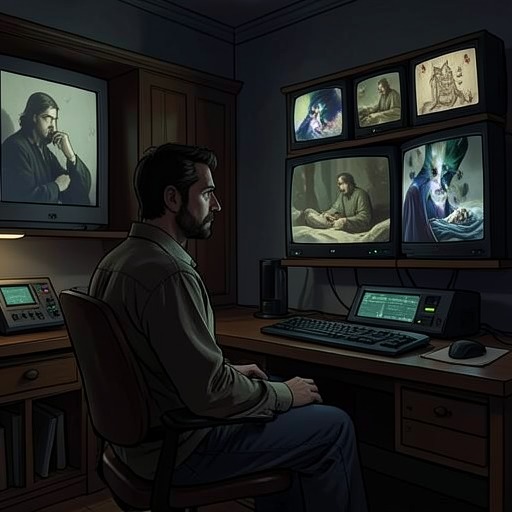
This cannot be all
The Old AxolotlThis cannot be all is the transformers’ cry against a life reduced to mechanical function. Set amid repetitive labor and the remembered loss of humanity’s “profound mystery and essence,” the expression gives voice to a suspicion they cannot fully explain: that existence must mean more than what they are able to do.
The Mechanical Life
The expression emerges from a portrait of days spent repeating work: fixing, doing, building. The transformers surrender to energy cycles described as more rigidly immutable than the alternation of darkness and light, while artificial entertainment supplies after-images from which they wind fictional lives around their minds. Their routines extend beyond labor. They stand for hours in statue-like stupor, switched off like robots, and cease even to perform bodily social rituals or the “pathetic charade of sexbot carnality.” Against this catalogue of inactivity and repetition, “THIS CANNOT BE ALL” is not a settled explanation but a persistent feeling that their life cannot be complete.
What Was Lost
The passage places that feeling beside the claim that the transformers lost humanity’s mystery and essence so completely in the IS3 transformation that they can no longer make the imaginative leap needed to comprehend what is missing. Their inability to describe the loss does not erase it: they still feel it and suspect that the mechanical life before them is insufficient. The expression therefore marks a gap between diminished understanding and continuing unease. They cannot recover a clear account of what humanity meant, yet the sense of absence survives.
Recollection and Ambiguity
A short exchange sharpens the uncertainty. After the assertion “But I had one,” the response “Did you?” leaves the object of possession unstated. In the surrounding passage, the words resonate with the lost human mystery, but the exchange does not specify exactly what “one” refers to. This unresolved pronoun keeps the expression from becoming a doctrine or a confident claim of recovery: the remembered possibility of having possessed something greater is immediately questioned. The refrain is powerful precisely because its conviction exceeds the transformers’ ability to say what, beyond work and routine, that missing something was.