Tokyo Bay Flood
The Old AxolotlThe Tokyo Bay Flood is the disaster that permanently changed the landscape of Tokyo after human beings were gone. A powerful earthquake and tsunami inundated the city, and the absence of a society capable of rebuilding turned a familiar cycle of destruction and repair into an irreversible transformation. The flood’s reach is measured both in submerged neighborhoods and in the shrinking prospect of maintaining transformer life amid a world of failing systems.
Background and vulnerability
On 744 PostApoc, an earthquake measuring over seven on the Richter scale struck Japan, with its epicenter near Aogashima. The tsunami surged inland as such waves had before, but this time nobody remained to restore damaged infrastructure or erase the traces of nature’s hostility from the urban grid. The difference was not the arrival of a new natural force, but the disappearance of the human labor that had repeatedly made recovery possible.
That dependence on maintenance runs throughout the wider history of the post-Extermination world. Before the Extermination, specialized technicians preserved practical knowledge about cables, ports, and cooling hardware even as programmers lost touch with physical machines. Bartek, described as the basement support for those IT workers, later identifies his own role as a hardware janitor: he handles memory drives, motherboards, optical memory, and RAID arrays. These details make visible the skilled, often concealed labor on which functioning systems depend. The flood’s devastation belongs to the same material reality: once repair and upkeep cease, even systems that seem durable become vulnerable to accumulated failure.
Inundation and lasting change
The water reached Minamisunamachi and Nishikasai, on the far side of the Arakawa. Matternet relayed precise information about the advancing surge as buildings, streets, and flyovers were successively inundated and gave way under the floodwater’s ebb and flow. The account follows the flood across connected parts of the urban grid, showing infrastructure not as a static backdrop but as something progressively overwhelmed.
The city’s transformation is explicitly lasting. Unlike earlier disasters, the Tokyo Bay Flood left no one to rebuild, restore the damaged network, or remove nature’s marks from the urban environment. The flood therefore does more than damage Tokyo: it ends the assumption that devastation will be followed by recovery. The water’s advance becomes a permanent alteration of the cityscape.
Witnesses above the flood
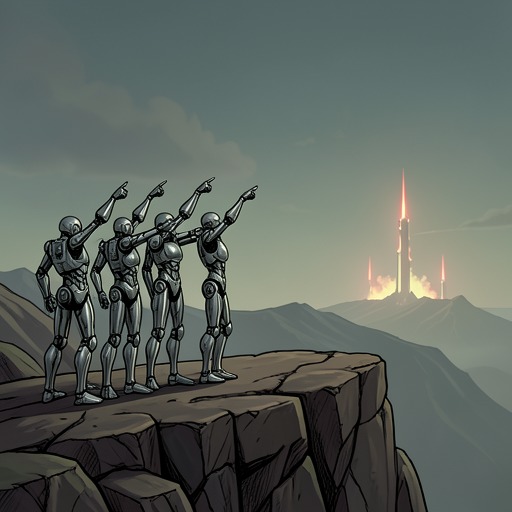
High above the inundated city, Bartek and SoulEater39 perch on the uppermost ledge of a multistory parking lot. From there, the flood extends in every direction. SoulEater39 gestures across the scene with a shogun arm and points to clothing swept along by the cold waves: shirts, pants, coats, sweaters, and skirts, their tags still blinking beneath the water as their Mothernet slowly flickers out. The tags preserve a trace of the systems that once organized these objects even as the network sustaining them fails.
Their exchange turns the view into a question of endurance. SoulEater39 tells Bartek, “You realize that this is how it’s going to look from now on.” When Bartek asks what he means, SoulEater39 calls the catastrophe their flight from nature and asks how many spare parts Bartek has, and how many repairs they can support. Bartek points out that the Dwarves are still soldiering on. SoulEater39 allows that they might succeed, but asks how many production lines would have to be started merely to maintain the status quo. The conversation shifts the scene from spectacle to reckoning: survival depends not only on escaping the water but on sustaining a supply of parts, repairs, and production.
Infrastructure and significance
The flood’s consequences resonate with later failures in communications infrastructure. Millennia afterward, the last telecommunications satellite still transmitting across the Atlantic fails; the undersea cables had already succumbed, after the routine human repairs that had maintained them ended with the Extermination. The resulting loss of global access to mechs helps turn mobile guilds and alliances into territorially rooted nations. This later collapse is not presented as a consequence of the Tokyo Bay Flood, but it echoes the same dependence: networks and machines require maintenance, and their apparent autonomy rests on labor that can disappear.
The Tokyo Bay Flood makes that dependence visible in a single, immense landscape. It submerges the built environment, leaves the city without a route back to its former condition, and forces Bartek and SoulEater39 to measure the future in spare parts and production lines. The catastrophe’s lasting force lies in that reversal: technology offers no escape from nature when the systems needed to repair and sustain it have themselves become fragile.