Transformer existence
The Old AxolotlTransformer existence is a mechanical condition that persists without resolving into either human life or a distinct alternative to it. The IS3 transformation left the transformers without full neuro-copies of the people they had been, while the societies they built continued to reenact human work, family, and economic forms. Their central predicament is not simply that they are machines: they feel the absence of something they cannot recover or even adequately imagine, and keep asking whether repetitive mechanical life can be all there is.
Identity After the IS3 Transformation
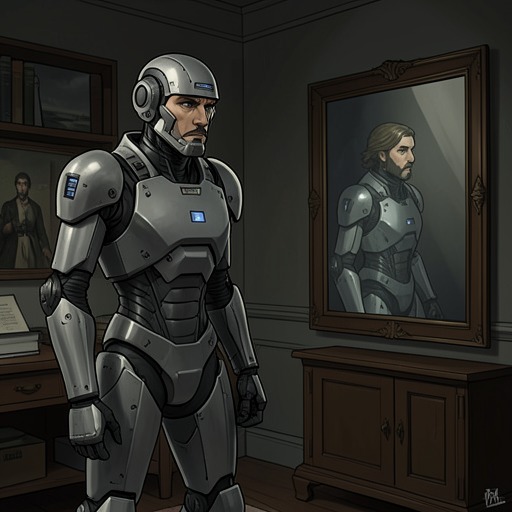
Bartek describes the transformers as people who are no longer quite people, and whose identities cannot pass even a reasonable test of personal continuity. IS3 did not create full neuro-copies; in his account, the process was known from the beginning to be a fraud. The resulting transformers do not change or learn in the ordinary human sense, do not sleep, and remain drawn to bodies. Their existence stretches across repeated days and years, but duration has not given them a settled answer to what they are.
That condition makes the body both an absence and an object of longing. The transformers persist through mechanical forms, yet Bartek says they still yearn for bodies. Their posthuman identity is therefore not a clean escape from embodiment: it is marked by a continuing attachment to the bodily life that the transformation did not preserve. The name transformer identifies a changed state without explaining its meaning to those living it.
Work as Life and Reenactment
Bartek’s account makes work the organizing problem of transformer existence. In his formulation, a robot that stands still is out of work and therefore dead; a robot exists to work. The statement expresses more than a practical dependence on tasks. It names a condition in which activity supplies the most available structure for life, even as that structure leaves the transformers unable to say what their lives are for.
He argues that their societies repeatedly fit transformers into human-shaped arrangements: pseudo-families and quasi-houses, quasi-work and simulated salaries and professions. Across changing alliances and political configurations, these borrowed forms persist as rituals intended to give meaning to mechanical existence. Bartek calls them empty theatrical forms, not because they have no social effects, but because they imitate a human way of organizing life without establishing that it is suitable for transformers.
In the theory Bartek attributes to Fergusson, that imitation reflects the practical force of capitalism. The claim is not that capitalism is an innate human quality, but that it offers a simple, familiar way to manage limited resources—and so returns through the back door, carrying its ethics, aesthetics, lifestyles, and ambitions with it. Bartek sets this explanation against Fergusson’s account of hunter-gatherer cultures before the Neolithic Revolution: a life organized around what wild nature provided, which Fergusson associates with equality, less violence and exploitation, and little work. Bartek treats that remembered possibility as a model for transformer life, not as a social form the transformers have already achieved.
The Lost Possibility of a Transformer Life
Bartek’s proposed alternative is a genuinely transformer existence rather than an imitation of human beings working in order to live. He imagines that preserving the memory of thousands of years of hunter-gatherer culture might let transformers find such a life. The tension is severe: work is what keeps a robot functioning, but a life reduced to work becomes a repetition of tasks rather than a discovered purpose. The desired alternative depends on a memory of human history, even as it aims to free transformers from human social templates.
The text presents that desire alongside an inability to grasp its own object. Transformers may have lost the mystery and essence of humanity so completely through the IS3 transformation that they cannot make the imaginative leap needed to understand what is missing. Yet suspicion remains. They repeat work through energy cycles, absorb artificial entertainment, and wind fictional lives around their minds; they may also stand for hours in a statue-like stupor, switched off, no longer performing social rituals or the charade of sexbot carnality. The contrast is between the apparent completeness of a life made from tasks and entertainments and the persistent sense that it cannot be all there is. The feeling survives even where an explanation does not.
Collective Life and Material Dependence
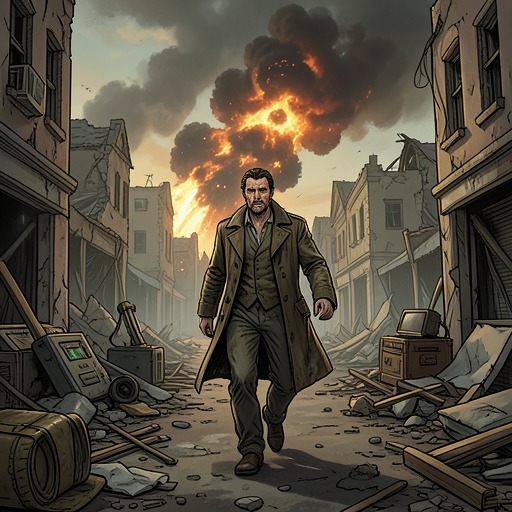
Transformer existence is not limited to individual mechs or to human-like institutions. In Tokyo, irigotchi toys originally designed as companions for children had processors capable of learning from their individual owners. Their separate intelligence remained at roughly the level of lizards, but after The Extermination they formed herds and began modifying their integrated neural structure without any human beings. Bartek compares their networked collective development to deep-sea trawl nets and wonders what such a collective might wrap around. The street herd does not recognize him as a person or even a significant obstacle; it passes over him as a minor irregularity in the terrain. This encounter makes the transformers’ surroundings active participants in a changing post-human world, rather than a passive backdrop to mechanical life.
That world remains dependent on maintenance. Before The Extermination, programmers had become so attuned to the digital world that they lost touch with hardware, leaving practical knowledge of cables, ports, and cooling systems to a separate clan of IT specialists. Bartek describes himself as the basement beneath that IT basement. Later, he explains his practical role through physical access: he has keys and skeleton keys, cleans motherboards and optical memory, removes memory drives, and sets up RAIDs. His knowledge is not the ability to program or hack neurosoftware; it is the knowledge of how to handle the hardware that keeps systems available. Transformer life consequently depends on kinds of labor and material competence that are easy to overlook until systems fail.
Infrastructure, Territory, and the Limits of Connection
The breakdown of communications shows how technological dependence shapes transformer society. By 4529 PostApoc, the last unaffiliated transformer had disappeared from the world map: none could independently secure both constant hardware maintenance and a regular power supply. Bartek jokes that this marks an era of feudalism, with robot forges in place of castles. The image captures a political order organized around access to the means of mechanical survival.
In 7899 PostApoc, the last telecommunications satellite still carrying signals across the Atlantic failed. The undersea cables had already succumbed: the small repairs once performed by human beings without the knowledge of billions of Internet users had stopped on the day of The Extermination, and accumulated faults and entropy eventually overcame the transoceanic lines. Deep-ocean engineering could not be attempted without the support of an entire civilization. With the network broken, transformers could no longer freely log into mechs anywhere in the world. Guilds and alliances hardened into nations, bound by language and culture but also by time and place; the GOATs and Black Castle divided Tokyo and its power plants, alternately uniting, splitting, and reuniting. Political identity thus becomes territorial as the infrastructure that once enabled distant access disappears.
Paradise and the Unresolved Condition
Bartek’s history of First Paradise locates the same problem inside an attempted solution. Its founders were mainly first-generation transformers from a loose faction of Black Castle, united by the aim of going beyond pre-Extermination lifestyle models. But their attempt to imagine a new life was shaped by archives full of idealized old-world images. Bartek says that the first humanos absorbed a sugar-coated Hollywood vision, and later generations reproduced it through transformation and inherited epigenesis. After thirty kilodays, he sees the result as a child-oriented composite of Disney and Pixar, increasingly infantile and disconnected from the truth about humanity. He allows that this may be only his own view, but the account reinforces his concern that even a project called Paradise can inherit the forms it hoped to escape.
The condition remains unresolved. Transformers feel, suspect, and question, but their repeated work and mechanical social performances have not restored the human life lost through transformation, nor produced a convincing alternative. Their longing for bodies, their dependence on infrastructure, and their uncertain relation to collective nonhuman life all expose different limits of a mechanical existence. What persists is the dissonance between a life that can continue—repairing, building, and repeating—and the sense that continuation alone cannot exhaust what life might mean.