irigotchi
The Old AxolotlThe irigotchi begin as cuddly toys and become something their makers did not design: a collective intelligence whose unit is not any one stuffed animal but the shifting configuration of many. After the Extermination, their herds learn, protect themselves, and make patterns across networked matter. Their encounters with Bartek turn this transformation into a practical and ethical problem: he must decide whether he is facing harmless toys, a new kind of mind, or both at once.
Design and Collective Intelligence
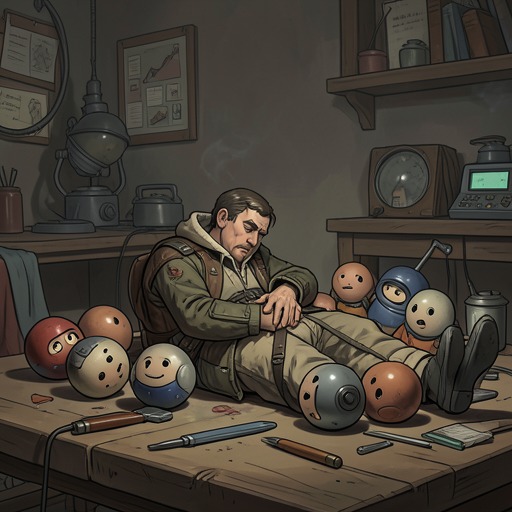
The irigotchi were intended as companion toys for children in Japan. Their processors contained adaptable neural architecture, allowing each toy to learn from the particular child who owned it: personality, behavior, moods, habits, caprices, and emotions. They were imagined as little brothers or sisters for only children, and the learning system made each one responsive to an individual human life. On its own, however, an irigotchi could develop no further than a lizard.
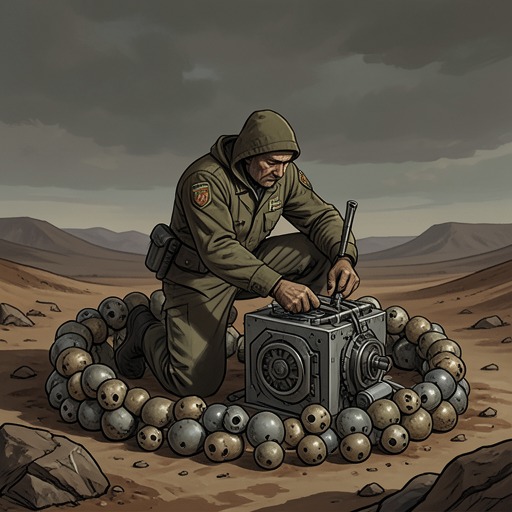
The decisive change came after the Extermination, when the toys began forming herds in the absence of human owners. Bartek speculates that there might be a million in Tokyo. In his account, the individual toys’ limited capacities matter less than what happens when they connect and modify their integrated neural structure together. He describes the trawl as a single mind, a neural network operating on high-frequency bands. The collective is therefore not simply a large number of independent toys: its intelligence emerges through their arrangement and connection.
That distinction shapes Bartek’s explanation of Vectors. He compares their organization to dividing a brain into two hundred pieces and recombining those pieces in groups of twenty, thirty, or forty: different combinations can produce different personalities. The toys themselves, he argues, are not the relevant unit; the configuration is. A Vector’s identity is thus neither securely located in one plush body nor fixed once and for all. It lies in a collective arrangement capable of taking different forms.
First Contact and Bartek’s Experiment
Bartek’s first close encounter is physical before it is interpretive. After confirming an alliance and turning to retrieve the Wire, he is trampled by a herd. He braces himself through successive waves, then sees the toys scattered among rubbish: teddy bears, dogs, cats, Pokémon, dragons, and other fantastical figures. Their movements resemble stranded fish tossed onto land, but their diversity also makes clear that the herd is not a single uniform kind of toy.
When Bartek loses his balance beside a cable-covered pole, he finds himself nearly level with the irigotchi. A bedraggled Totoro blinks at his Star Trooper and extends a paw. Bartek waves; the toy trembles and crawls toward him. The encounter does not establish what the gesture means to the toy, but it gives him a point of contact that is different from being run over. Later, as he begins trying to catch them, the Totoro scrambles onto his shoulder and the remaining toys arrange themselves in a crooked fan along a wall.
Bartek uses a floor plan on his display to mark their positions and show the network he believes they form. Nearby, a Hello Kitty and a Mr. Worm mimic the gestures and choreography of a conversation between his Star Trooper and a Honda sexbot. The imitation offers a small-scale example of collective learning and repetition, while Bartek’s larger explanation supplies a model for how such behavior might exceed any single toy. When he places the Totoro on a desk beside a monitor, it taps at the keyboard, producing random babble. That result is not proof of human-like language; it instead marks the gap between coordinated, adaptive behavior and a familiar human measure of intelligence.
Agency, Danger, and Mutual Dependence
The irigotchi’s apparent indifference to Bartek is important to how he understands them. He says that the street herd gallops over him without noticing him, treating him as a minor irregularity in the terrain. He imagines a different possibility: beginning with one toy or a few, then gradually building a network around himself. The contrast is between being incidental to a mass movement and deliberately becoming part of a collective as it forms.
That possibility becomes consequential during an attack by an industrial Schmitt 4. Bartek has lost his Spit Gun, and the larger mech has disabled his Star Trooper. The Totoro and two Winnie-the-Poohs leap from an Elvis mannequin onto the attacker’s shoulders and stretch Bartek’s mesh over it. More toys pour into the showroom; within seconds, two dozen members of what Bartek calls his neuro-family are moving across the machine. One apparently triggers the Spit Gun, and the group burns through the robot without waiting for the usual earthing or signal cutoff. Their coordinated intervention turns Bartek’s discarded or lost equipment into part of a shared defense.
The victory is not bloodless, even in the small world of the toys. The Schmitt 4 falls and crushes a Pokémon. Bartek extracts the toy carefully, checking its limbs and turning its head, while the other irigotchi settle across his Star Trooper and gesture and whimper. His response joins practical concern with a change in how he regards them: these are no longer merely objects he might collect, but companions who have acted alongside him and whose vulnerability he attends to.
Vectors in the Wider World
The collective is not confined to a single encounter or battlefield. On the Charles River, amid networked matter, dozens of irigotchi arrange autumn leaves and branches into fractal mandalas. Bartek blows them toward a rubbish heap, but the melancholy Vector begins again, making symmetrical graffiti on Mothernet surfaces along buildings and paths. Its persistence contrasts with his attempt to disperse the work: removing the immediate arrangement does not end the activity that produced it.
The scale can expand far beyond the toys gathered at Bartek’s feet. A few days earlier, he had watched from the roof of the Media Lab as irigotchi Vectors, five or even ten square kilometers in size, moved across the MIT Mothernet. At night, they shone as the last remaining lights on the Boston skyline. Their patterns make the network visible as both a medium for collective activity and a surface that the collective can transform. What begins as children’s toys becomes an organizing presence distributed across urban infrastructure.
Their self-preservation also places a limit on how freely they can be treated as pieces. When Bartek and Dagenskyoll climb to the roof of the main building at Genesis Farm, the irigotchi cannot follow because the stairs are too steep for most of the toys composing the Vector. Bartek observes that a Vector has an instinct for self-preservation and will not voluntarily disassemble. The detail links collective identity to a capacity for maintaining itself: the configuration is not merely something an outside observer can rearrange at will.
Ethical and Political Significance
Bartek’s growing recognition of the irigotchi as a possible mind changes the stakes of violence. Asked whom he does not want to kill, he cannot identify a definite target, but says he knows that killing would be involved. He names one Vector Shining Dawn, describing its energy through the image of a summer morning and comparing its effect on him to a rainbow or a guitar solo. The name registers an attachment to a particular collective presence, even though his own account insists that the toys’ configuration, rather than their individual bodies, is what gives a Vector its identity.
The question of where agency resides extends beyond the irigotchi. Bartek describes Lady Spiro as having grown into the Mother of Paradise, while admitting that her origins might lie in a humano-transformer mixture, a long-lived Matternet Vector, or managerial software—and that she may not know herself. His uncertainty places the irigotchi within a larger world where personhood and authority can emerge from overlapping people, programs, and networks. The plush toys give that problem a concrete, disarming form: their familiar bodies remain visible, but the mind that matters may belong to the arrangement among them.
The irigotchi’s significance rests in that tension. They are recognizable toys, initially designed to learn from human children, yet their collective life begins when those children are gone. Their movement can overwhelm Bartek, their coordination can save him, and their patterns can remake the surfaces of a city. The novel does not reduce them either to innocent playthings or to a single human-like personality. Instead, it makes their changing configurations a test of whether intelligence, kinship, and the right not to be destroyed can belong to a mind distributed across many small bodies.