Casablanca
The Old Man and the SeaCasablanca, the Moroccan port city on the Atlantic coast, occupies a singular place in Santiago's inner life as the setting of his most celebrated youthful exploit and as a landmark in the geography of his remembered past. It is not a place he visits during the story's present action, but it surfaces in his thoughts and dreams as a site of strength, youth, and proven prowess, standing in contrast to the old age and physical decline that mark his present existence.
Youthful Voyages and the African Coast
Long before he became the old man of the skiff, Santiago sailed before the mast on a square-rigged ship that ran to Africa, and he saw lions on the beaches in the evening. This experience, which he recounts to the boy Manolin, establishes Casablanca as part of a wider African geography that includes the long golden beaches and the white beaches of his dreams, the high capes, and the great brown mountains. He lived along that coast every night in his dreams, hearing the surf roar and smelling the tar and oakum of the deck and the smell of Africa that the land breeze brought at morning. Casablanca is thus woven into the fabric of his most cherished and recurring dream imagery, alongside the lions that play like young cats in the dusk.
The Hand Game and the Title of Champion
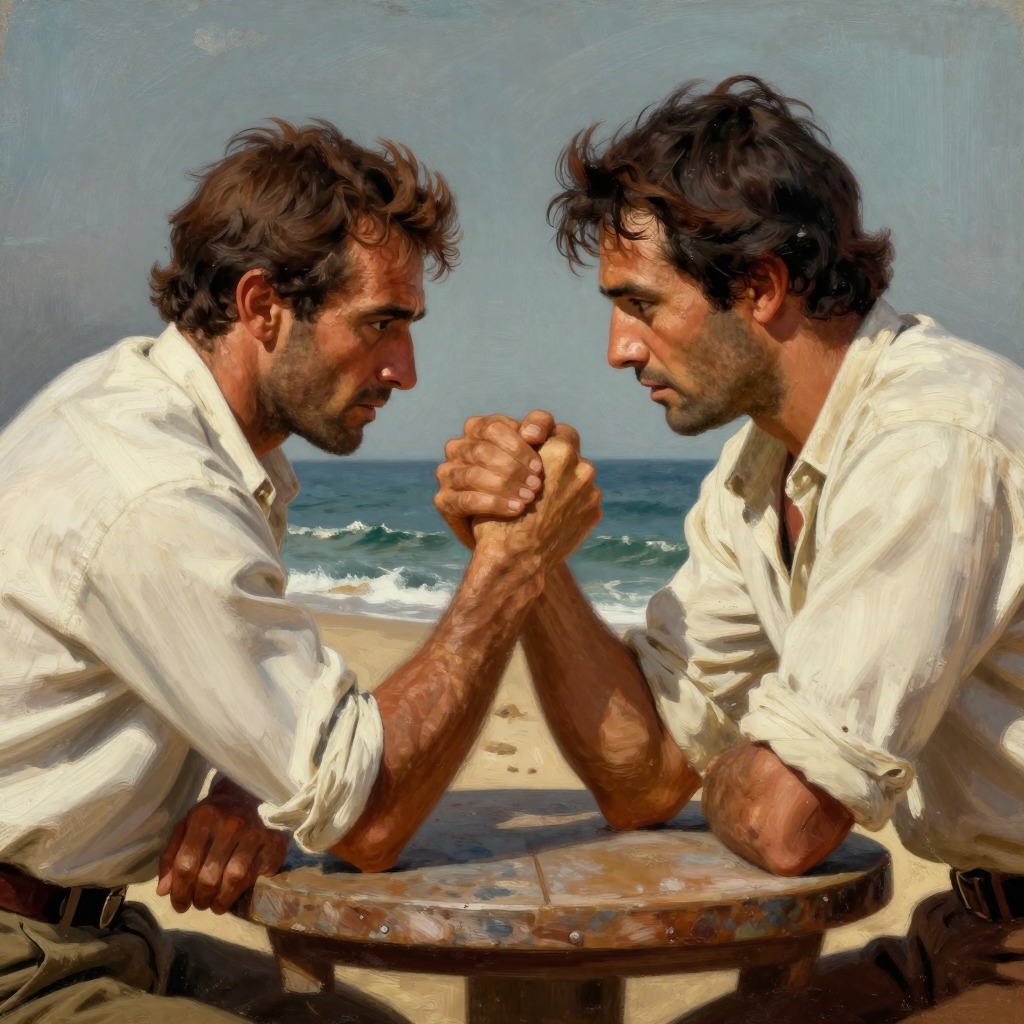
Casablanca is most vividly associated with the hand game, the legendary arm-wrestling match that Santiago fought in a tavern there against the great negro from Cienfuegos, who was the strongest man on the docks. The contest lasted one day and one night, with their elbows on a chalk line on the table, their forearms straight up, and their hands gripped tight. There was much betting, and people went in and out of the room under the kerosene lights. The walls were painted bright blue and were of wood, and the lamps threw shadows against them; the negro's shadow was huge and moved on the wall as the breeze moved the lamps. Blood came out from under the fingernails of both their hands. The odds changed back and forth all night, and they fed the negro rum and lighted cigarettes for him. At one point, the negro nearly had Santiago, who was not an old man then but was Santiago El Campeon, three inches off balance, but Santiago raised his hand up to dead even again. At daylight, when the bettors were asking for a draw and the referee was shaking his head, Santiago unleashed his effort and forced the hand of the negro down and down until it rested on the wood. The match started on a Sunday morning and ended on a Monday morning. Many bettors had asked for a draw because they had to go to work on the docks loading sacks of sugar or at the Havana Coal Company, but Santiago finished it anyway, before anyone had to go to work. For a long time after that, everyone called him The Champion. There was a return match in the spring, but not much money was bet, and Santiago won it quite easily since he had broken the confidence of the negro from Cienfuegos in the first match.
Significance as a Touchstone of Identity
Santiago's memory of the Casablanca hand game serves as a crucial source of confidence and self-definition during his ordeal with the great marlin. As the sun set on his second day at sea, he remembered the match to give himself more confidence. The memory of having beaten the strongest man on the docks, of having been The Champion, reinforces his belief that he can endure and prevail. He decided after that match that he could beat anyone if he wanted to badly enough, and he decided that it was bad for his right hand for fishing. He had tried a few practice matches with his left hand, but his left hand had always been a traitor and would not do what he called on it to do, and he did not trust it. Casablanca thus represents a moment of peak physical strength and willpower, a standard against which he measures his current struggle, and a reminder that his identity is not merely that of an unlucky old fisherman but of a man who has proven himself in the most direct contest of strength.