Gulf Stream
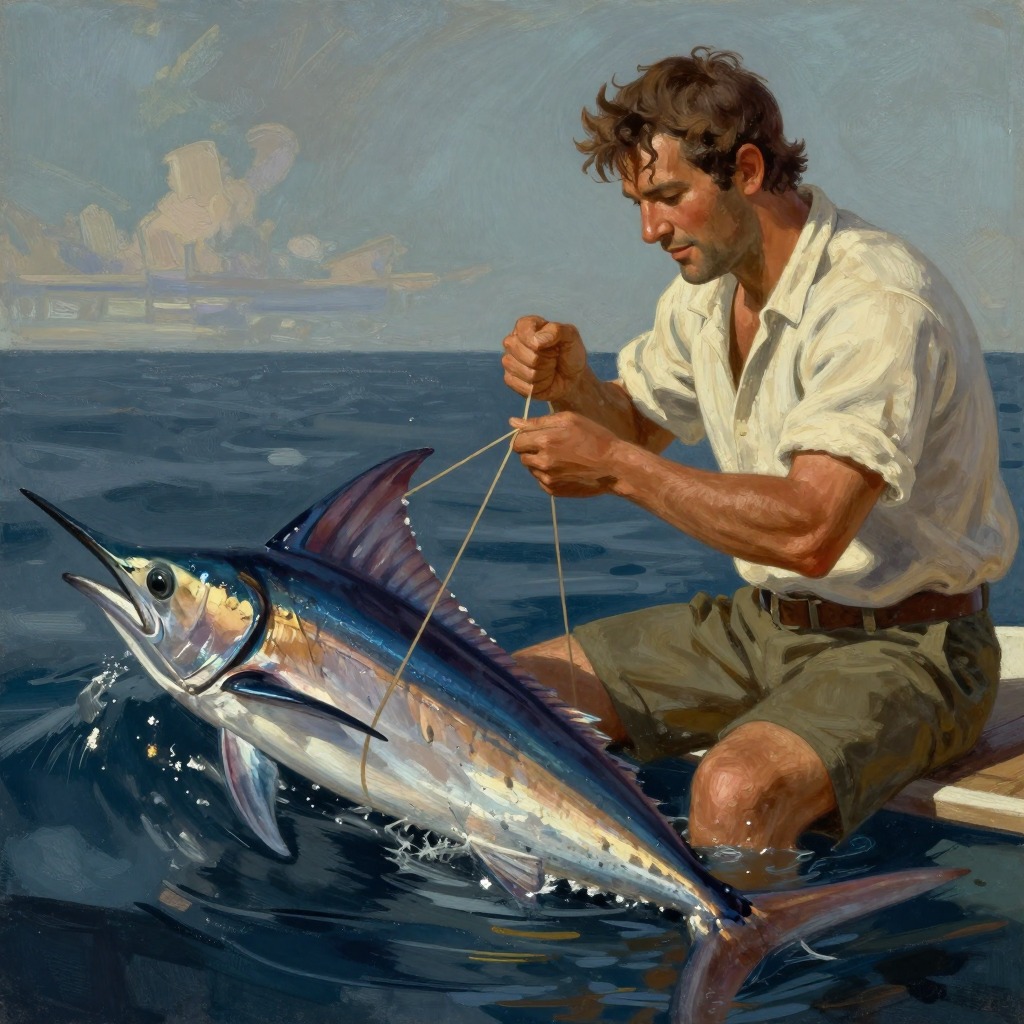
The Old Man and the SeaThe Gulf Stream is the vast, powerful ocean current that forms the central geographical and metaphorical stage of Ernest Hemingway's The Old Man and the Sea. It is the old man Santiago's workplace, his hunting ground, and the medium through which his entire ordeal unfolds. More than a mere setting, the Stream is a living entity with its own character, rhythms, and inhabitants, and Santiago's relationship with it defines his identity as a fisherman and his place in the world.
Geography and the Fisherman's Domain
The Gulf Stream is the warm, deep-blue current that flows northward past Cuba, and Santiago ventures into its heart to find his great fish. He knows its specific features intimately, such as "the great well," a sudden deep of seven hundred fathoms where fish congregate due to the swirl of the current against the ocean floor. He rows out, leaving the smell of the land behind, to enter the "clean early morning smell of the ocean." The Stream is not a uniform body of water; it has currents, depths, and a distinct ecology. Santiago sets his baits at precise depths—forty, seventy-five, one hundred, and one hundred and twenty-five fathoms—demonstrating his mastery of the Stream's vertical structure. He keeps his lines "straighter than anyone did, so that at each level in the darkness of the stream there would be a bait waiting exactly where he wished it to be." This precision is his art, and the Gulf Stream is his canvas.
The Stream as a Source of Life and Sustenance
The Gulf Stream teems with life, providing both the quarry and the sustenance for those who fish it. Santiago observes the red sifting of plankton, which he knows means fish, and the phosphorescence of the Gulf weed. The current itself does a third of the work of rowing, and he relies on its flow to drift his baits. The Stream is home to the flying fish, which Santiago calls his "principal friends on the ocean," and the porpoises, which he considers brothers. It also brings the Sargasso weed, the Portuguese man-of-war, and the tiny shrimp that Santiago eats to keep up his strength. The great marlin itself is a creature of the deep current, and Santiago's battle with it is a contest played out within the Stream's vast arena. The old man's knowledge of the Stream is practical and profound; he reads its signs—the shape of the clouds, the color of the water, the behavior of the birds—to find his fish.
The Stream as a Highway of Death and Return
The Gulf Stream is not only a source of life but also a conveyor of death and destruction. The shark factory on the other side of the cove, where sharks are processed for their livers, fins, and hides, is a direct consequence of the Stream's bounty. The scent of the factory, carried by the wind, is a reminder of the industrial exploitation of the sea. More directly, the Stream becomes the highway for the sharks that attack Santiago's marlin. The blood from the marlin's wound spreads "like a cloud" in the blue water, creating a trail "as wide as a highway through the sea" that attracts the Mako and the galanos. The Stream carries the skiff and the lashed fish homeward, but it also brings the predators. Santiago's return journey is a desperate rearguard action fought against the sharks that follow the scent through the current. The Stream, which enabled his greatest triumph, also enables its systematic destruction.
The Stream as a Metaphor for the Sea's Duality
Santiago's understanding of the Gulf Stream is inseparable from his view of the sea itself. He always thinks of the sea as "la mar," a feminine entity that gives or withholds great favors. The Stream, as the sea's most powerful expression, embodies this duality. It is "kind and very beautiful," yet it can be "so cruel and it comes so suddenly." The old man loves the sea and respects its power, but he also knows that it is a place of contest and, ultimately, of defeat. The Gulf Stream is the arena where a man can prove himself, but it is also the place where he can be destroyed. Santiago's final, exhausted return to the little harbour is a return from the Stream's domain, and the skeleton of the marlin, lashed to the skiff, is the only evidence of the epic struggle that took place within its currents. The Stream, in the end, is both the source of the old man's greatest glory and the agent of his final, physical defeat, yet it remains a constant, indifferent, and magnificent force.