Mako shark
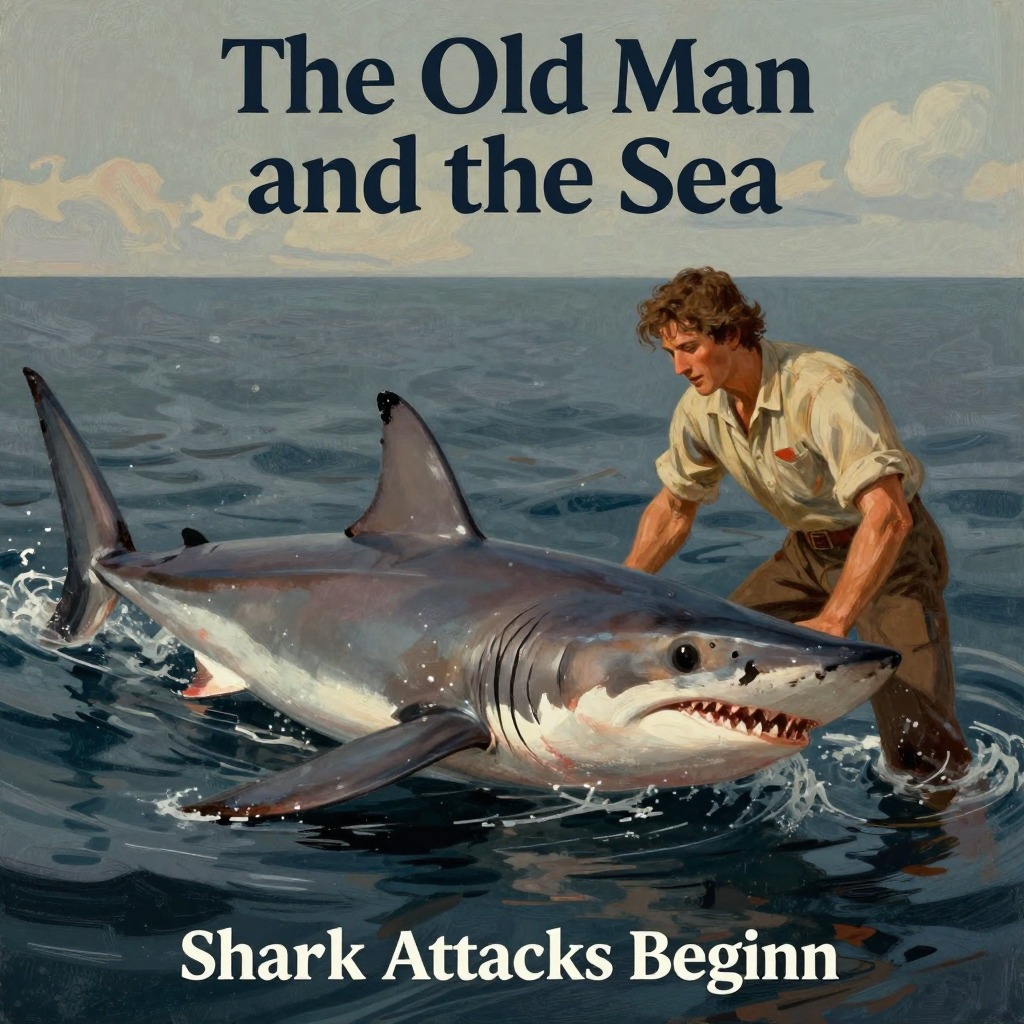
The Old Man and the SeaThe Mako shark is the first and most formidable predator to attack Santiago's great marlin, and its appearance marks a decisive turning point in the old man's journey. Unlike the scavenging shovel-nosed sharks that follow, the Mako is a noble, beautiful, and fearless hunter, built to prey on the fastest fish in the sea. Its assault strips Santiago of his harpoon and a significant portion of his prize, and the fight against it tests the old man's courage, skill, and philosophy of endurance. The Mako's attack initiates the sequence of losses that ultimately reduces the marlin to a skeleton, and its killing becomes a complex act of self-defense, pride, and respect for a worthy adversary.
Appearance and Nature
The Mako shark is described as a creature of exceptional beauty and power, built for speed and predation. Its back is as blue as a swordfish's, its belly is silver, and its hide is smooth and handsome. Everything about it is beautiful except its jaws. Inside its closed double lip, eight rows of teeth are slanted inward, shaped like a man's fingers when crisped like claws, nearly as long as Santiago's fingers, with razor-sharp cutting edges on both sides. This is a fish built to feed on all the fishes in the sea, so fast, strong, and well-armed that they have no other enemy. The Mako has no fear at all and will do exactly what it wishes. Santiago identifies it as a dentuso, a term that carries both respect and dread, and he acknowledges that it is cruel, able, strong, and intelligent. Unlike the scavenging galanos, the Mako is not a mere moving appetite; it lives on live fish, is beautiful and noble, and knows no fear of anything.
The Attack and the Fight
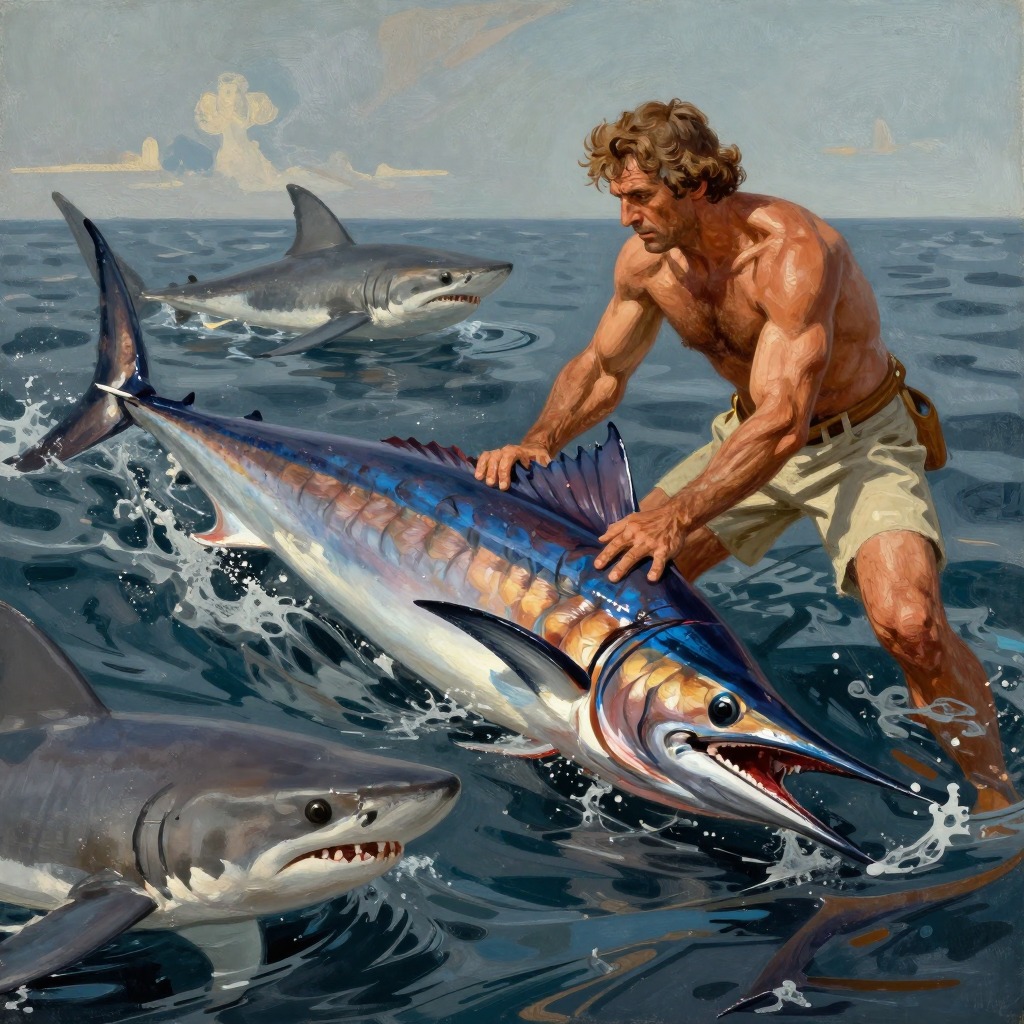
The Mako shark attacks about an hour after Santiago has lashed the marlin to his skiff and set sail for home. It comes up from the deep, drawn by the dark cloud of blood from the marlin's heart, and breaks the surface of the blue water without caution. Santiago sees it coming and knows that this is a shark that has no fear. He prepares his harpoon, though the rope is short because he has cut away much of it to lash the fish. His head is clear and full of resolution, but he has little hope. The shark closes fast astern and hits the marlin just above the tail, its mouth open, its strange eyes visible, its teeth clicking as it drives forward into the meat. Santiago drives the harpoon down onto the shark's head at the spot where the line between its eyes intersects with the line running straight back from its nose—the location of the brain. He hits it with his blood-mushed hands, driving the harpoon with all his strength, without hope but with resolution and complete malignancy. The shark swings over, wrapping itself in two loops of the rope, and though dead, it does not accept its fate. On its back, with its tail lashing and jaws clicking, it plows over the water like a speedboat until the rope comes taut, shivers, and snaps. The shark lies quietly for a little while on the surface, then goes down very slowly.
Consequences and Significance
The Mako shark takes about forty pounds of the marlin's meat, and it also takes Santiago's harpoon and all the remaining rope. This loss leaves the old man nearly defenseless for the subsequent attacks. The mutilation of the fish feels to Santiago as though he himself were hit. Yet he takes pride in having killed the biggest dentuso he has ever seen, and he reflects that he was more intelligent than the shark, or perhaps only better armed. The Mako's attack forces Santiago to confront the limits of his strength and the inevitability of loss. He wishes it had been a dream and that he had never hooked the fish, but he also articulates his central creed: "A man can be destroyed but not defeated." The Mako shark, in its beauty, nobility, and ferocity, embodies the natural forces that Santiago both loves and must fight. Its killing is an act of self-defense, but also an act of respect for a worthy opponent. The shark's role in the story is to initiate the series of defeats that strip Santiago of his triumph, yet also to provide the occasion for his most profound statement of human endurance.