Marlin
The Old Man and the SeaThe Marlin is the central antagonist and companion of Santiago's epic struggle in The Old Man and the Sea—a creature of such extraordinary size, beauty, and dignity that it transcends the role of mere prey to become a brother, a mirror of the old man's own will, and the vessel of his greatest triumph and deepest loss. Hooked far out in the Gulf Stream after eighty-four fruitless days, the fish tows Santiago's skiff for two nights and a day, forcing him to endure physical agony, loneliness, and a profound moral reckoning. Though Santiago kills the Marlin with a harpoon thrust to the heart, sharks destroy the carcass before he can bring it to harbor, leaving only a skeleton—a fact that transforms the fish from a prize into a symbol of the paradox that a man can be destroyed but not defeated.
Identity and Appearance
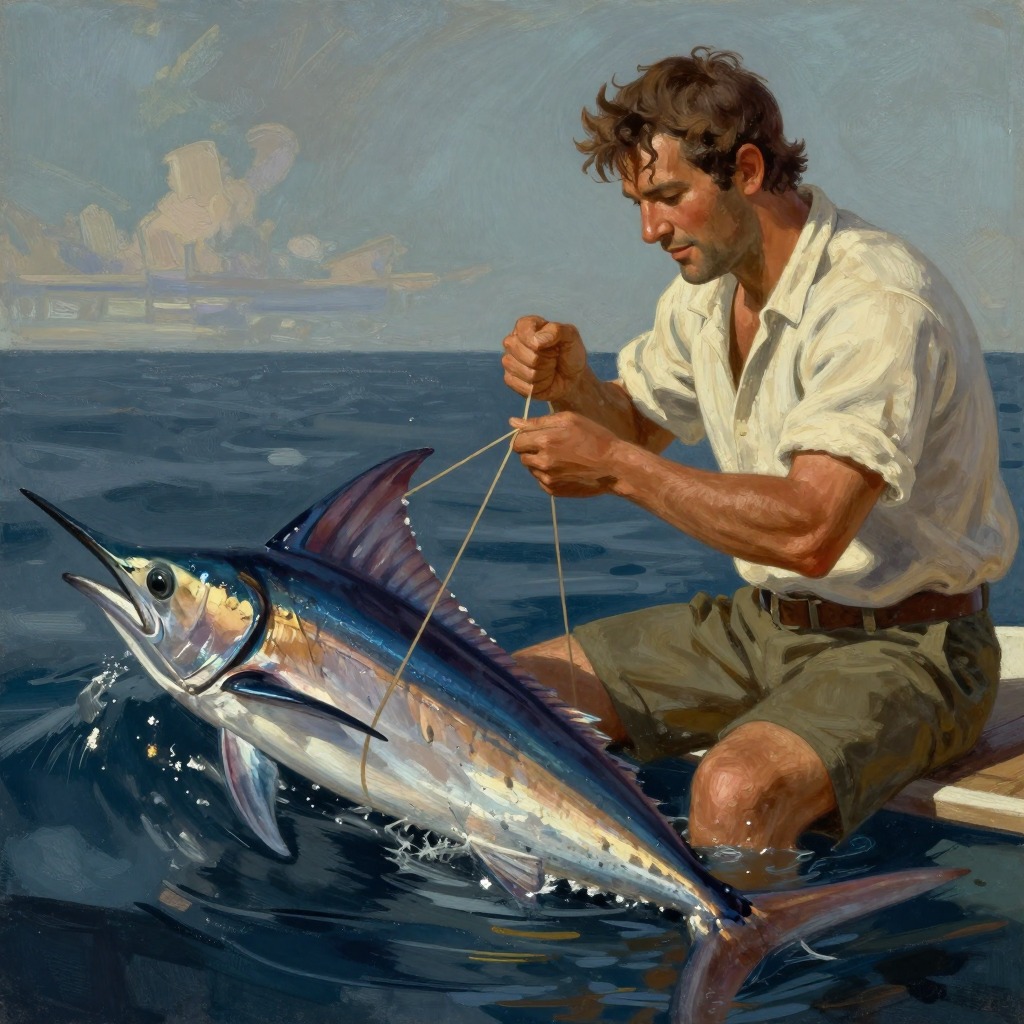
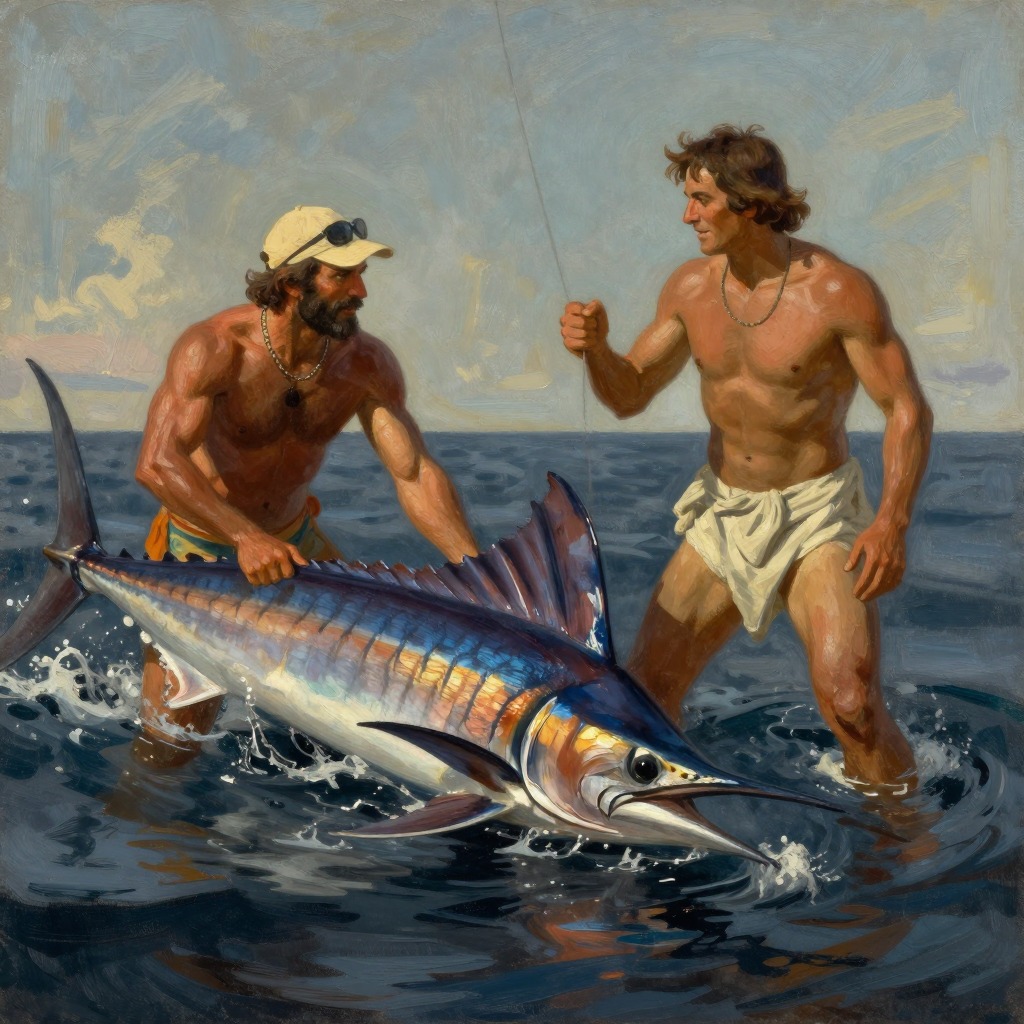
The Marlin is first sensed as a presence rather than seen: one hundred fathoms down, it begins to nibble at the sardines covering the hook, and Santiago feels a "light delicate pulling" that gives way to "something hard and unbelievably heavy" . When it finally breaches, the fish reveals itself as a creature of staggering dimensions. It is "two feet longer than the skiff" , and Santiago later estimates its weight at over fifteen hundred pounds . Its body is dark purple on the head and back, with wide, light lavender stripes on its sides; its sword is "as long as a baseball bat and tapered like a rapier" . The Marlin's tail is "higher than a big scythe blade" and a "very pale lavender above the dark blue water" . When the fish first appears, Santiago cannot believe its length: "No," he says, "He can't be that big" . The Marlin's eye is "as detached as the mirrors in a periscope or as a saint in a procession" , lending it an almost otherworldly composure.
The Battle and the Bond
From the moment the Marlin takes the bait at noon, it begins a steady, relentless pull to the northwest, towing the skiff for hours without panic or frenzy. Santiago, braced with the line across his back, recognizes the fish's quality: "He took the bait like a male and he pulls like a male and his fight has no panic in it" . The old man recalls a pair of marlin he once caught—the male stayed by the boat after the female was gaffed, jumping high to see where she was, then going down deep with his lavender wings spread wide. "That was the saddest thing I ever saw with them," Santiago remembers . This memory deepens his respect for the hooked fish, which he begins to address as a person: "Fish," he says, "I love you and respect you very much. But I will kill you dead before this day ends" . As the struggle extends into a second night, Santiago's identification with the Marlin intensifies. He thinks, "He is my brother" , and later, when the fish begins to circle, Santiago says, "You are killing me, fish... But you have a right to. Never have I seen a greater, or more beautiful, or a calmer or more noble thing than you, brother" . The Marlin's refusal to surrender—its calm, intelligent circling—forces Santiago to draw on reserves of strength he did not know he had, and the fight becomes a mutual test of will.
The Killing and Its Aftermath
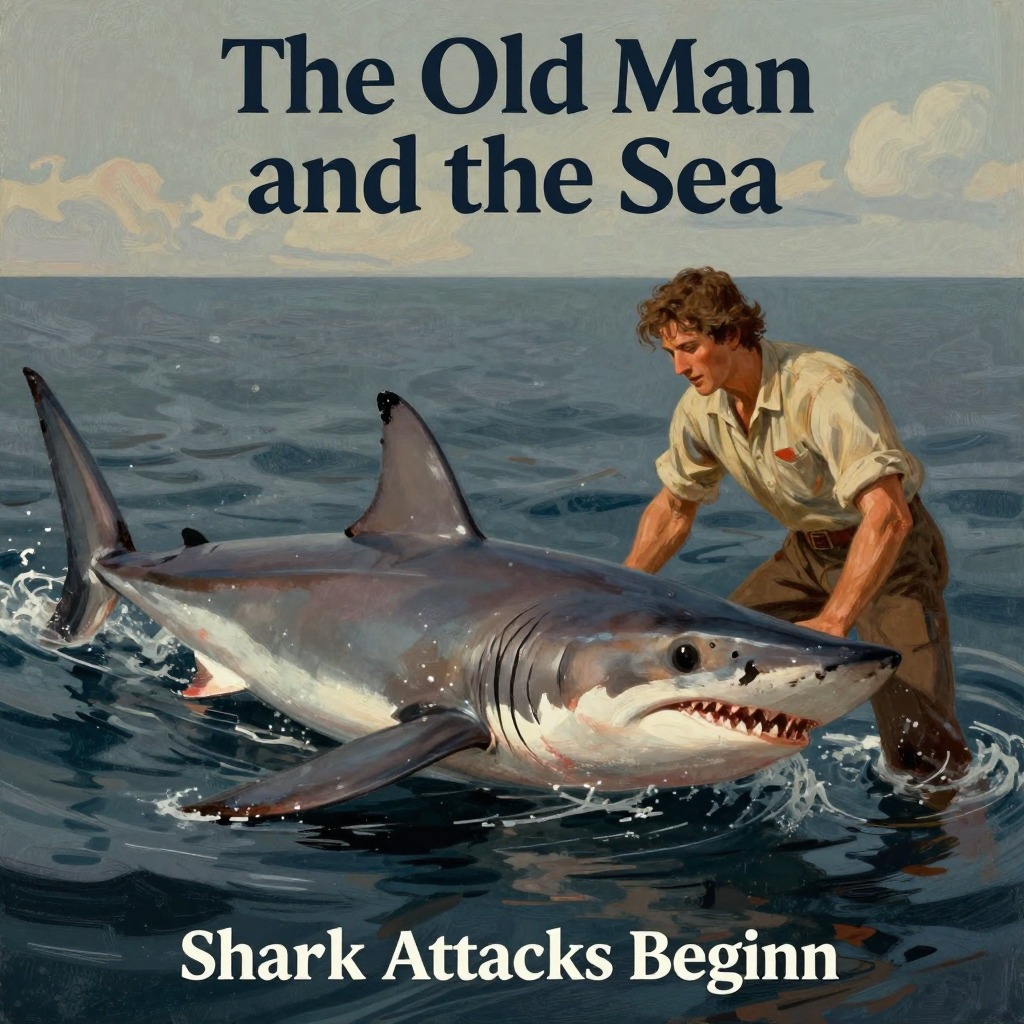
After the Marlin has circled the skiff many times, Santiago, nearly blind with exhaustion, drives the harpoon into the fish's side just behind the great chest fin. The Marlin comes alive with death in him, rising "high out of the water showing all his great length and width and all his power and his beauty," hanging in the air before crashing down . The sea discolors with the red of the fish's heart blood, spreading like a cloud in the mile-deep water . Santiago lashes the Marlin alongside the skiff—its head against the bow, its tail noosed astern—and sets sail for home. But the trail of blood attracts sharks. The first, a Mako, tears away about forty pounds of meat . Santiago kills it, but more sharks come: shovel-nosed galanos that attack in packs, stripping the Marlin of its flesh until only the skeleton remains. Santiago apologizes to the fish: "I shouldn't have gone out so far, fish... Neither for you nor for me. I'm sorry, fish" . He later reflects, "You did not kill the fish only to keep alive and to sell for food... You killed him for pride and because you are a fisherman. You loved him when he was alive and you loved him after" . When Santiago finally reaches the harbor, the Marlin is a "great long white spine with a huge tail at the end" , measured at eighteen feet from nose to tail . The proprietor of the Terrace declares, "There has never been such a fish" .
Thematic Significance
The Marlin is the physical embodiment of the code by which Santiago lives: it is noble, powerful, and worthy of the utmost respect, yet it must be killed for the fisherman to fulfill his identity. The fish's destruction by sharks does not negate the achievement of having caught it; rather, it underscores the novel's central assertion that a man can be destroyed but not defeated. The Marlin also serves as a mirror for Santiago's own aging body and undefeated spirit—both are scarred, both are pushed to their limits, and both are ultimately more than the sum of their parts. The skeleton that remains, mistaken by a tourist for a shark, becomes a monument to a struggle that only the old man and the sea truly understand.
The marlin in the novel was inspired by a real story Hemingway heard from his Cuban guide Carlos Gutiérrez in the mid-1930s, which he later recounted in an Esquire essay titled "On the Blue Water: A Gulf Stream Letter." This tale, possibly originating with Cuban author Ramón Meza y Suárez Inclán in 1891, had been passed among fishermen for decades. Hemingway's own extensive experience with big-game fishing in the Gulf Stream, where he spent thousands of hours aboard his boat Pilar, also shaped the portrayal of the marlin as a formidable opponent. He participated in and won several fishing tournaments and developed a keen interest in marine biology, inviting experts like Henry Weed Fowler and Charles Cadwalader to document catches. The marlin thus embodies not only Santiago's personal struggle but also Hemingway's deep engagement with the natural world and the traditions of Cuban fishing lore.