la mar
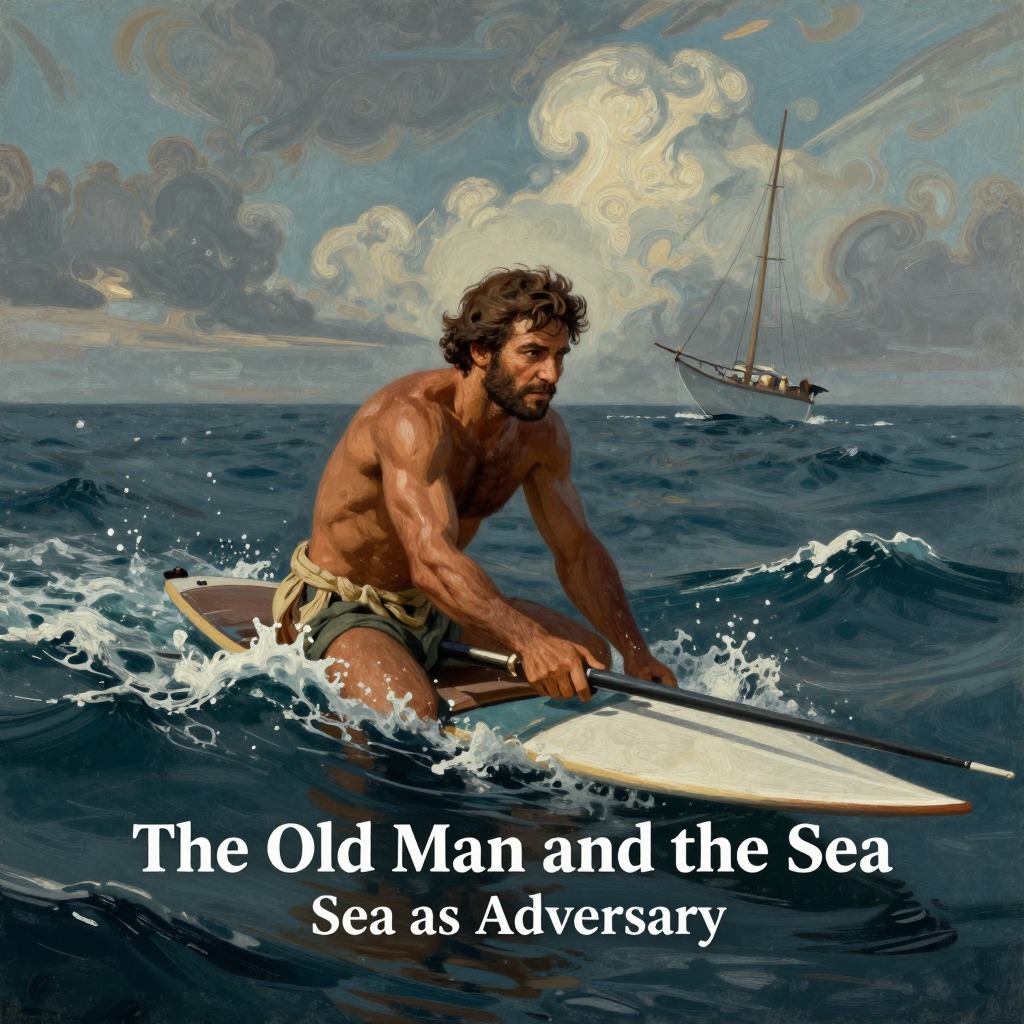
The Old Man and the SeaLa mar is the Spanish feminine name for the sea that Santiago, the old fisherman, uses throughout his three-day ordeal in the Gulf Stream, a choice that reveals the deepest structure of his relationship with the ocean. While younger fishermen, who use motorboats and buoys, speak of the sea as el mar—masculine, a contestant, a place, or even an enemy—Santiago always thinks of her as la mar, something that gives or withholds great favors, and if she does wild or wicked things it is because she cannot help them. This gendering of the sea is not a mere grammatical habit; it is the foundation of a worldview in which the ocean is a person, a partner, and a being with her own moods and agency, to be loved, respected, and fought against, but never simply exploited.
The Feminine Sea and Its Contradictions
Santiago's conception of la mar is built on a paradox: she is kind and very beautiful, but she can be so cruel, and it comes so suddenly. He thinks of the small, delicate dark terns that are always flying and looking and almost never finding, and reflects that the birds are made too delicately for the sea. The moon affects her as it does a woman, he thinks. This femininity does not make the sea gentle; it makes her unpredictable, capable of both nurturing and destroying, and therefore deserving of the same complex mixture of love, wariness, and endurance that one might feel toward a powerful and capricious woman. The old man's love for the sea is not sentimental; it is a love that includes the acceptance of her cruelty as part of her nature.
The Sea as Brother, Friend, and Enemy
Throughout the novel, Santiago's relationship with la mar oscillates between kinship and antagonism. He thinks of the flying fish as his principal friends on the ocean, and the porpoises as brothers who play and make jokes and love one another. Yet he also acknowledges that the sea contains enemies: the Portuguese man-of-war, which he calls agua mala—"you whore"—because its beautiful iridescent bubbles are the falsest thing in the sea, and the sharks, which he must fight to the death. The sea is not a single entity but a community of beings, some friendly, some hostile, and Santiago's task is to navigate this community with skill, respect, and a willingness to kill when necessary. He tells the fish, "I love you and respect you very much. But I will kill you dead before this day ends," a statement that applies equally to his relationship with the sea itself: he loves it, but he must also conquer it to survive.
The Sea as a Mirror of the Self
Santiago's dialogue with la mar is also a dialogue with himself. When he is alone, he speaks his thoughts aloud, and many of these thoughts are addressed to the sea or to the creatures within it. He says, "The fish is my friend too. I have never seen or heard of such a fish. But I must kill him. I am glad we do not have to try to kill the stars." This reflection reveals that the sea, for Santiago, is a realm where the boundaries between self and other, love and violence, are blurred. He thinks of the fish as his brother, yet he must kill him; he thinks of the sea as a friend, yet he must fight it. The sea becomes a mirror in which Santiago sees his own endurance, his own pride, and his own mortality. When he says, "You are killing me, fish," he is also acknowledging that the sea is killing him, and that this is a natural and even noble process.
The Sea as a Source of Meaning and Sin
In the aftermath of the shark attacks, Santiago's relationship with la mar becomes a source of moral and existential questioning. He thinks, "Perhaps it was a sin to kill the fish. I suppose it was even though I did it to keep me alive and feed many people. But then everything is a sin." He then reflects, "You did not kill the fish only to keep alive and to sell for food. You killed him for pride and because you are a fisherman. You loved him when he was alive and you loved him after. If you love him, it is not a sin to kill him. Or is it more?" This internal debate is framed entirely within the context of his relationship with the sea and its creatures. The sea is not a neutral resource; it is a moral arena where Santiago must justify his actions to himself. The fact that he cannot resolve the question—that he oscillates between seeing the killing as a sin and as a natural act of love—underscores the depth of his connection to la mar.
The Sea as a Final Judge
When Santiago finally returns to the harbor, his skiff towing the skeleton of the great marlin, he is beaten but not defeated. He says aloud, "Nothing. I went out too far." This admission is not a confession of failure but an acknowledgment that he violated the unspoken contract with la mar: he went beyond the limits that a fisherman should respect. The sea, in the end, is the judge of his actions, and it has taken everything except his life and his will. The skeleton that remains is a monument to his struggle, but also a reminder that the sea is ultimately unknowable and uncontrollable. The tourists who see the skeleton mistake it for a shark, and the waiter does not correct them; the true story of Santiago's battle with la mar remains invisible to those who do not understand the sea as he does. The novel ends with Santiago dreaming of the lions on the beach, a return to the Africa of his youth, a place where the sea and the land meet in a vision of peace and beauty that transcends the violence of his ordeal.