little harbour
The Old Man and the SeaThe little harbour is the modest, rock-lined inlet on the Cuban coast that serves as the home port for Santiago and the other fishermen of his village. It is the fixed point from which Santiago departs on his eighty-fifth day without a fish and to which he returns, broken but alive, after his three-day ordeal with the great marlin. More than a mere geographical feature, the harbour anchors the story's moral and emotional geography: it is the threshold between the known world of the Terrace, the bodega, and the shack, and the vast, indifferent sea where Santiago's deepest test of endurance takes place. The harbour is also the site where the community gathers to witness the material evidence of his struggle—the eighteen-foot skeleton—and where outsiders, in the form of a party of tourists, misread that evidence entirely, underscoring the gap between lived experience and public perception.
Geography and Daily Life
The little harbour is a working inlet, not a grand port. It is described as having a "little patch of shingle below the rocks" where Santiago beaches his skiff after each day's fishing. The harbour is flanked by the shark factory on the other side of the cove, a place where sharks are hoisted on a block and tackle, their livers removed, their fins cut off, and their flesh cut into strips for salting. When the wind is from the east, a smell from the shark factory comes across the harbour, though on the day before Santiago's great voyage the wind has backed into the north, leaving only a faint edge of the odour. The harbour is also the site of the Terrace, the open-air restaurant where the fishermen gather, where Martin the owner sends meals to Santiago, and where the boy Manolin fetches coffee for the exhausted old man after his return. The harbour's physical details—the coral rocks, the pebbled sand, the skiffs hauled up on the shingle—are the textures of a life lived close to the sea, a life Santiago has known since boyhood.
Departure and Return
Santiago's departure from the little harbour is described in the dark before dawn. He and Manolin lift the skiff and slide her into the water, and Santiago rows out past the other boats, leaving the smell of the land behind. The harbour is the last trace of human community before he enters the solitary realm of the Gulf Stream. His return, three days later, is a study in exhaustion. He sails into the little harbour after midnight, when the lights of the Terrace are out and everyone is in bed. There is no one to help him; he pulls the boat up as far as he can, steps out, and makes her fast to a rock. He unsteps the mast, furls the sail, and shoulders it, then starts to climb. The depth of his tiredness is revealed in the physical struggle: he falls at the top of the climb and lies for some time with the mast across his shoulder, and he has to sit down five times before he reaches his shack. The harbour, which he left with hope and confidence, receives him in silence and solitude.
The Skeleton and the Community
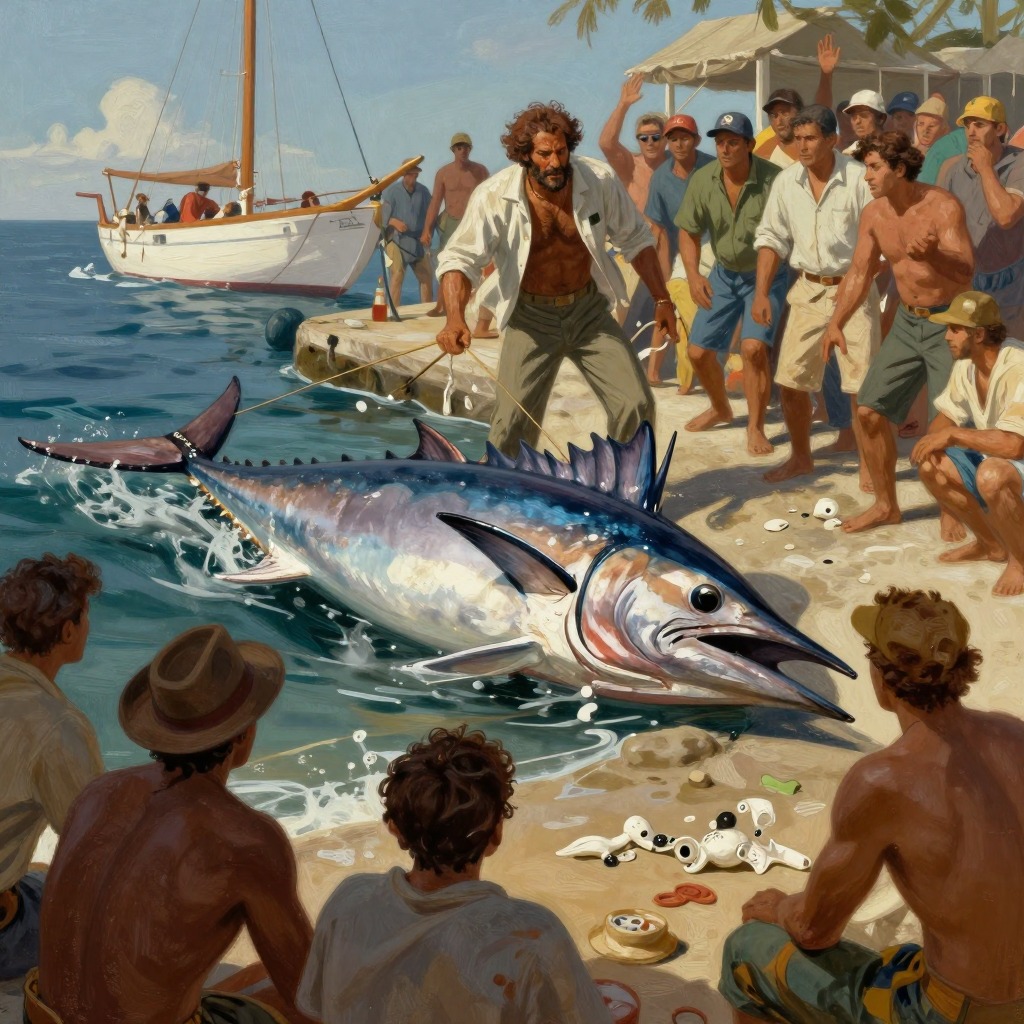
The morning after Santiago's return, the little harbour becomes the scene of a quiet commotion. Many fishermen gather around the skiff, looking at what is lashed beside it. One fisherman, with his trousers rolled up, stands in the water measuring the skeleton with a length of line. He announces that the fish was eighteen feet from nose to tail. Manolin, who has come to the shack and seen Santiago's hands, does not go down to the harbour; he has been there before, and one of the fishermen is looking after the skiff for him. The skeleton—the great tail standing up well behind the skiff's stern, the white naked line of the backbone, the dark mass of the head with the projecting bill, and all the nakedness between—is the material proof of Santiago's achievement, but it is also a ruin. The harbour, which once saw the old man return each day with an empty skiff, now sees him return with the largest fish anyone has ever heard of, reduced to garbage.
The Tourists' Misreading
That afternoon, the little harbour is the setting for a final, ironic coda. A party of tourists at the Terrace looks down into the water among the empty beer cans and dead barracudas. A woman sees the great long white spine with the huge tail at the end, lifting and swinging with the tide while the east wind blows a heavy steady sea outside the entrance to the harbour. She asks a waiter what it is, pointing to the long backbone that is now "just garbage waiting to go out with the tide." The waiter, meaning to explain what has happened, says, "Tiburon"—shark. The woman replies that she did not know sharks had such handsome, beautifully formed tails, and her male companion agrees. The harbour, which has witnessed Santiago's entire ordeal from departure to return, becomes the stage for a final act of incomprehension, where the evidence of his struggle is misidentified and reduced to a tourist's casual observation.
Narrative Significance
The little harbour is the story's geographical and emotional anchor. It is the place where Santiago's identity as a fisherman is defined—where he is mocked by some and pitied by others, where he receives the boy's loyalty and Martin's charity, and where he returns, beaten but not defeated, to sleep and dream of the lions. The harbour's smallness and modesty mirror Santiago's own condition: it is not a grand port but a humble inlet, just as he is not a young or lucky fisherman but an old man with a patched sail and a skiff that has seen better days. The harbour also serves as a contrast to the vastness of the sea: it is the known, the communal, the safe, while the sea is the unknown, the solitary, the dangerous. The journey from the harbour out to the great well and back is the arc of Santiago's trial, and the harbour's silent reception of his return—first in darkness, then in the morning light, and finally in the tourists' misunderstanding—completes the story's meditation on what it means to strive, to suffer, and to be seen.