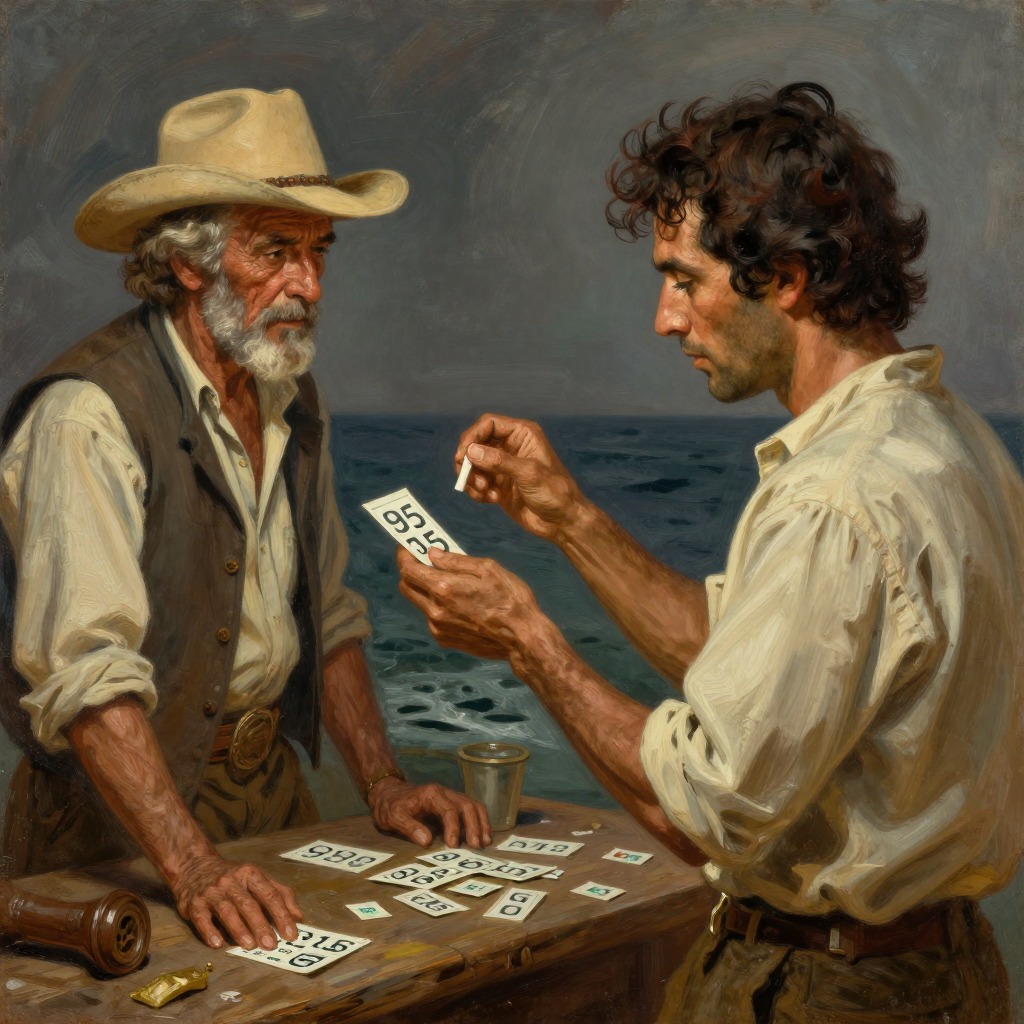
the Terminal as a ticket
The Old Man and the SeaThe Terminal as a ticket is a lottery ticket that Santiago and Manolin discuss buying for the eighty-fifth day of Santiago's unlucky streak, a concept that crystallizes the old man's blend of hope, superstition, and practical need. It appears in the evening before Santiago's great battle, when he proposes to Manolin, "Do you think we should buy a terminal of the lottery with an eighty-five? Tomorrow is the eighty-fifth day." This proposal is not a casual whim but a calculated act of faith: Santiago has gone eighty-four days without a fish, and the number eighty-five carries a superstitious weight, as he declares, "Eighty-five is a lucky number." The ticket represents a tangible investment in the possibility of a reversal of fortune, a small wager against the vast indifference of the sea.
The Lottery as a Shared Ritual
The plan to buy the Terminal is a collaborative act between Santiago and Manolin, reinforcing their bond and shared hope. Manolin immediately agrees, saying, "We can do that," but then challenges Santiago with a reference to his past record: "But what about the eighty-seven of your great record?" This exchange reveals that the lottery ticket is not merely a financial transaction but a ritual that connects Santiago's present struggle to his past triumphs. Santiago dismisses the idea of repeating the eighty-seven-day record, saying, "It could not happen twice," and insists on the eighty-five, showing his focus on the immediate future. The ticket also highlights their poverty: Santiago asks, "Who can we borrow that from?" and Manolin replies, "That's easy. I can always borrow two dollars and a half." Santiago, however, resists borrowing, stating, "I try not to borrow. First you borrow. Then you beg." This moment underscores the dignity and pride that define Santiago's character, even as he contemplates a gamble.
The Terminal as a Symbol of Hope and Luck
The Terminal as a ticket functions as a symbol of hope in a narrative dominated by struggle and loss. Santiago's world is one where luck is a tangible force—he has been labeled "salao," the worst form of unlucky, by the boy's parents. The lottery ticket offers a concrete, if improbable, path to change that luck. It is a small, human attempt to impose order on a chaotic universe, much like his precise fishing techniques. The ticket also connects to the broader theme of luck versus skill: Santiago tells himself, "It is better to be lucky. But I would rather be exact. Then when luck comes you are ready." The Terminal is not a substitute for his own efforts but a companion to them, a way to court fortune while relying on his own resolution and tricks. In the end, after the sharks have destroyed the marlin, Santiago reflects, "You violated your luck when you went too far outside." The lottery ticket, never actually purchased, remains a symbol of the hope that Santiago carries into his ordeal, a hope that is tested but never entirely extinguished.
The Terminal's Place in Santiago's Worldview
The concept of the Terminal as a ticket is embedded in Santiago's worldview, which blends superstition, religious faith, and a deep respect for the natural order. He makes a pilgrimage promise to the Virgin of Cobre if he catches the fish, and he prays the Our Father and Hail Mary. The lottery ticket is a secular counterpart to these religious acts, a way of engaging with fate on a practical level. It also reflects the community's culture: the Terrace, the bodega, and the lottery are part of the social fabric of Havana. The ticket is a thread connecting Santiago's solitary struggle to the world of men, baseball, and commerce. When he later thinks of the great DiMaggio, he wonders if the bone spur would hurt him too much, and he measures his own suffering against that of his hero. The Terminal, like DiMaggio, is a reference point for Santiago's identity as a fisherman and a man. It is a small, almost mundane object that carries the weight of his hopes, his poverty, and his unyielding determination to prove himself, even as the sea and the sharks conspire against him.