the fisherman who measured
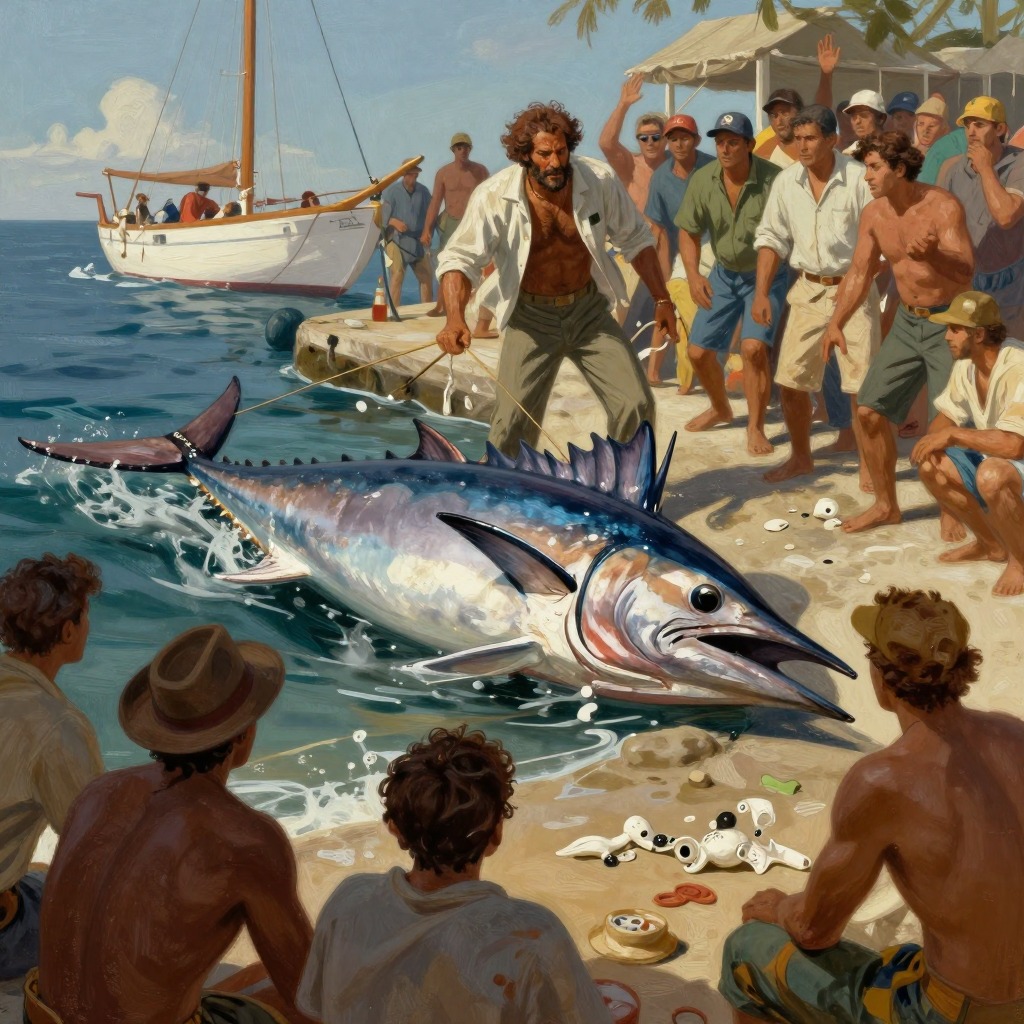
The Old Man and the SeaThe fisherman who measured is a minor character who appears only at the conclusion of The Old Man and the Sea, yet his single action carries considerable symbolic weight. He is the one who wades into the water, rolls up his trousers, and uses a length of line to determine the exact dimensions of the great marlin's skeleton that Santiago has lashed to the side of his skiff. His measurement — eighteen feet from nose to tail — provides the only objective, quantifiable record of the fish's size, transforming Santiago's private ordeal into a public fact that the community can grasp and marvel at.
Identity and Role
This fisherman is one of the older fishermen of the village, part of the same community that had earlier watched Santiago's daily return with an empty skiff. He is not named, and his identity is defined entirely by his function: he is the one who measures. Unlike the younger fishermen who had made fun of Santiago on the Terrace, or the successful fishermen who had butchered their marlin and carried them to the fish house, this man performs a quiet, respectful act of documentation. He is present among the group of fishermen who gather around the skiff the morning after Santiago's return, looking at what is lashed beside it. One of them is in the water, his trousers rolled up, measuring the skeleton with a length of line. The boy, Manolin, does not go down to join them; he has already been there before, and one of the fishermen — likely the measurer — is looking after the skiff for him.
The Measurement and Its Significance
The fisherman who measured calls out his finding: "He was eighteen feet from nose to tail." This announcement is the first and only precise description of the marlin's size that the reader receives. Throughout the novella, Santiago has estimated the fish's weight — "over fifteen hundred pounds the way he is" — and has marveled at its length, noting that it is "two feet longer than the skiff." But the measurement provides an authoritative, external confirmation. The boy, Manolin, responds simply, "I believe it," accepting the fact without surprise or elaboration. The measurement also serves a narrative function: it gives the tourists who later see the skeleton a concrete detail to misunderstand. When a woman on the Terrace points to the long backbone and asks what it is, the waiter answers "Tiburon" — shark — and the woman remarks that she did not know sharks had such handsome tails. The irony is that the skeleton is not a shark's but a marlin's, and the measurement that the fisherman took is the only accurate piece of information that the tourists never receive.
Connection to the Community
The fisherman who measured is part of a network of minor characters who together form the village community that surrounds Santiago. He is one of the older fishermen who, earlier in the story, looked at Santiago and were sad but did not show it, speaking politely instead about the current and the depths. He is also one of those who, along with the proprietor Martin — who had sent meals to Santiago — and Pedrico — who receives the marlin's head for fish traps — demonstrates that Santiago is not entirely alone. The measurement is an act of respect, a way of acknowledging the magnitude of what the old man has done. It is the community's way of saying that they understand, even if they cannot fully comprehend, the scale of his achievement. The fisherman who measured does not speak again, and his name is never given, but his single action — the act of measuring — becomes the final, objective record of the marlin's existence, a fact that outlasts the fish itself and becomes part of the story that the village will tell.