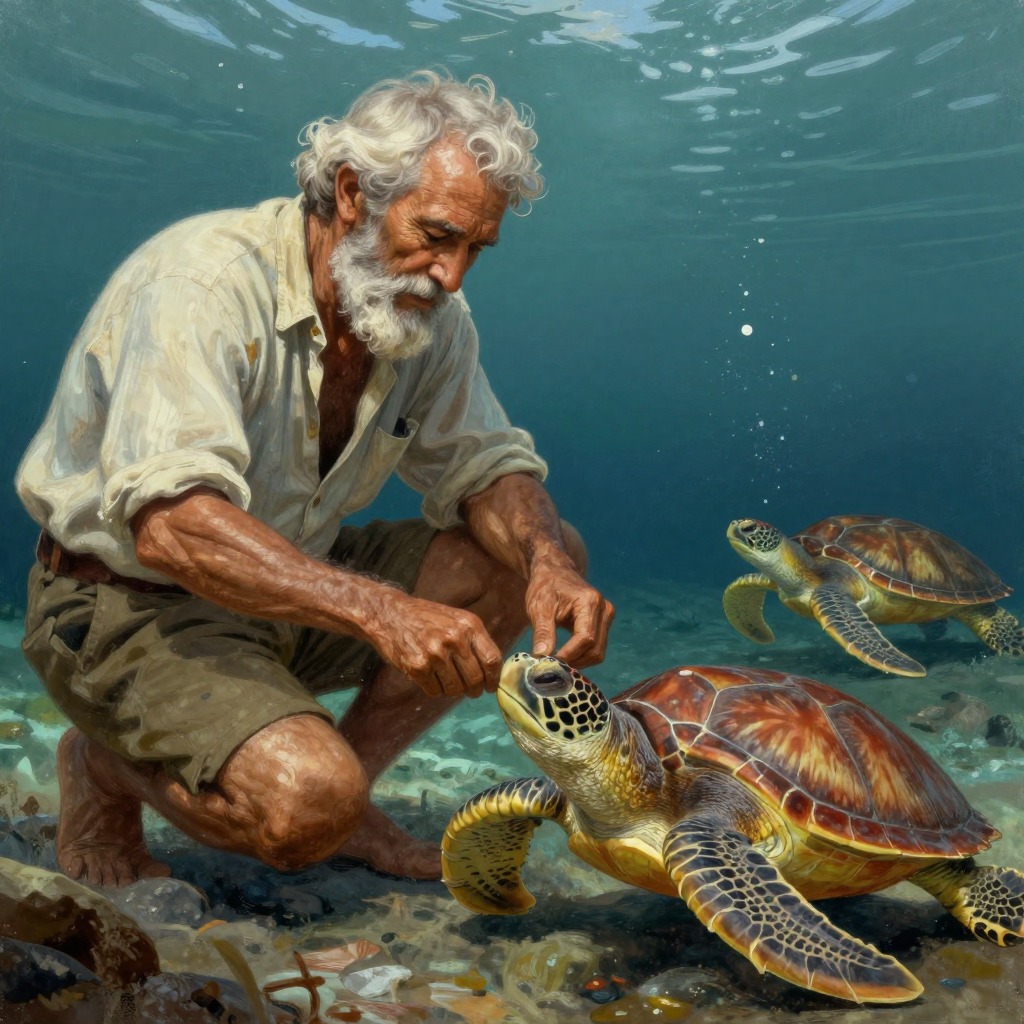
the green turtles
The Old Man and the SeaThe green turtles appear in The Old Man and the Sea not as active participants in the plot but as a persistent element of Santiago's inner world, woven into his reflections on the sea, his own body, and the nature of struggle. They embody a form of graceful endurance that the old man admires and, in his own way, shares.
Identity and Santiago's Affection
Santiago loves the green turtles and the hawk-bills for their elegance, speed, and great value, holding a friendly contempt for the huge, stupid loggerheads. He has no mysticism about turtles despite having gone in turtle boats for many years, and he feels sorry for them all, even the great trunk backs as long as his skiff and weighing a ton. He is aware that most people are heartless about turtles because a turtle's heart will beat for hours after it has been cut up and butchered, and he thinks, "I have such a heart too and my feet and hands are like theirs." This identification is central: he sees his own stubborn vitality mirrored in the turtle's tenacious life force.
The Turtle's Heart and Santiago's Body
The old man's comparison of his own heart and hands to a turtle's is not a passing metaphor but a sustained physical identification. He eats the white eggs of turtles to give himself strength, consuming them all through May to be strong in September and October for the truly big fish. He also drinks a cup of shark liver oil each day from the big drum in the shack where many fishermen keep their gear, a remedy that is good against colds and grippes and good for the eyes. These practices connect him to the turtle's world of raw, elemental nourishment and resilience. The turtle's heart, which continues to beat long after death, becomes a symbol of the kind of stubborn, unyielding life that Santiago himself embodies as he endures the long battle with the marlin and the subsequent shark attacks.
The Turtles and the Portuguese Man-of-War
Santiago's love for the turtles is also tied to their role as natural predators of the Portuguese man-of-war, which he calls "agua mala" and "you whore." He loves to see the big sea turtles eating the Portuguese men-of-war, approaching them from the front, shutting their eyes so they are completely carapaced, and eating them filaments and all. He also loves to walk on them on the beach after a storm and hear them pop when he steps on them with the horny soles of his feet. The turtles, in their methodical, unglamorous consumption of the beautiful but poisonous creatures, represent a kind of practical, unpretentious victory over the sea's false beauties, a quality Santiago values in his own approach to fishing.
Thematic Significance: Endurance and the Cycle of Life
The green turtles, along with the other turtles Santiago contemplates, form part of the novel's broader meditation on the cycle of life, death, and endurance. They are not romanticized; they are creatures of the sea that are hunted, butchered, and whose hearts beat on. Santiago's identification with them underscores his own place in this cycle: he is a fisherman who kills to live, who endures pain and loss, and whose own heart, like the turtle's, continues to beat long after the fight is over. The turtles, in their quiet, unglamorous resilience, offer a counterpoint to the more dramatic struggles with the marlin and the sharks, grounding Santiago's heroism in the ordinary, persistent life of the sea.