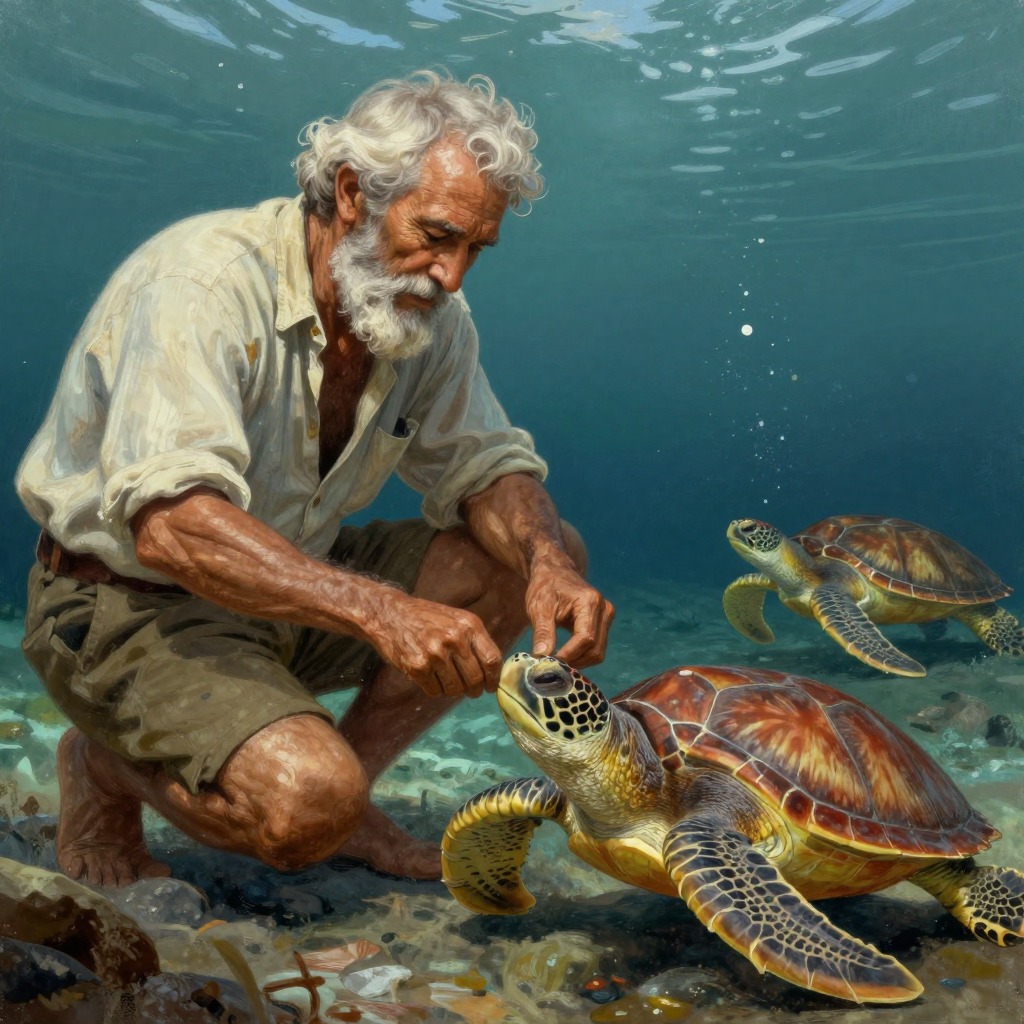
the loggerheads
The Old Man and the SeaThe loggerheads are a species of sea turtle that appear in Santiago's reflections during his ordeal at sea, embodying the raw, unglamorous endurance of life in the ocean. Unlike the elegant green turtles and hawk-bills, which Santiago loves for their speed and value, the loggerheads are huge, stupid, and yellow in their armor-plating, with strange mating habits. They happily eat Portuguese men-of-war with their eyes shut, a behavior Santiago finds both contemptible and endearing. He has a friendly contempt for them, recognizing their clumsiness and lack of sophistication, yet he respects their place in the sea's ecosystem.
Santiago's Relationship with the Loggerheads
Santiago's attitude toward the loggerheads is complex, blending affection with a sense of superiority. He loves to see the big sea turtles, including loggerheads, eating the beautiful but deadly Portuguese men-of-war, which he calls "agua mala" or "whore." The turtles approach the men-of-war from the front, shut their eyes, and consume them entirely, filaments and all. Santiago also enjoys walking on the beaches after a storm and stepping on the Portuguese men-of-war, hearing them pop under his horny soles. This visceral connection to the turtles' resilience reflects his own hardiness and his acceptance of the sea's harsh realities.
The Loggerheads as Symbols of Endurance
The loggerheads, with their thick shells and slow, deliberate movements, symbolize a form of endurance that Santiago deeply understands. He has no mysticism about turtles, despite having worked on turtle boats for many years, but he feels a kinship with them. He notes that most people are heartless about turtles because a turtle's heart will beat for hours after it has been cut up and butchered, and he thinks, "I have such a heart too and my feet and hands are like theirs." This identification underscores Santiago's own resilience and his ability to endure pain and suffering without complaint. The loggerheads, in their simple, unthinking persistence, mirror Santiago's own stubborn will to survive.
The Loggerheads in the Context of the Sea's Economy
The loggerheads also appear in the broader context of the sea's economy, which Santiago navigates with a mix of practicality and reverence. He eats turtle eggs to give himself strength, consuming them all through May to be strong in September and October for the truly big fish. He also drinks shark liver oil daily, a practice shared by many fishermen, to ward off colds and grippes and to maintain his eyesight. These habits connect him to the loggerheads and other sea creatures in a cycle of consumption and survival. The loggerheads, like the other turtles, are part of the natural order that Santiago accepts without sentimentality, even as he acknowledges their role in the sea's harsh beauty.
The Loggerheads and the Theme of Brotherhood
While Santiago explicitly calls the marlin his brother and the porpoises his brothers, his relationship with the loggerheads is more distant but still marked by a sense of shared existence. He has a friendly contempt for them, but he does not dismiss them as worthless. Instead, he sees them as part of the sea's fabric, creatures that, like him, are subject to the ocean's whims. The loggerheads' ability to consume the poisonous Portuguese men-of-war without harm is a testament to their adaptation, and Santiago's observation of this behavior reflects his own need to adapt to the sea's challenges. In the end, the loggerheads, like all the creatures Santiago encounters, contribute to his understanding of the sea as a place of both beauty and brutality, where life and death are intertwined in an endless cycle.