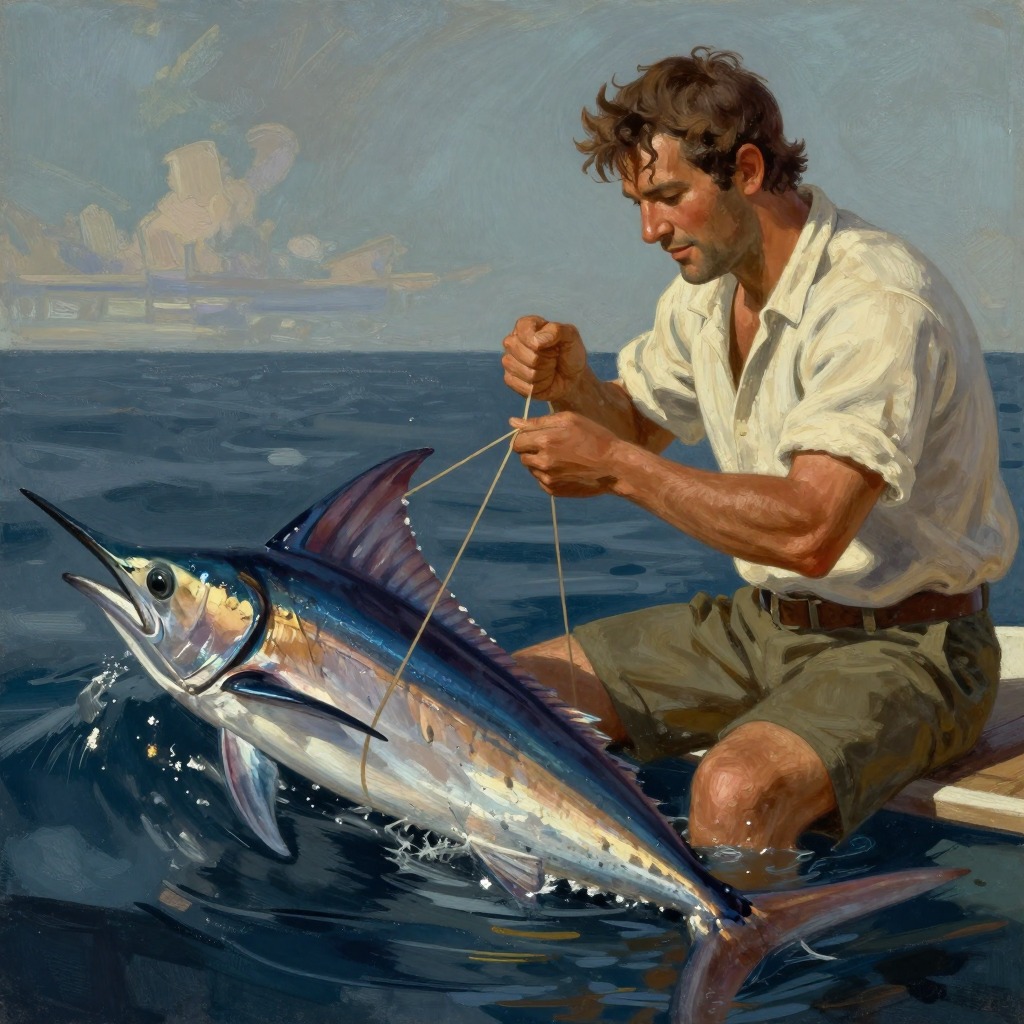
the phosphorescence
The Old Man and the SeaThe phosphorescence is a recurring luminous phenomenon in the waters of the Gulf Stream, appearing as a ghostly glow that marks the presence of organic matter, the movement of fish, and the passage of the skiff. For Santiago, it is not merely a visual curiosity but a constant, tangible sign of the sea's hidden life and of his own physical engagement with the elements. It appears at key moments of strain and exhaustion, binding his body's condition to the ocean's chemistry and reminding him of the relentless cycle of feeding, killing, and decay that governs his world.
Appearance and Physical Character
The phosphorescence manifests as a faint, self-generated light in the water, most visible at night. Santiago first notices it as he rows out before dawn, seeing "the phosphorescence of the Gulf weed in the water" as he passes over the great well, a deep area where fish congregate. Later, when his hands are raw from handling the line and from skinning a dolphin, he watches "the flow of the water against his hand" and sees that "his hand was phosphorescent from skinning the fish" and that "particles of phosphorus floated off and drifted slowly astern." The phenomenon is thus directly tied to the handling of fish—the blood, guts, and gills he discards over the stern leave "a trail of phosphorescence in the water" as they sink. It is a chemical afterglow of the sea's own processes, a sign that something has been killed or disturbed.
Connection to the Old Man's Body and Suffering
The phosphorescence becomes a measure of Santiago's physical state and his connection to the sea. When his left hand is cramped and he feels the line's pull, he notes the "phosphorescent streak in the water straight out from his shoulders," the line itself glowing as it cuts through the dark. The glow is a byproduct of his own labor and pain. After he has skinned the dolphin, his hand is coated with the luminous substance, and he watches the particles drift away, noting that "the flow was less strong" than before—a subtle indication that the fish is tiring or resting. The phosphorescence thus externalizes his internal sensations: the slowing of the current mirrors the slowing of his own strength, and the glow on his hand is a physical trace of the work he has done.
Symbolic and Thematic Significance
Beyond its physical reality, the phosphorescence functions as a symbol of the sea's dual nature—beautiful and deadly, generous and cruel. It is a light born of decay, a luminous trail left by the guts of a fish or the skin of a dolphin. It appears in the same waters where the Portuguese man-of-war floats, "iridescent" and "beautiful" but poisonous, and where the old man's own blood from the line cuts mixes with the sea. The phosphorescence is a sign of life that is also a sign of death: it marks the path of the marlin's blood that attracts the sharks, and it glows on Santiago's hands after he has killed and cleaned a fish. It is the sea's own writing, a language of light that speaks of the constant, unending cycle of feeding and being fed. For Santiago, who thinks of the sea as "la mar," a feminine force that "gave or withheld great favours," the phosphorescence is one of her many moods—a beautiful, indifferent, and truthful illumination of the world beneath the surface.
Recurrence and the Rhythm of the Voyage
The phosphorescence recurs at structurally significant points in Santiago's journey, marking the passage of time and the progression of his ordeal. It first appears as he rows out, a sign of the rich fishing grounds. It returns during the night when he is alone, towing the marlin, as the line shows "like a phosphorescent streak." It appears again after he has killed the dolphin and cleaned it, the guts leaving a luminous trail. And it is present in the final, desperate night when the sharks attack in a pack, their fins showing "their phosphorescence as they threw themselves on the fish." Each recurrence deepens the sense of isolation and struggle, turning the phosphorescence from a mere natural phenomenon into a constant, silent companion—a light that reveals the old man's labor, his wounds, and the relentless predation of the sea.