the waiter
The Old Man and the SeaThe waiter is a peripheral figure in Ernest Hemingway's The Old Man and the Sea, yet his single, brief appearance at the Terrace carries disproportionate symbolic weight. He is the one who, when a tourist points to the great marlin skeleton lashed to Santiago's skiff and asks what it is, answers "Tiburon"—shark—meaning to explain what had happened but instead providing a misidentification that reduces the old man's monumental struggle to a commonplace, easily dismissed sight. In that moment, the waiter becomes the unwitting agent of the story's central irony: the epic, the heroic, and the tragic are, for those who did not witness them, indistinguishable from garbage waiting to go out with the tide.
Role and Context at the Terrace
The Terrace is the social and commercial hub of the fishing village, where fishermen gather, drink, and exchange news. The waiter works there, serving the community. He is part of the establishment run by Martin, the proprietor, who has shown generosity to Santiago by sending meals and beer through the boy Manolin. The waiter's world is one of routine service: he brings coffee, answers questions, and attends to the tourists who come to the harbor. He is not a fisherman himself, and his understanding of the sea's events is mediated by what he hears and sees secondhand. When the party of tourists arrives, looking down at the water among the empty beer cans and dead barracudas, the waiter is the one they turn to for an explanation of the great long white spine with the huge tail at the end that lifted and swung with the tide.
The Misidentification and Its Significance
The tourist, a woman, sees the skeleton and asks, "What's that?" The waiter replies, "Tiburon. Shark." He was meaning to explain what had happened—that Santiago had caught a great marlin, that sharks had destroyed it, that the old man had fought them off until nothing was left but the backbone and the head. But the word "shark" alone, without context, conveys nothing of the three-day battle, the endurance, the love and respect Santiago felt for the fish, or the tragedy of its destruction. The tourist's companion then says, "I didn't know sharks had such handsome, beautifully formed tails," and the woman agrees. The waiter's well-intentioned but incomplete answer allows the tourists to walk away with a comfortable, trivializing interpretation: they have seen a shark's skeleton, nothing more. The waiter thus embodies the failure of language and community to transmit the full meaning of an extraordinary experience. He is not malicious; he is simply a man doing his job, but his job requires only the simplest of answers.
Contrast with the Fishermen's Response
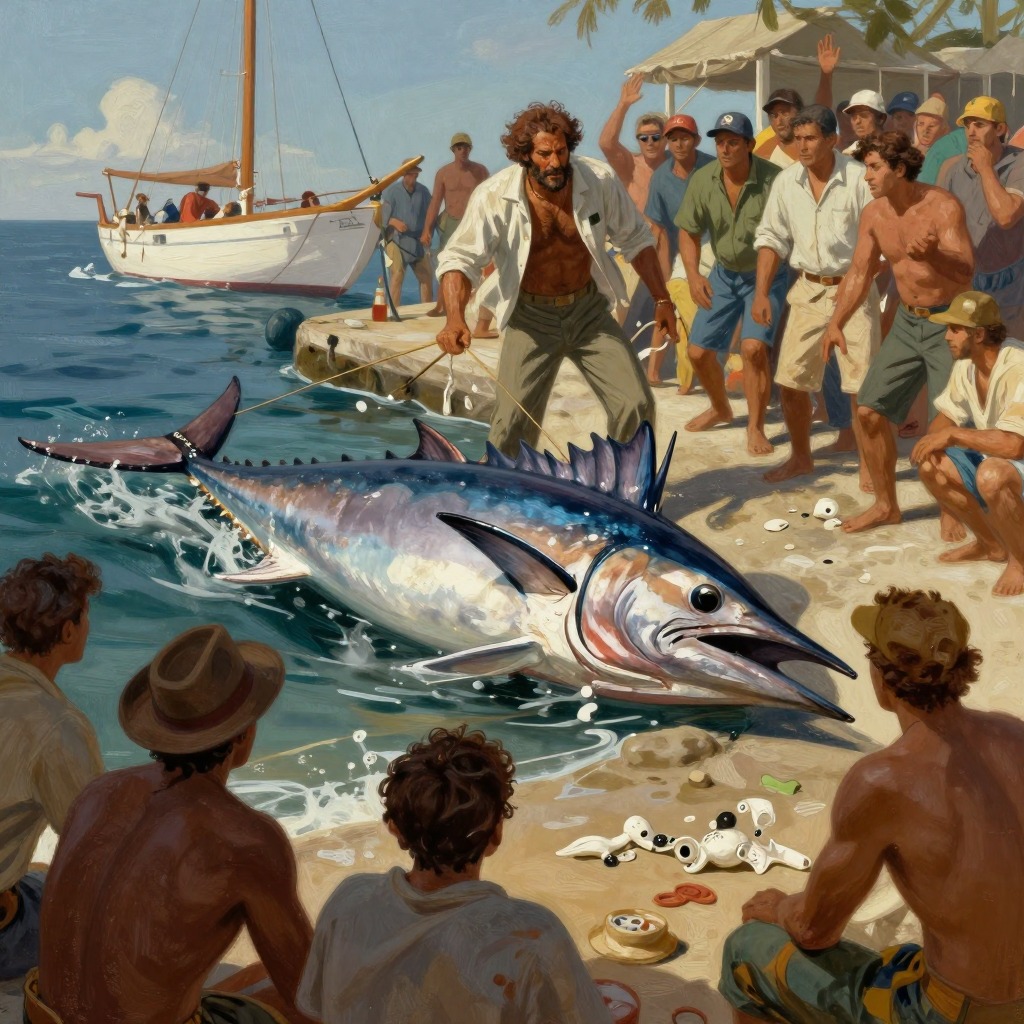
The waiter's response stands in sharp contrast to the reactions of the fishermen who had gathered around the skiff earlier that morning. They had measured the skeleton—eighteen feet from nose to tail—and one of them had called out the measurement. They knew what it was. Manolin, the boy, had wept when he saw Santiago's hands and again when he heard the measurement. The fishermen understood the magnitude of what Santiago had done, even if only the skeleton remained. The waiter, however, is not part of that inner circle of fishermen. He is a server, an observer, a conduit between the harbor and the outside world. His misidentification is not a personal failing but a structural one: the community's knowledge does not automatically transfer to those who serve it, and the epic story, when filtered through a casual question and a one-word answer, becomes a tourist's anecdote.
Thematic Resonance: The Unseen and the Misunderstood
The waiter's role echoes a larger pattern in the novel: the gap between Santiago's inner experience and the external world's perception of it. Santiago himself worries about this gap, thinking at one point, "I wish I had the boy. To help me and to see this." He knows that the fight, the beauty of the fish, the nobility of the struggle—these are things that must be witnessed to be understood. The waiter, by providing a misidentification, confirms that without a witness, the truth is easily lost. The marlin's skeleton becomes "just garbage waiting to go out with the tide," and the waiter's word "shark" becomes the official, though inaccurate, label. The novel's final image—Santiago dreaming of the lions, the boy sitting by him—is a private, unshared resolution. The waiter, in his small way, represents the public world that will never fully grasp what happened out on the Gulf Stream.