A silverback gorilla’s duty to protect the group
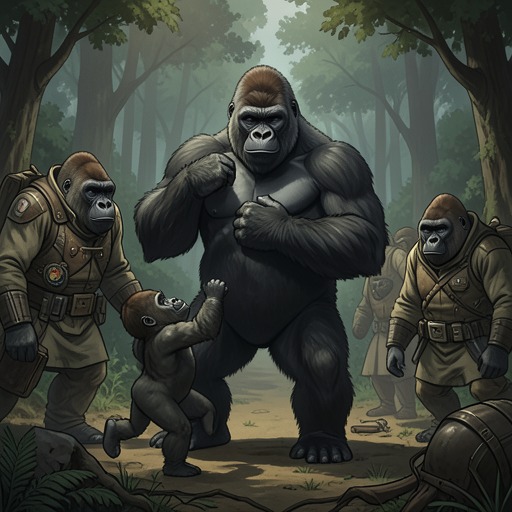
The One and Only IvanA silverback gorilla’s duty to protect the group is presented as a responsibility rooted in gorilla social life, not simply a display of strength. Ivan remembers his father’s chest-beating as a warning that asserted authority and defended the troop; later, in the confined world of Exit 8 Big Top Mall and Video Arcade, Ivan begins to understand protection as a responsibility he must answer for himself. The idea shifts from inherited knowledge to a lived obligation when he realizes he has someone to protect.
Definition and Meaning
A silverback is an adult male gorilla over twelve years old, identified by a patch of silver hair on his back. The role carries authority, but authority is inseparable from the obligation to protect the family. The silverback’s anger is therefore purposeful: it maintains order and warns the troop of danger. Ivan recalls that when his father beat his chest, the gesture meant to command attention and signal that he was in charge. Its force was not anger for its own sake, but anger used in the service of protection.
That understanding makes Ivan’s description of his own domain striking. There, he observes, there is no one to protect. The empty role distinguishes captivity from the social life for which a silverback’s responsibilities have meaning. A billboard depicts Ivan as angry, but he rejects the image: he is not angry all the time, and anger is precious precisely because it has a particular purpose. In this contrast, the duty to protect is defined not by appearance or reputation but by the relationship between a warning gesture and the presence of a group at risk.
Learning What Protection Requires
A conversation with Stella gives the duty a more intimate dimension. Reflecting on parenthood, Stella says the hardest part would be keeping babies safe from harm. Ivan connects that responsibility to the way silverbacks protect their families, and Stella agrees. The exchange places the gorilla’s protective role alongside the care of young, emphasizing that protection involves sustained responsibility rather than a single act of force.
Ivan tells Stella confidently that she, too, would have been good at protecting. Her response is uncertain: she looks at the iron bars around her and doubts her own ability. The bars make protection more complicated than a matter of strength or willingness. Stella’s uncertainty also sharpens the difference between understanding a duty and having the freedom to carry it out. The conversation allows Ivan to recognize protective care in Stella while revealing how captivity limits the conditions in which such care can be practiced.
Anger Becomes Personal
Later, Ivan’s understanding changes from an account of what silverbacks do to a feeling he experiences himself. He bounces off the walls, screeches and bellows, and beats his chest repeatedly. Bob hides beneath Not-Tag, covering his ears with his paws. After this outburst, Ivan recognizes that he is angry at last and that he has someone to protect. The two realizations occur together: anger takes on the meaning his father’s example gave it, because Ivan now understands himself as responsible for another.
The scene does not present anger as easy or triumphant. Ivan grows quiet after a long while and sits, acknowledging that being angry is hard work. The effort matters: the protective response is not a permanent pose or a simple assertion of dominance. It is an emotionally costly use of force, and its significance depends on the responsibility Ivan has recognized. Bob’s frightened retreat also makes the cost of the display visible, even as Ivan understands his anger through the duty to protect.
Protection Under Human Control
The duty takes on new stakes as human officials begin examining the animals and the mall. An inspector arrives with a clipboard and makes check marks while examining Ivan’s floor, Ruby’s hay, and the water bowls. A week later he returns with a woman in a white coat, who watches Ivan and then Ruby before speaking with the inspector and Mack. The inspection is presented through concrete acts of observation and evaluation; its purpose is not fully explained in these moments.
When the woman later returns with other people and a large box sized for Ruby, Ivan suddenly understands that she is there to take Ruby away. She leads Ruby toward the box and places an apple inside. Afterward, Ivan wakes to find men putting a large metal box in the ring, this one sized for him. These scenes place Ivan’s protective responsibility within a process directed by humans, who control the animals’ surroundings and movements. The boxes make the prospect of removal visible, but the supplied events do not yet show where either animal will go. What they do show is the change in Ivan’s position: the responsibility that once seemed meaningless in a place with no one to protect now has a particular object, Ruby, and is caught up in decisions made beyond his control.