Art as expression and communication
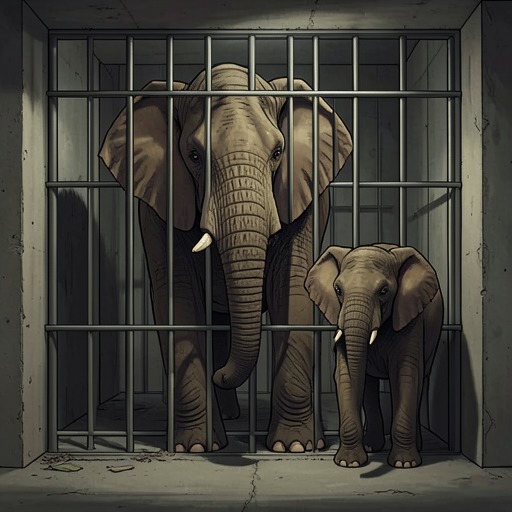
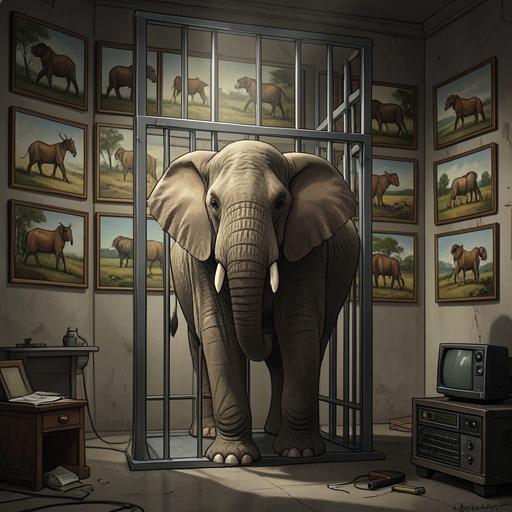
The One and Only IvanArt as expression and communication is both a private practice and a way to make a message legible beyond the artist’s immediate world. Ivan’s drawings begin with the modest objects available inside his cage, but they eventually become part of an effort to communicate a larger purpose through a billboard. The movement from solitary attention to shared interpretation makes art a form of agency: first a way to inhabit the present, then a way to reach others.
Drawing the World at Hand
Ivan’s subjects are not imagined landscapes but the scraps and remains that fill his days: an apple core, a banana peel, and a candy wrapper. He draws the same kinds of things repeatedly, sometimes choosing a subject he has already eaten. The limitation is concrete: his surroundings supply the material. Yet repetition does not make the practice dull for him. Drawing holds his attention so completely that he stops thinking about his location, the past, or what comes next. The paper and crayons offer a narrow but real interval in which confinement recedes from thought.
The contrast with Julia clarifies how differently the two artists work. Her pictures invent smiling clouds and swimming cars, while Ivan draws recognizable things in his cage. He regards his own work as pale and timid beside hers, but the difference is not simply a measure of skill. Julia draws ideas from her mind; Ivan attends to what is immediately present. His art gives ordinary, easily overlooked objects sustained attention. In that sense, its apparent simplicity is also its subject: a banana peel becomes worthy of looking at because he chooses to draw it.
Private Attention and Inner Quiet
Ivan does not initially make pictures to satisfy a human audience. People squint at his drawings and mistake a banana for something else, such as an airplane or a wingless duck. Their misreadings establish a gap between making an image and controlling what viewers see in it. Ivan accepts that gap because their recognition is not the reason he draws. The practice matters to him even when its subject is misunderstood.
When Ruby asks why he loves drawing, Ivan identifies an effect he has not previously described to anyone: while making a picture, he feels quiet inside. Ruby considers quiet boring, and Ivan’s answer—that quiet is not always boring—keeps the exchange small rather than turning it into a lesson. The scene nonetheless gives art a precise inward function. It is not presented as escape into a fantasy world; Ivan has already said he does not remember his dreams. Instead, drawing concentrates his attention on the movement of crayon across paper and briefly stills the thoughts that attach him to place and time. His slight puffing of his chest as he identifies himself as an artist also marks a modest assertion of identity: drawing is something he loves and claims as his own.
From Promise to Work
Art changes its reach when Ivan decides how to keep a promise. After remembering Ruby’s account of villagers rescuing her and recalling Stella’s belief that humans can surprise others, he looks at his fingers coated with red paint and understands what he must do. The narrative then sets waiting and making against one another: during the days he waits; during the nights he paints. The repeated division of time makes the work a sustained undertaking rather than a single expressive gesture.
The process is painstakingly incremental. Ivan closes his eyes, dips his fingers into paint, and sets each finished sheet aside to dry. A sheet is small, and he knows he will need many. These details make the scale of the task visible through its units: one sheet at a time, repeated across nights. At the same time, Ruby is no longer resisting Mack and does what he asks. The paintings therefore take shape while the situation Ivan hopes to change remains in place. Art is not itself an immediate release; it is the deliberate preparation of a message that may travel beyond the enclosure.
Images That Become a Message
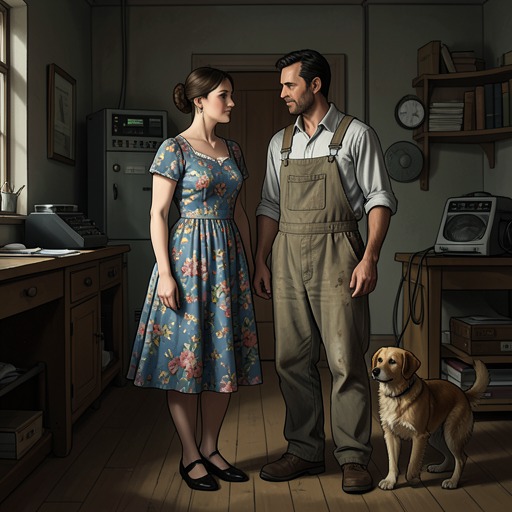
The transition from private work to communication depends on Julia’s ability to interpret and arrange what she sees. George initially sees many blobs and occasional swirls. Julia, however, kneels to straighten the pictures, recognizes an H, and places another image where it belongs, identifying an E. As she moves the sheets around, she understands that they form a puzzle: a word, perhaps several words, and a giant picture. The images do not communicate through one isolated sheet. Their meaning depends on arrangement, attentive looking, and another person’s participation.
Julia then proposes a billboard, a scale of display large enough to match the idea she believes Ivan has communicated. George questions how she knows what Ivan wants, while Julia answers through their shared identity as artists. The scene presents communication as more than direct speech: Ivan’s work reaches Julia through visual form, and Julia turns her reading of it into a public plan. That outward use does not cancel the earlier purpose of drawing for himself. Rather, the same practice that gave Ivan quiet and focus becomes capable of carrying intention to other people. Art in the novel thus joins private attention to collective action, while leaving the act of interpretation essential to the passage between them.