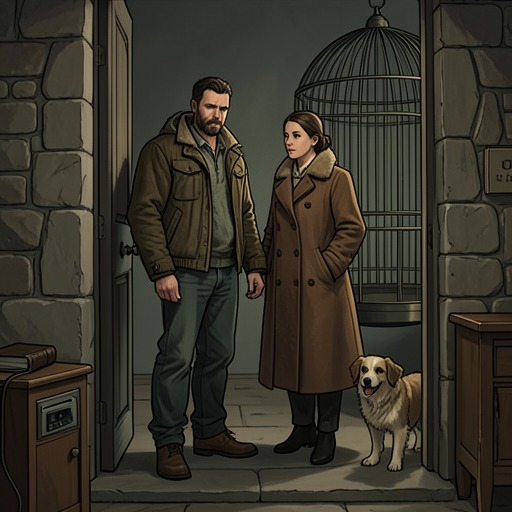
Dog
The One and Only IvanDogs occupy more than one place in the book’s world: they can be performers kept by Mack, but they can also survive on their own terms. Bob, the stray dog who becomes Ivan’s dearest friend, embodies that tension. He makes a home wherever he chooses, evades the mall workers who try to catch him, and later accepts a practical role in Julia’s family’s life without simply becoming another animal under Mack’s control.
Bob’s Place in the Mall
Bob is one of Ivan’s closest friends, alongside Stella, even though Ivan has no gorilla friends. The contrast is telling: within the mall, the captive animals’ nearest companionship crosses species lines. Bob is small, wiry, big-eared, and quick; Ivan compares his appearance to a barking squirrel and his tail to weeds moving in the wind. More important than his size is his ability to slip through cracks and crevices, a skill that lets him remain beyond the mall workers’ grasp.
Bob has no permanent address. He lives off discarded food, pulling hot-dog ends from the trash and licking up spilled lemonade and melted ice cream. Ivan tries to share his own food, but Bob is a picky eater and prefers to hunt for himself. When Ivan worries that eating more might bring more visitors and make Mack happy, Bob rejects appetite as the source of the problem. He hops onto Ivan’s chest and checks his chin for leftovers, turning a serious conversation into an affectionate, comic routine. Their closeness is practical as well as emotional: Bob can settle on Ivan without disturbing him, and Ivan once stays still through the night rather than wake the sleeping dog.
Independence and the Idea of Home
Bob’s life is defined by a refusal to equate shelter with belonging. When Ivan asks why he does not want a home, Bob answers that everywhere is home and describes himself as wild, untamed, and undaunted. The response distinguishes his freedom from Ivan’s enforced residence in a glass-and-metal domain. Bob can move through the mall’s overlooked spaces; Ivan cannot leave his enclosure. Their friendship does not erase that difference, but it lets Ivan encounter a form of animal life not organized around human ownership.
Ivan imagines that humans favor dogs because a puppy would be easier to cuddle than a gorilla. Bob’s independence resists that comforting picture of dogs as naturally domestic companions. Ivan even suggests that Bob could join the shows, like Snickers, the poodle who rides Stella. Bob points out the life that comes with that arrangement: Snickers sleeps on a pink pillow in Mack’s office and eats foul-smelling canned meat. His disgust makes the apparent comforts of a performer’s place seem like evidence of dependence rather than proof of a good home.
Companionship, Play, and Representation
Bob and Ivan share the mall’s old television. Both enjoy watching it, though their tastes differ: Ivan likes bright cartoons and slapstick, while Bob prefers professional bowling and cat-food commercials. They also watch romance films together, in which humans embrace and lick one another. Ivan notes the absence of gorillas from those romances; the observation places the friends outside the human stories they watch, even as their shared viewing becomes its own small form of companionship.
Julia’s drawings give Bob another kind of presence. She pictures him racing across the page as a blur of feet and fur, or holding still behind a trash can or against the soft slope of Ivan’s belly. Sometimes she gives him wings or a lion’s mane; once, a tortoise shell. The shifting transformations do not make him less recognizable. Instead, they register the lively variety of how he is seen by Ivan and by the child who draws him. Ivan especially loves these pictures, which place the tiny, mobile dog within a world of imaginative possibility.
Bob at the Turning Point
When humans prepare a transport box for Ivan, Bob remains at Ivan’s side. While the workers attend to the box, he hides behind Ivan’s pool, unnoticed, then sneaks over to lick Ivan’s chin for leftovers. Ivan calls him the One and Only Bob, an affectionate recognition of the dog’s singular identity at a moment when separation is imminent. Ivan also offers Bob Not-Tag, a limp, stuffing-less toy marked with paint. Bob tilts his head in confusion, a brief exchange that makes the coming departure tangible through the small objects and gestures shared between friends.
Bob later appears at the zoo, where he explains that George’s job there has not yet begun. Julia has made an arrangement: she walks three extra dogs to cover Ivan’s food, and all three are poodles. Bob says Julia’s mother likes his company, so he considers the arrangement a favor to everyone—a win-win. The ending changes the circumstances of his independence without cancelling the earlier claim that everywhere can be home. Bob now has a connection to Julia’s family and a task that helps support Ivan, but the account presents the arrangement as his own practical calculation, not as a conversion into a conventional pet.
Significance
The book’s dogs reveal different possibilities within animal life under human care. Snickers’s pink pillow and canned food accompany work in Mack’s shows; Bob’s streetwise survival and chosen companionship offer a contrasting model. Yet the contrast is not simply between a bad domestic life and an idealized wild one. Bob eventually cooperates with people and walks poodles, while retaining the self-description and judgment that set him apart. Through him, the story treats companionship as compatible with agency: friendship with Ivan, affection from Julia’s mother, and useful work need not mean that Bob’s identity is wholly defined by human possession.