Exit 8 Big Top Mall billboard
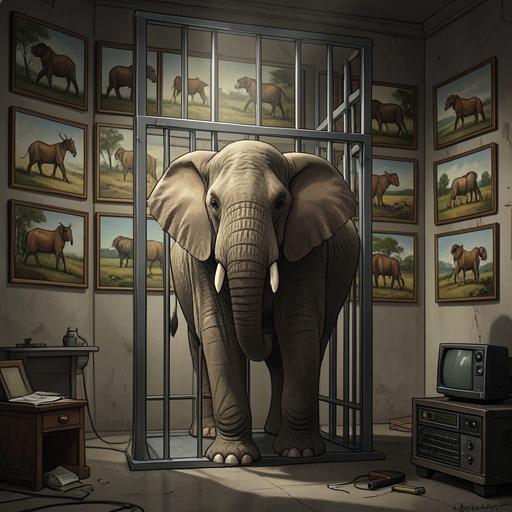
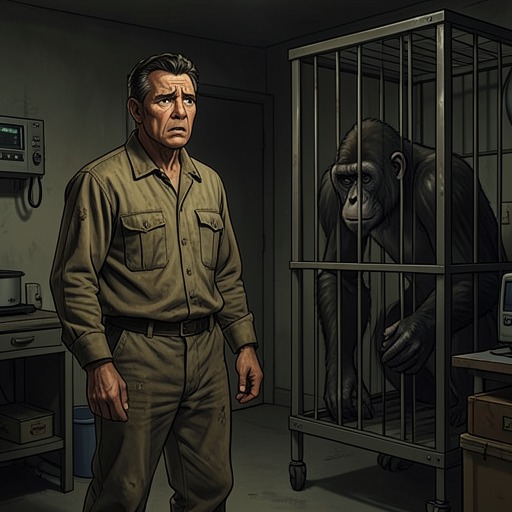
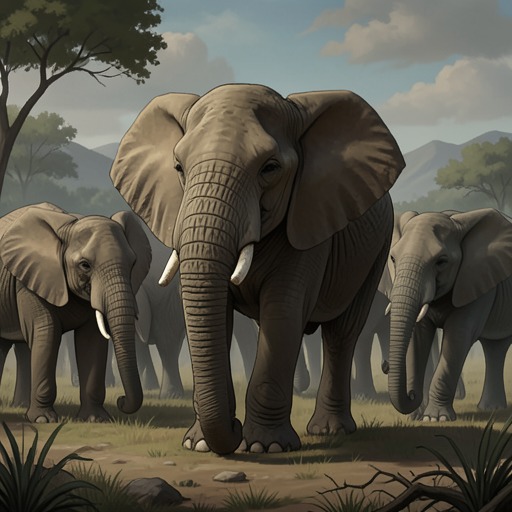
The One and Only IvanThe Exit 8 Big Top Mall billboard is first a roadside invitation to stop at the mall, with Ivan presented as its singular attraction. Over time, pictures of Ruby and Ivan’s own paintings alter what the sign shows and what it can do: it draws visitors, carries Ivan’s art beyond his enclosure, and becomes the public-facing expression of an idea Julia recognizes in his work. Its changing images hold together the tension between advertising the animals as attractions and making their individual presence visible.
Setting and Original Message
The billboard stands at the edge of the freeway beyond the mall’s vast parking lot. From his enclosure, Ivan can see cars streaming past and the giant sign beckoning drivers to stop, an invitation the narration compares to gazelles coming to a watering hole. The comparison makes the sign part of Ivan’s view of a world beyond the mall, but its purpose is practical: to turn passing traffic into visitors.
The sign is faded and its colors have bled, yet Ivan knows its words because Mack once read them aloud. It advertises the “EXIT 8 BIG TOP MALL AND VIDEO ARCADE” as the “HOME OF THE ONE AND ONLY IVAN, MIGHTY SILVERBACK!” The boast makes Ivan the billboard’s central attraction, presenting him through a title rather than through his own account of himself. His inability to read is part of this early relationship to the sign: the message is visible from his domain, but its words reach him through Mack.
Ruby Added to the Advertisement
The billboard first changes when Mack and George climb tall wooden ladders beside the highway. George carries a bucket and a long-handled broom; Mack has pieces of paper. Mack presses a piece against the sign, and George wets it with liquid from the bucket so that it stays in place. They repeat the process with many pieces. From inside the mall, Ivan sees the work through a window, a distant act of construction whose result becomes legible when the two men climb down.
The new addition is a picture of a little elephant: she wears a red hat, has a lopsided smile, and a tail that curls like a pig’s. Ivan judges that she does not look like Ruby—not even like an elephant—and thinks that, despite having known Ruby for only one day, he could have drawn her better. The mismatch matters because the image is supposed to help sell the mall by representing Ruby, while Ivan notices the distance between the pictured creature and the real one. The billboard gains a new animal, but the image still belongs to the logic of promotion rather than to Ruby’s particular appearance as Ivan understands it.
Ivan’s Image and Memory
One morning, with dew glimmering across the parking lot, Ivan sees himself on the billboard, bathed in the pink light of dawn. The picture makes him look angry, with a furrowed brow and clenched fists. Instead of experiencing the image as a simple likeness, Ivan connects it to his father: he says that he looks as his father did on the day the men came. The public image thus brings a private memory into view, linking the advertised silverback to a family history marked by the arrival of men.
Later, Ivan looks at the billboard’s image of himself alongside a faded picture of Stella and recalls Mack and George putting Ruby’s picture there to attract new visitors to the mall. He also remembers Ruby’s story of the villagers who came to her rescue and hears Stella’s belief that humans can sometimes surprise those who doubt them. These memories place the billboard among images and experiences that do not settle into one meaning. It remains an advertisement, but Ivan’s attention to it gathers together Ruby, Stella, his father, and the possibility that human actions may differ from what the sign’s commercial purpose suggests.
From Promotion to Public Display
A later shift begins not with the billboard itself but with Julia looking closely at Ivan’s paintings. She realizes that the work is meant for a billboard and tells George that the idea is “Billboard big.” The recognition gives Ivan’s art a destination beyond the paintings’ earlier setting: his images can be placed where passing drivers, rather than only people inside the mall, will encounter them.
When a newspaper prints a photograph of the new billboard, Mack tapes the story to Ivan’s window. More curious people arrive. They park in front of the sign, point, shake their heads, and take photographs before entering the mall and buying Ivan’s paintings. The billboard now draws attention not only to the promise of seeing the “One and Only Ivan,” but also to pictures made by Ivan himself. That attention has a direct commercial consequence: the paintings become goods for the gift shop, and Ivan’s framed pictures are priced at sixty-five dollars.
The images keep accumulating. While visitors watch, Ivan paints trees with birds, a newborn elephant with glittering black eyes, a squirrel, a bluebird, and a worm. He paints Bob as well, making a portrait for the billboard that Bob likes, though he objects that his distinguished nose has not been quite captured. Each afternoon, Mack and George add Ivan’s new pictures to the sign; drivers slow down, honk, and wave as they work. The billboard remains an instrument for bringing people to the mall, but its changing surface also displays a widening range of Ivan’s attention and skill. Its significance lies in that unresolved change: a sign designed to make animals attractions becomes a place where Ivan’s own images can reach the public.