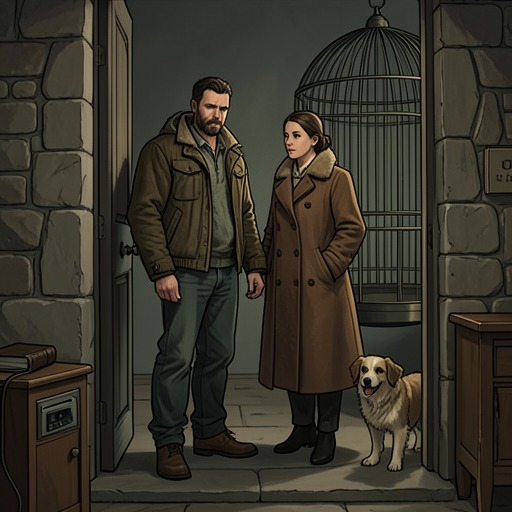
George and Julia
The One and Only IvanGeorge and Julia’s father-daughter relationship is a quiet source of care in the mall and a decisive force in Julia’s campaign to help Ruby. George provides structure and protection while the family faces illness and financial uncertainty; Julia, in turn, presses him to recognize the needs of others and helps turn his hesitation into action. Their bond is revealed through small routines as much as through crisis, with Ivan observing how affection and responsibility meet in the choices they make together.
Family Life and Nightly Routine
George cleans the mall at night, and Julia stays near Ivan’s domain although she could sit elsewhere, including by the carousel, in the empty food court, or on the sawdust-coated bleachers. Ivan notes that Julia always chooses his company and understands their shared love of drawing as part of the reason. Her willingness to remain beside him gives the father-daughter relationship a setting beyond the family home: while George works, Julia makes a place for herself among the mall’s animals and spaces.
Julia’s mother once helped clean the mall too, but after she became sick, pale, and stooped, she stopped coming. Julia repeatedly offers to help her father with his work. George firmly redirects her to her own responsibilities, telling her, “Homework, Julia. The floors will just get dirty again.” His answer is practical and protective: the cleaning can be repeated, while Julia’s homework is worth her attention. The exchange also shows that she is eager to share the burdens of the household, even when George insists on keeping those burdens from her.
The contrast between them is affectionate rather than adversarial. Julia wants to help with the work she sees immediately in front of her; George tries to preserve space for her childhood and education. Ivan’s amused attention to homework—its sharp pencil, thick books, and long sighs—adds a gently comic perspective to this household routine, while the pencil Julia uses to draw becomes one small point of connection between her interests and Ivan’s.
Care in a Moment of Illness
Julia’s attentiveness extends beyond her father. When she notices that Stella is lying in dirty hay and breathing raggedly, Julia calls George over from his cleaning work and asks him to look at her. She asks whether Stella is all right and whether they can call Mack, insisting that something is seriously wrong. The scene shows Julia using her father not simply as an authority but as the adult she turns to when an animal may be in danger.
George sets aside his mop in response to her call. The relationship’s care therefore works in both directions: Julia identifies the urgent change in Stella’s condition, and George stops his routine to attend to the concern she has raised. The scene anticipates their later disagreement over Ruby. Julia’s compassion is already expressed as action—notice, call, ask for help—while George’s response begins with listening and making room for her alarm.
Persuasion and Shared Action
When Julia asks George to help put Ivan’s picture on a billboard, he initially refuses. She clasps her hands and begs him, but he says there will be no billboard. Julia explains that she and Ivan are artists, then turns the request toward Ruby’s situation: even if the sign cannot guarantee change, people might see that Ruby does not belong in the mall and choose to help. Her argument does not claim certainty; it asks her father to accept the possibility that public attention could matter.
George questions whether a sign would change anything. Julia answers that she is not sure, but that uncertainty does not end her appeal. She reminds him that Ruby is still a baby and asks whether he wants to help her. When George remains unconvinced, Julia raises the possibility that Ruby could end up like Stella. George looks at Ivan, Ruby, and Julia, then drops Mack’s claw-stick and tells her where the ladder is. His decision is a concrete reversal: the same father who had rejected the plan now supplies the means to carry it out. Julia’s plea has made the risk to Ruby immediate, and George’s concern becomes practical assistance.
Work, Insecurity, and Parting
The family’s economic vulnerability becomes explicit when George is fired by Mack. On what Julia calls her last night with Ivan, George gathers his tools and belongings instead of getting his mop and broom. Julia tells Ivan that the zoo woman may have an opening for her father later, cleaning cages, but the possibility is uncertain. Her farewell to Ivan takes place alongside the loss of the work that has structured George’s nights at the mall.
Julia worries about what will happen to Ivan if Mack closes the mall entirely, and George says Mack intends to try keeping it open without the animals. George is also worried about Bob, whom he describes as a survivor. Julia immediately imagines a way to help: Bob could live with the family, whose mother loves dogs, and keep her company. George answers that he may not yet have a job and may not be able to feed Julia, let alone another dog. Julia offers her dog-walking money. The exchange leaves no confirmed outcome for Bob, but it shows the daughter proposing care even as her father tries to reckon honestly with their limited means.
The Relationship’s Significance
George’s care is expressed through boundaries, work, and caution; Julia’s through attention, appeals, and proposals. Their differences become most visible when she asks him to act for Ruby. George does not accept the billboard campaign because he is certain it will succeed; the evidence shows that he doubts its effect. He changes course after Julia makes Ruby’s possible fate vivid, and his action—dropping the claw-stick and agreeing to fetch the ladder—shows that his hesitation can yield to compassion.
Their relationship is not presented as a simple reversal in which the child teaches and the parent merely follows. George continues to protect Julia, redirecting her toward homework and speaking plainly about the family’s uncertain income. Julia, however, is not kept outside the household’s moral and practical decisions: she notices Stella’s distress, argues for Ruby, and offers her earnings toward Bob’s care. Through Ivan’s observations, the father and daughter emerge as a family negotiating how to care for one another when both work and security are precarious. Their bond makes Julia’s concern consequential: she can call George into action, and he can answer her with more than reassurance.