Glass Wall
The One and Only IvanThe Glass Wall is a physical boundary in Ivan’s life at the Big Top Mall and a daily lesson in separation: people can come close enough to leave marks, but the barrier decides what kind of contact is possible and whose presence lasts. Ivan’s account makes the wall more than part of an enclosure. Its surface records the brief encounters of visitors, while his own presence can be erased; later, the contrast between an impermanent noseprint and a handprint in paint gives that difference a new form.
The Wall as Boundary and Declaration
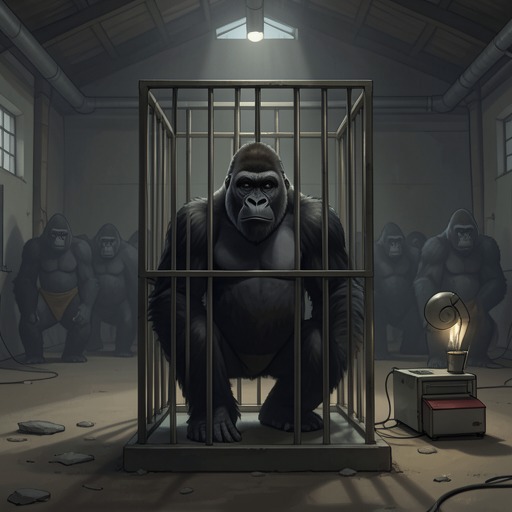
At the mall, Ivan’s enclosure stands at one end of the central ring. He says he lives there because he is too much gorilla and not enough human. The Glass Wall makes that division tangible. Visitors press their hands against it from inches away, near enough to face him but still held apart by the surface. In Ivan’s understanding, the glass turns separation into a rule: humans belong on one side, animals on the other, and the arrangement appears permanent.
The wall also determines what Ivan’s days contain. His life is filled with flashing lights, pointing fingers, and visitors who arrive without invitation. The proximity of the crowd does not mean companionship or shared space. Instead, the barrier permits people to watch and gesture while keeping Ivan enclosed. The visitors’ hands flatten against the glass, but their nearness cannot undo the division it enforces. The wall is therefore not simply a limit on movement; it organizes who may approach, who may observe, and who remains contained.
Fingerprints, Noseprint, and Erasure
The glass gathers traces of those encounters. Visitors leave fingerprints sticky with candy or slick with sweat, and each night a weary man comes to wipe them away. The cleaning repeats the boundary’s daily operation: human contact appears on the surface, then disappears before the next round of looking and touching. The marks do not change the separation between visitor and animal; they are temporary evidence that the two came close to the same wall.
Ivan sometimes presses his nose against the glass. His noseprint resembles a human fingerprint in being singular, but its place on the surface does not grant it equal permanence. The man wipes the wall, and Ivan describes himself as gone. The image gives the routine of cleaning a sharper consequence: what remains of Ivan’s contact can be removed along with the marks of the visitors. The scene does not present the glass as a neutral screen. It is the surface on which the difference between being able to leave a trace and being allowed to keep one becomes visible.
A Mark That Cannot Be Wiped Away
When Ivan begins making art with paint, the handprint offers a counter-image to the marks on the wall. He first places a finger on paper and sees a red mark; then he takes a larger glob of paint and presses his hand down, leaving its red twin on the page. He recognizes that this is unlike the ghostly handprints visitors leave on his glass. The painted print cannot be wiped away so easily.
The contrast rests on the material and on who makes the mark. On the glass, visitors’ fingerprints are temporary, and Ivan’s noseprint is removed by the nightly cleaning. On paper, Ivan’s painted hand becomes a lasting image. The change does not open the barrier or reunite the two sides, but it gives Ivan another way to leave evidence of himself. The handprint turns a familiar gesture of contact into an act of making: rather than pressing against a surface that separates him from others, he creates a mark that can remain after his hand lifts away.
From Glass to the Walls Beyond
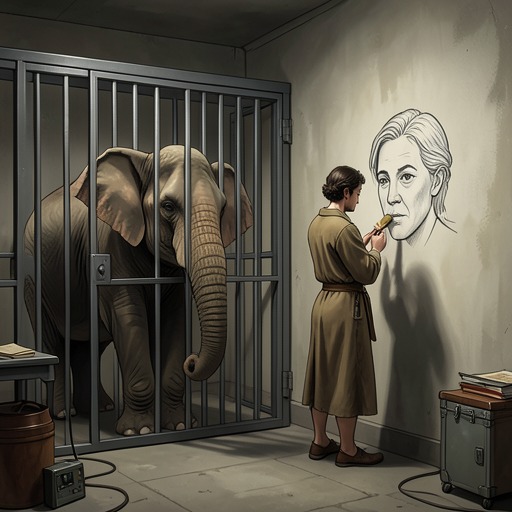
The novel later places the glass barrier within a wider pattern of enclosure. At one point, Ivan’s cage door is propped open, but an enormous box has been moved against the doorway and opened. The apparent invitation to leave leads directly into another human-made container. The scene is not the same as the Glass Wall, yet it sharpens the problem the wall represents: a boundary may change form without making movement genuinely free.
At the zoo, Ivan explores a hill and encounters a high, wide, clean wall stretching toward the habitats beyond his own. It is built to keep the animals in and others out, and Ivan still recognizes the place as a cage. This wall is not identified as glass, so it should not be confused with the mall’s transparent barrier. Its significance is the recurrence of the enclosing boundary in a new setting. The zoo offers a different landscape, with grass under Ivan’s knuckles and a hill to explore, but the wall remains a material limit on where he can go.
Together, these scenes make the Glass Wall part of the book’s larger attention to how spaces divide and constrain animals. At the mall, the transparent surface exposes the division by letting visitors approach and leave marks while Ivan stays enclosed. In the painted handprint, he answers erasure with an image that endures; in the box and the zoo wall, the novel shows that leaving one boundary does not by itself abolish confinement.