Gorillas
The One and Only IvanGorillas in Ivan’s account are not merely imposing bodies displayed for human attention: they are family members with distinct bonds, a social order, and a need for protection. The contrast between Ivan’s remembered life in a forest troop and his solitary enclosure at Exit 8 Big Top Mall makes that difference central. His experience gives the novel’s portrayal of Gorillas both physical force and an inward, relational point of view.
Identity and Physical Presence
Ivan introduces himself as a gorilla and describes having once been wild while still looking the part. His appearance combines a shy gaze and sly smile with the snowy saddle of fur associated with a silverback. In sunlight, that coat and his size cast a majestic shadow; at four hundred pounds, his outstretched arms span wider than the tallest human. The details establish a body that people might read as made for battle, even though the narrative distinguishes appearance from temperament.
That mismatch is visible in the image on the freeway billboard: its angry animal is meant to be Ivan, but the picture’s fierceness is a mistake. Ivan says he is never angry. For him, anger has a particular social purpose: a silverback uses it to maintain order and warn his troop of danger. His father’s chest-beating communicated that he was in charge and angry in order to protect the group. The billboard turns a protective signal into a marketable look of menace, while Ivan’s explanation restores its meaning within Gorilla family life.
Ivan also places Gorillas within a wider kinship that unsettles the human boundary between species. He identifies himself as a great ape and includes humans, chimpanzees, orangutans, and bonobos among distant, distrustful cousins connected across time and space. His dry acknowledgment that this connection may be troubling refuses to make human beings the unquestioned measure of animal life. The kinship is real in his account even when humans behave, from his perspective, like ill-mannered clowns.
Life in a Troop
Ivan’s memories begin in a dense rainforest in Central Africa, a place he considers too beautiful for crayons to capture. Gorilla parents do not name newborns immediately: they first get to know their babies and wait to see hints of who they may become. Ivan and his twin sister are the youngest members of their group. His parents name her Tag because she loved chasing him through the forest. Naming, in this recollection, follows attention to a young animal’s character and relationships rather than preceding them.
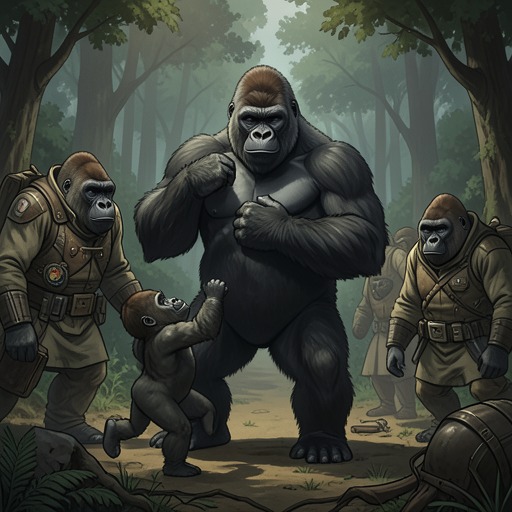
The troop consists of ten Gorillas: Ivan’s father, the silverback; his mother and three other adult females; a juvenile male called a blackback; and two other young Gorillas, alongside the twins. Its members sometimes squabble, but Ivan remembers an ordinary rhythm of feeding, foraging, napping, and playing. His father guides the group to ripe fruit for morning meals and good branches for night nests. Leadership is shown through practical care as well as authority: the silverback is guide, teacher, and protector, and a scowl can be enough to settle the young ones.
This remembered order also clarifies Ivan’s account of his own anger. The silverback’s power is not presented simply as dominance; it is tied to responsibility for other members of the troop. In the mall, by contrast, Ivan says there is no one to protect in his domain. The absence is more than a lack of company: it marks the loss of the social purpose that gave his father’s authority and strength their meaning.
Captivity and Isolation
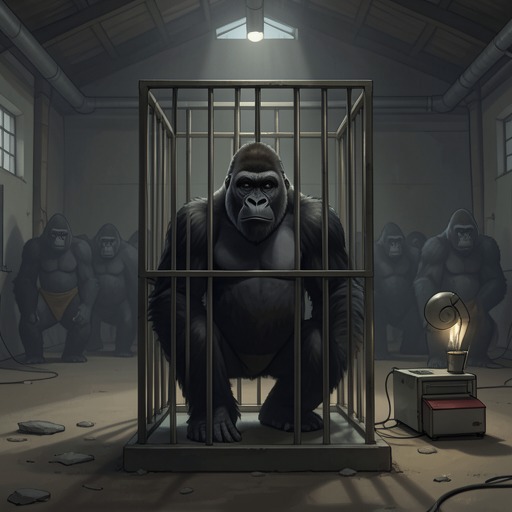
At Exit 8 Big Top Mall and Video Arcade, Ivan lives at one end of the performance ring. Stella’s domain is next to his, and she and Bob are his dearest friends, but he has no Gorilla friends. He explains the separation by saying that he is too much gorilla and not enough human. The mall’s ring, with benches for customers and sawdust on the floor, makes his living space part of a human commercial setting; his use of the word “domain” does not erase the isolation within it.
The gap between remembered troop life and the mall is particularly stark in Ivan’s account of protection. In the forest, his father’s strength served a group whose members fed, rested, and played together. In the enclosure, Ivan’s body remains powerful, but the troop that would give that power a protective role is absent. The billboard’s fierce version of him cannot represent this condition: it displays strength as an attraction, while Ivan’s own explanation measures it against the responsibility he no longer has anyone to exercise it for.
Recognition Through Images
A television image first gives Ivan a glimpse of another Gorilla. The screen shows a lush forest, moving grass, rustling trees, and birds; then a threadbare, scrawny Gorilla appears before the program cuts to other animals. Ivan spends the night wondering where that Gorilla lives, whether he might visit, and whether there could be a female Gorilla as well. The encounter makes his lack of Gorilla companions newly palpable: another life becomes imaginable, but remains beyond the screen.
Later, Ivan watches a nature program without human voices or advertisements. It shows Gorillas eating, grooming, play-fighting, and sleeping. The group on the screen is small and unlike the troop in his memories: three females and a juvenile male, with no silverback to protect them. Ivan sees them groom one another, eat, and sleep, and describes them as contented and good-natured, though they bicker at times. The repeated acts of care and daily routine matter as much as the more dramatic images of play-fighting. These are lives being lived, not a performance staged for the mall’s customers.
When a string is pulled, Ivan sees three females and a juvenile male—the family he has been watching—no longer confined to the television screen. The recognition changes the image from distant spectacle into immediate presence. The account supplied here ends at that sight, without detailing what follows; its force lies in the crossing of a boundary that had separated Ivan from the Gorilla lives he could only observe.
Welfare and the Meaning of a Home
The novel also places Gorilla welfare within human inspection and relocation procedures. A man with a clipboard checks the property, including Ivan’s floor, Ruby’s hay, and the animals’ water bowls. A week later he returns with a woman in a white coat, who watches Ivan and Ruby before speaking with the inspector and Mack. Afterward, the woman returns with other people and a large box sized for Ruby. Ivan realizes that she has come to take Ruby away. Later, while Bob watches from Ivan’s belly, four men place a metal box in the ring that is sized for Ivan.
These checks and boxes make the animals’ treatment materially visible: floors, food, water, observation, and the means of transfer all become part of their circumstances. The evidence does not present inspection as the whole of Gorilla life or establish every later outcome, but it sets human oversight against the animals’ own needs and relationships. Across forest memory, enclosure, television, and encounter, Gorillas emerge as social beings rather than props: their significance rests not only in the strength humans notice, but in the family ties and protective care that strength can serve.