Home of the One and Only Ivan, Mighty Silverback!
The One and Only IvanHome of the One and Only Ivan, Mighty Silverback! is first a slogan that sells the Exit 8 Big Top Mall and Video Arcade by making Ivan its advertised attraction. Repeated in moments of doubt by Bob and finally whispered by Ivan at the zoo, the phrase changes from a public claim about a captive performer into a hard-won affirmation of identity and belonging.
The billboard and its borrowed words
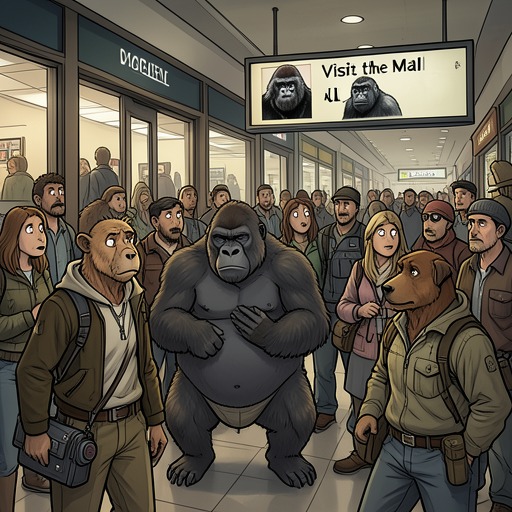
The phrase appears on a giant sign beyond the mall’s treeless parking lot, beside a freeway where cars pass without end. Its colors have faded and bled, but the words remain legible to Ivan because Mack once read them aloud: “COME TO THE EXIT 8 BIG TOP MALL AND VIDEO ARCADE, HOME OF THE ONE AND ONLY IVAN, MIGHTY SILVERBACK!” The wording joins a commercial invitation to a grand claim of uniqueness. Ivan is presented as the mall’s draw, and his identity is packaged as part of the place’s name and appeal.
That arrangement is especially pointed because Ivan cannot read. He wishes he could, imagining stories as a way to fill empty hours, and recalls having enjoyed a book left in his domain. Yet the billboard’s words reach him through Mack’s voice rather than through reading. The slogan is something spoken over the space he inhabits: a declaration designed for passing motorists that becomes lodged in Ivan’s memory. The title’s promise of a home is therefore double-edged. It calls the mall Ivan’s home while describing the setting where he is confined.
Bob makes the slogan an affirmation
Later, Ivan cannot sustain the identity the billboard advertises. He tells Bob that he should not have made a promise and admits that he wanted to make Stella happy. Pointing toward Stella’s domain, he says he cannot save Ruby and cannot even save himself. The admission reduces the mighty public image to a painful contrast: the animal promoted as a powerful, singular silverback feels unable to protect anyone, including himself.
Bob answers not with an argument about what Ivan can accomplish, but by making him repeat who he is. He leaps onto Ivan’s belly and calls him “the One and Only Ivan” and “Mighty Silverback.” When Ivan does not respond, Bob orders him to say it; when silence continues, he licks Ivan’s nose until Ivan gives in. Ivan mutters, “I am the One and Only Ivan.” Bob insists that he must not forget. The exchange turns the billboard’s grand language into an intimate act of encouragement: Bob treats the name not as advertising, but as an identity Ivan must be helped to reclaim. The cold cement still hurts Ivan, and the moon Stella loved is hidden by clouds, so the affirmation does not erase grief or helplessness. It gives him words to hold against them.
The slogan returns as a remembered voice
The billboard remains present even when Ivan is no longer reading its physical message. Looking out his window, he hears Mack’s voice in his head repeating the full advertisement and counts to twelve, then counts again. The recurrence links the public slogan to Ivan’s private concentration. The passage offers no explicit explanation for the counting, so it does not settle what the exercise means; it does show that Mack’s once-spoken words continue to echo in the mall, alongside Ivan’s effort to attend to a single word.
The repetition also shifts the phrase’s force without changing its wording. On the sign, “home” belongs to the mall’s pitch to motorists, and Ivan’s name is part of the attraction being sold. In Bob’s mouth, the title becomes a reassurance offered to a friend who has confessed failure. The same language can therefore serve two very different relationships: the mall’s public presentation of Ivan and Bob’s personal insistence that Ivan remain present to his own worth.
From public title to chosen belonging
At the zoo, as the visitors turn to leave and the pathway lamps blink on, Bob calls to Ivan from Julia’s backpack: “You are the One and Only Ivan.” Ivan nods and turns toward his family, his life, and his home. He then whispers, “Mighty Silverback.” The ending gives the phrase a changed setting and a changed speaker. Ivan no longer repeats the whole billboard invitation, and the title is no longer only something Mack has read or Bob has urged him to say. Ivan speaks the closing words himself.
That final whisper does not simply restore the mall’s boast. The narrative places it after Ivan has found a family and a home at the zoo, so the old language of being singular and mighty now accompanies a different reality of belonging. The movement from billboard to remembered voice, from Bob’s command to Ivan’s quiet reply, is the expression’s central development. A name once used to advertise where Ivan was kept becomes a phrase through which he can recognize where his life is now.