Human Contradictions
The One and Only IvanHuman Contradictions is a recurring tension in Ivan’s understanding of people: humans can impose captivity and separation, yet also act with compassion and help repair harm. Through the stories of Ruby and Stella, and through Ivan’s changing experience of enclosure, the novel refuses to treat humans as either wholly cruel or reliably benevolent. Their capacity to harm does not cancel their capacity to help; neither does one rescue make confinement disappear.
Captivity and the Human Boundary
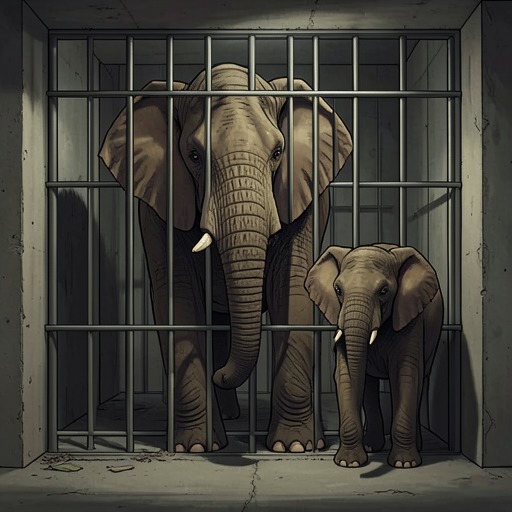
At the Exit 8 Big Top Mall and Video Arcade, Ivan describes his enclosure as a domain, but its defining condition is separation. He says he lives there because he is too much gorilla and not enough human, and notes that he has no gorilla friends. The language of a domain gives an imposed living space a name, while the reason for his confinement reveals the boundary beneath it: Ivan is being held apart because he is not human.
The glass makes that division visible. Visitors stand inches away and press their hands against the wall, while Ivan’s life is filled with flashing lights, pointing fingers, and unwelcome attention. The glass seems to declare that humans and animals belong to permanently separate sides. Its transparency allows people to look at Ivan without sharing his space; closeness becomes a spectacle rather than contact. The nightly removal of visitors’ fingerprints further underscores how routinely human presence marks the barrier while leaving the separation intact.
That arrangement complicates Stella’s description of a good zoo as a large, safe place with room to roam and humans who do not hurt. Her account proposes that people can make amends by creating safer places for animals, but Ivan’s own description makes clear why the word domain can be inadequate: a named enclosure remains a place from which an animal cannot simply choose to leave. The contrast does not make care meaningless. It makes the question of what care requires more exacting.
Ruby’s Rescue and the People Who Harm
Ruby’s account of falling into a human-made hole first seems to confirm Bob’s suspicion that people bring animals to harm. The hole was near a village, and Ruby does not know why humans dug it. Bob assumes that, after she became trapped, people captured her, put her in a box, and sent her away, as they had done to Stella. His conclusion reflects the evidence of captivity around him, but it is not what happened at the hole.
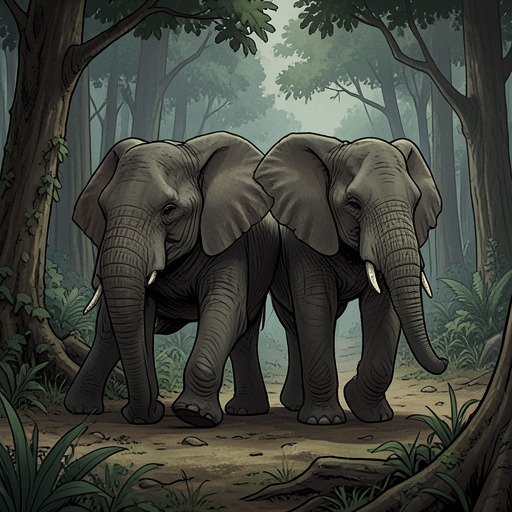
Ruby corrects him: villagers organized to pull her out with ropes. The entire community took part, including children and older villagers. After she was freed, people cheered and gave her fruit; then they helped her find her family, a search that took the whole day. The distinct steps matter. The people do not merely discover Ruby or offer comfort at a distance: they work together to free her and return her to her family. Her story gives human cooperation a concrete outcome, even though it does not undo the danger that began with the hole.
Bob remains doubtful, and his question about why Ruby is now at the mall exposes the harder contradiction in her history. Ruby answers that bad humans killed her family and sent her to the mall, while the humans at the hole saved her. She does not let the rescuers stand in for all people, or let her captors erase what the rescuers did. Her distinction is ethical rather than abstract: people must be judged by what they do, and the same species can be responsible for opposing acts.
Stella’s Account of Making Amends
Stella offers another way to think about the possibility of human care. In a story about a boy visiting a gorilla family at a zoo, she describes a good zoo as a safe place where humans do not hurt the animals, and says that such a place can be a way for humans to make amends. The idea is hopeful, but it is not a claim that every human space is safe. Stella’s careful qualification—good zoo—makes humane treatment a standard to be met, not an automatic property of a place called a zoo.
Her story also turns the usual human perspective around. The boy watches and points at the gorillas, then loses his balance and falls into their enclosure. Ivan jokes about human clumsiness, but the reversal briefly makes the human visitor the one inside the enclosure. It throws the division between observer and observed into view: people who ordinarily watch animals from outside can themselves become vulnerable within an animal’s space. Stella’s account makes room for empathy, while the language of a safe place keeps attention on how the enclosure is governed and whether its inhabitants are protected.
Memory, Promise, and the Limits of Change
Ruby’s rescue story returns to Ivan later as more than an account of the past. Looking at the billboard image of himself, and remembering how George and Mack had added Ruby’s picture to attract visitors, Ivan recalls the villagers who helped her. He also remembers Stella’s assurance that humans can surprise animals. With his fingers coated in red paint, he understands how to keep his promise. The sequence links a remembered act of human kindness to Ivan’s own decision to act; the possibility of good action is not only something he observes in people, but something that informs his response.
The meaning of escape and safety remains unsettled when the door to Ivan’s enclosure is propped open. A large box has been moved against the doorway, so walking through his open door means entering the humans’ box. The opening is real, but it does not yet amount to unconfined movement: the route out of one enclosure leads directly into another. The scene gives physical form to the difference between an invitation to move and actual freedom.
After reaching the hilltop at the zoo, Ivan finds a long, carefully built wall separating habitats and keeping animals in and others out. He recognizes that this, too, is still a cage. The new surroundings offer grass, space to explore, and experiences fresh to him, but the wall prevents the move from being mistaken for freedom without limits. Human care can change the conditions of captivity and create room for safer lives; in Ivan’s account, it does not make the structures of confinement vanish. That unresolved contrast gives the theme its force: compassion is possible, consequential, and still not the same as release.