Ivan and Julia
The One and Only IvanIvan and Julia’s relationship grows through art: a crayon and paints pass through a break in Ivan’s glass, while Julia learns to read meaning in pictures that others dismiss as blobs. Their shared practice becomes more than companionship. When she recognizes that Ivan’s scattered paintings form a message intended for a billboard, their artistic understanding gives his plea for Ruby a possible route beyond the enclosure.
Identity and First Connection
Julia is ten years old and the daughter of George, the weary man who cleans the mall each night. Ivan sees a likeness between them that is not simply a matter of age or circumstance: both are great apes, and both are artists. The book establishes their bond through this shared identity and through the attention Julia gives to the world around her. She watches before she draws, treating observation as a way to understand what she sees.
Julia first reaches Ivan through small gifts. She gives him a stuffed toy gorilla with empty eyes and floppy limbs, which he sleeps with every night and names Not-Tag. The name recalls Tag, Ivan’s twin sister, giving the toy a private connection to his memory as well as a place in his daily life. Julia does not need to explain the gift’s meaning for it to become important: Ivan keeps it close, and it joins the relationship to a history he carries from before the mall.
Their exchange of art materials begins when Julia slips a stubby blue crayon and folded paper through the broken spot in Ivan’s glass. Ivan has watched her draw and understands what to do with the crayon; as he drags it across the paper, it leaves a blue trail. The exchange is modest in scale, but it crosses a barrier that otherwise separates them. Julia supplies the tools, and Ivan responds by making marks of his own.
Art as a Shared Language
Julia’s drawings are described as full of color and movement, populated by impossible images such as smiling clouds and swimming cars. She draws until her crayons break and her paper rips. Ivan’s attention to this work helps establish that his artistic practice develops in relation to hers, though their pictures do not need to look alike to connect them. Julia’s drawings show what sustained looking can produce; Ivan’s marks will later ask her to look just as carefully.
The exchange also includes Julia’s own work. When she begins to crumple a sheet, she changes her mind and slides it into Ivan’s enclosure through the break in the glass. Ivan gingerly picks it up and does not eat any of it. The gesture makes the paper a keepsake rather than a disposable object or food, and his careful handling answers Julia’s act of sharing. On another visit, she brings three jars of finger paint—yellow, blue, and red—and more paper, pushing each jar through the opening. Their artistic connection thus develops through tangible exchanges, not through conversation alone.
Julia’s way of looking at others appears in her drawing of Bob, the small dog who hides from mall workers. She watches him for a long time, chewing her thumbnail, before drawing him curled in a corner of Ivan’s enclosure. Her picture catches both his cleverness and a wistful quality in his gaze. The marks beneath the drawing turn out to be his name: George recognizes Bob in the picture, while Julia explains that she had to draw him first. Ivan witnesses an instance of Julia’s art making something recognizable to other people. The scene anticipates her later ability to identify meaning in Ivan’s work.
Reading Ivan’s Pictures
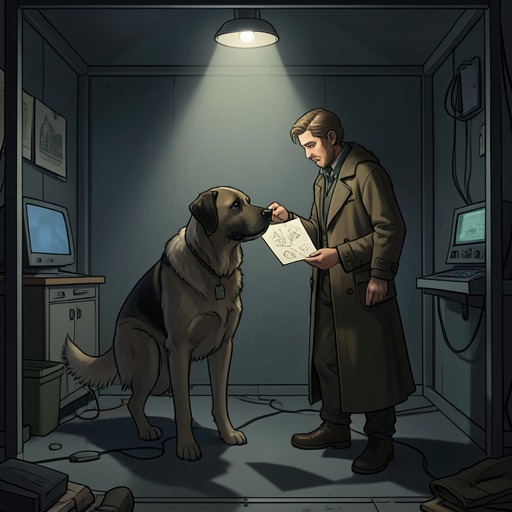
That ability becomes decisive when Ivan’s pictures lie scattered on the floor. George sees blobs and swirls, but Julia freezes, looks down, and begins to rearrange the pages. She identifies an H in one picture and an E in another, straightening and moving the pieces until she sees that they belong together. Her response is not immediate certainty: she examines the marks and tries different arrangements. In that patient process, the artistic attention she has shown while drawing Bob becomes a means of interpreting Ivan.
As the pieces come together, Julia understands that they form a giant image and a word—or perhaps words. A slow smile marks the moment when the possibility takes shape. She then proposes that Ivan’s work belongs on a billboard and recognizes the purpose behind it: he wants the image displayed where people can see it. George questions how she can know what Ivan wants, but Julia grounds her answer in their shared identity as artists. She treats the pictures not as random marks but as communication, and their relationship gives her confidence to act on that reading.
From Artistic Companionship to Advocacy
Julia’s recognition changes the reach of Ivan’s art. What began with paper and a blue crayon passing through damaged glass now points toward a public sign. She imagines people seeing the message and understanding that Ruby does not belong where she is. Julia does not claim to know exactly what will follow; she hopes that seeing the sign might persuade others to help. Her response makes the partnership practical: she interprets Ivan’s work and begins to consider how to carry its meaning beyond the two of them.
The appeal is also a test of whether artistic understanding can overcome human hesitation. George doubts that even a widely seen sign will change anything. Julia answers by focusing on Ruby’s vulnerability, reminding him that Ruby is still a baby and asking whether he wants to help her. She picks up Mack’s claw-stick and hands it to her father before making that plea. The evidence does not show that Julia can control what the adults or the public will do; it shows her trying to turn the insight she has gained through art into action on Ruby’s behalf.
Significance of the Relationship
Ivan and Julia’s partnership is built on reciprocal acts of attention. Julia gives materials and studies Ivan’s pictures; Ivan makes images and receives her drawings with care. The broken place in the glass makes their contact physically limited, but it also becomes the route through which their artistic exchange takes place. Art does not erase the separation between them; it gives them a way to communicate across it.
Their most consequential connection is Julia’s recognition that Ivan’s pictures can carry an intention others cannot see. Her interpretation leads from private companionship toward a campaign for Ruby, making the artistic relationship a bridge between expression and intervention. Julia’s claim that she understands Ivan because they are both artists is therefore not merely a statement of affinity: it explains why she is prepared to trust the meaning in his work and to help make that meaning visible.