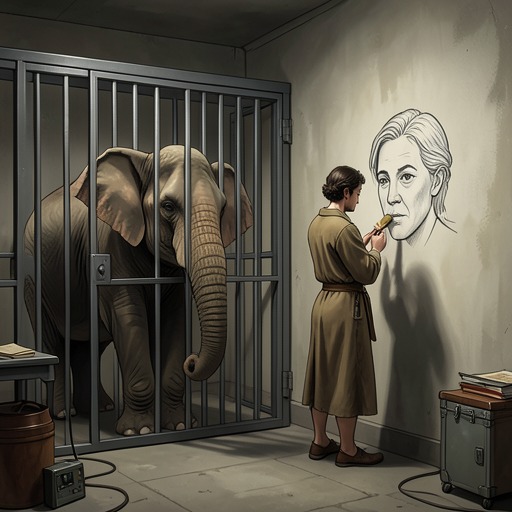
Ivan and Julia launch a billboard campaign to find Ruby a new home
The One and Only IvanIvan and Julia launch a billboard campaign to find Ruby a new home by converting Ivan’s paintings into a public appeal: a zoo, the word HOME, and Ruby’s future beyond the mall. The campaign begins not with a speech but with a painstakingly assembled picture puzzle, and its meaning becomes clear only when Julia looks closely enough to recognize that Ivan is communicating a specific wish. Once the paintings reach a billboard, that private exchange becomes a public argument about Ruby’s freedom.
From a Letter to a Word
Ivan looks out at the billboard carrying Mack’s familiar advertisement for the Exit 8 Big Top Mall and Video Arcade. He counts to twelve and then counts again before beginning. The care of that pause leads into a deliberate piece of construction: he lays out sixteen pieces of poster board, four down and four across, making a square. He studies the billboard, paints two thick upright lines and connects them with another line. To Bob, the result first resembles a ladder. Ivan explains that it is a letter, and that he must make three more before he will have a word.
That word is HOME. Ivan’s choice gives the campaign its central image and makes the paintings more than a collection of attractive pictures. The word is important because it names what the campaign seeks for Ruby: a home elsewhere, represented in the pictures as a zoo. The evidence does not show Ivan explaining this in a conventional conversation. Instead, he works through shape, sequence, and repetition, making an argument in a form he can create and others must learn to read.
Bob’s response supplies a pointed contrast. He is settled beside Not-Tag and says that home is not important to him, describing himself as homeless by choice. His indifference does not cancel the significance of Ivan’s word; it makes clear that the word carries different stakes for different animals. Bob can reject the idea of home for himself, while Ivan’s paintings connect it to Ruby’s need for a different life.
The Puzzle Becomes Legible
Julia and George take the pictures to the ring, where the pieces can be seen together. For an hour they try to assemble Ivan’s puzzle. Ruby is awake by then, and she watches with Bob and Ivan. When the completed image is visible, Ruby approves of the zoo pictured there, and Bob agrees. Julia, in the ring, recognizes that the letters spell HOME. Her excitement marks the first clear success of Ivan’s attempt: the message has survived the move from separate paintings into an arrangement another person can understand.
George does not immediately accept that the result is intentional. He suggests it may be a coincidence, comparing the possibility to a chimpanzee producing a book by chance. Ivan’s grumbling response rejects the assumption that a chimp could not deliberately make a letter, much less a book. The exchange sets the difficulty of the campaign in miniature: the pictures are visible, but their meaning can still be dismissed if viewers assume that Ivan cannot have meant what he made.
Julia’s recognition develops through looking rather than through a spoken explanation from Ivan. She watches him, studies the paintings again, and arrives at a new interpretation. She tells George that the picture is meant for a billboard and that this is what Ivan wants. When George challenges how she could know, Julia answers by pointing to their shared identity as artists. Her confidence makes artistic practice the bridge between them: she reads intention in the work that a more skeptical observer treats as accident.
Taking the Message Outside
Julia urges George to help put the image on the billboard. She proposes getting a ladder and glue and notes that the billboard is lit even though it is dark. George objects that Mack could fire him. Julia counters with the publicity the image could bring and the attention it would direct toward Ruby. The exchange makes the plan a risk for George as well as an appeal on Ruby’s behalf: bringing the paintings into public view could help Ruby, but it could also put his job in jeopardy.
The billboard eventually displays the campaign image. Mack agrees that it is perfect, and Ivan becomes a star again. A newspaper prints a photograph of the billboard, and Mack tapes the story onto Ivan’s window. The placement turns Ivan’s work into something people can encounter before they enter the mall. Each day, more curious visitors arrive, park in front of the billboard, point at it, shake their heads, and take photographs. They then come inside and buy Ivan’s paintings. The publicity thus has an immediate commercial consequence for the mall as well as a growing audience for the image.
Publicity Becomes Protest
The response does not remain a matter of curiosity or sales. Several people gather in the parking lot carrying signs on sticks, including a picture of a gorilla cradling a baby elephant. Ivan wishes he could read the signs, so their precise words remain beyond his understanding. He can nevertheless see the gathering and its pictures. More people arrive with signs the next day, and Ivan understands that they want Ruby to be free; some also want Mack to shut down the mall.
Mack tells George that the protesters are blaming the wrong person and says they will ruin everything. He thanks George for nothing and stomps away. George remains with his mop, watching Mack leave and rubbing his eyes; he looks worried. The campaign has therefore widened from a puzzle made by Ivan and interpreted by Julia into a public confrontation whose consequences worry the people working inside the mall. The billboard makes Ruby’s situation visible, but visibility also brings opposition and threatens the commercial world that surrounds her.
The sequence’s decisive change is from a message that might be mistaken for coincidence to a public demand that Ruby be free. Ivan supplies the image and the word; Julia recognizes their purpose and argues for taking them outside; the billboard and newspaper spread them beyond the ring. The resulting protest shows that the appeal has reached people who want more than to look at the paintings. At the same time, the visitors’ purchases and Mack’s approval reveal an uneasy overlap between advocacy and promotion: the same attention can make Ivan’s art sell and make Ruby’s confinement harder to ignore. The evidence establishes the campaign’s public reach and its protest, not the final outcome for Ruby.