Ivan and Mack
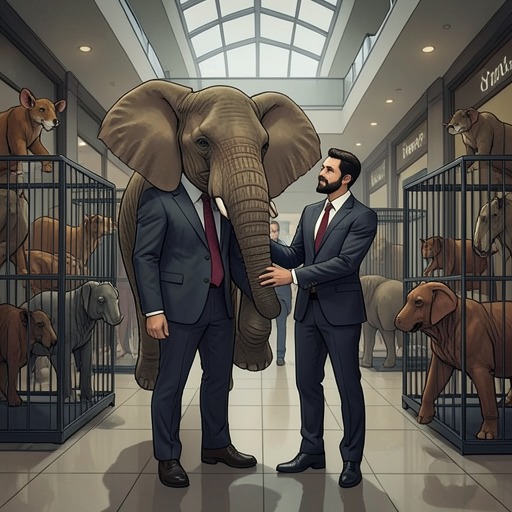
The One and Only IvanIvan and Mack’s relationship is both an intimate bond and the human-animal captivity that defines Ivan’s adult life. Mack buys and raises Ivan as though he were a human baby, sharing outings and memories with him; later, Ivan becomes too large for human life and remains confined in Mack’s mall. Their final farewell makes the contradiction plain: Mack can grieve their separation and remember their closeness, even as Ivan’s freedom depends on leaving him.
An upbringing shaped by human life
Mack pries open the crate and buys Ivan, then raises him in a human household. Ivan wears diapers, drinks from a bottle, sleeps in human beds, sits in human chairs, and hears human speech all around him. Mack’s wife, Helen, laughs readily but is also quick to anger when Ivan breaks things, which happens often. Ivan’s catalogue of damage includes a crib, forty-six glasses, lamps, a couch, shower curtains and rods, a blender, a television, a radio, and three of his own toes. The list gives the early relationship a domestic, comic texture, but it also records the mismatch between a growing gorilla and the fragile objects and expectations of a human home.
The household extends beyond its rooms. On weekends, Mack and Helen take Ivan in their convertible to a fast-food restaurant, where they order French fries and a strawberry shake. Mack enjoys the cashier’s expression when he asks for extra ketchup for his child. Ivan also goes with them to baseball games, the grocery store, a movie theater, and a circus that has no gorilla. He rides a small motorbike and celebrates birthdays with cake and candles. These are not merely lessons in human habits: they are shared routines that give Mack and Ivan a history of outings, play, and ordinary family life. Yet that upbringing cannot make Ivan human, and it offers no lasting place for him as he grows.
Growing beyond the household
As Ivan becomes larger and stronger, the arrangement changes. Mack grows sullen while Ivan becomes too big for chairs, hugs, and human life. Ivan tries to remain calm and move with dignity, even attempting to eat daintily, but human manners cannot overcome the difference between what he is and the life Mack has tried to teach him. The change marks a turning point in their bond: the child Mack raised is no longer able to fit within the domestic role that once brought them together.
Mack’s answer is a new place for Ivan, which Ivan initially welcomes. It has no furniture or glasses for him to break, no toilets into which he can drop Mack’s keys, and it includes a tire swing. Ivan feels relief at having a place of his own. But the comfort is sharply limited: he does not understand how long he will remain there. The contrast between the household and this enclosure captures the relationship’s central imbalance. Mack has provided Ivan with care and familiar comforts, but the place that accommodates Ivan’s body is also where his life is confined.
Affection within confinement
Years later, Mack presses his forehead against the glass and reflects on everything they have been through together. The gesture conveys tenderness and recognition across the barrier, but the glass also makes their unequal positions visible: Mack can approach and leave, while Ivan remains on the other side. Mack’s attachment is real, yet it does not change the conditions of Ivan’s life. Ivan’s account of their history therefore holds affection and injury together rather than reducing Mack to either a loving caretaker or a distant captor.
That contradiction is also visible in Mack’s treatment of Ruby after Stella’s death. Mack is absent for two days; when he returns, he does not speak about Stella. He says the billboard has brought more visitors and that it is time for a new beginning, then spends the afternoon and evening training Ruby. Her feet are looped with rope so she cannot run, and a heavy chain hangs from her neck. Mack presents her with Stella’s ball, pedestal, and stool and introduces her to Snickers. When Ruby obeys, she receives sugar or dried apple; when she does not, Mack yells and kicks the sawdust. The scene does not erase Ivan and Mack’s earlier closeness, but it shows the coercive system in which Mack’s affection for animals coexists with their restraint and training.
The approaching separation
The arrival of inspectors and other humans changes the situation around Mack’s animals. A man visits with a clipboard and checks Ivan’s floor, Ruby’s hay, and their water bowls. A week later, he returns with a woman in a white coat; she watches Ivan and Ruby, speaks with the man and Mack, and the man gives Mack a sheet of paper. Mack goes to his office and slams the door. The narrative does not specify what the paper says, but the subsequent visit makes the consequences legible to Ivan: the woman returns with other people, and they place a large box in the ring, sized for Ruby. Ivan realizes she has come to take Ruby away.
The process of removal also reaches Ivan. One morning, Bob watches four men place a large metal box in the ring, and Ivan recognizes that it is sized for him. These preparations turn the relationship’s long-standing division of power into an imminent parting: people can arrange the animals’ departure, while Ivan can only interpret the boxes and wait. Mack’s absence during the preparations, and his staying in his office all day during Ruby’s removal, leave the separation to unfold without a direct conversation between them.
A farewell that cannot undo the past
On the night before Ivan’s departure, Mack opens his cage. Moonlight falls on Mack’s sagging shoulders, and he seems smaller to Ivan. Bob jumps off Ivan’s stomach and hides beneath Not-Tag; Mack knows the dog sleeps there and settles onto Ivan’s tire swing for one more night. He tells Ivan that his friend is leaving the next day. Ivan is not ready: he has not said his goodbyes or thought the separation through.
Mack takes a small photograph from his shirt pocket. It shows Ivan young, wearing a baseball cap and eating an ice-cream cone beside Mack in the front seat of the convertible. Ivan recognizes that he looks unlike a real gorilla. Mack recalls taking him on a roller coaster and trying to teach him basketball, laughing about Ivan’s poor jump shot. The memories return to the ordinary pleasures of Ivan’s childhood, now seen from the moment those shared experiences end. Mack says he will miss Ivan, then leaves without looking back. His departure does not settle the moral weight of their relationship: it confirms that the bond mattered to him, while Ivan’s long confinement remains part of what that bond meant in practice.