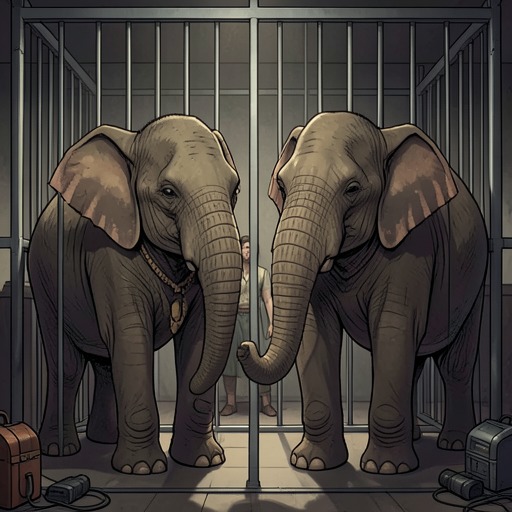
Ivan and Ruby
The One and Only IvanIvan and Ruby form a friendship that becomes a promise of protection: when Stella asks Ivan to help Ruby find a safer life, he accepts a responsibility that carries their bond from companionship into action. Their relationship is shaped by shared captivity, by the possibility of a life beyond it, and finally by the difficult tenderness of letting Ruby go.
First Meeting and Shared Circumstances
Ruby first reaches Ivan through the bars of Stella’s domain. The morning after Ivan hears Stella’s tired voice, he wakes to see a small trunk poking between the bars; Ruby introduces herself, and Ivan answers with his own name. Their meeting begins across a barrier, in a place where even Stella’s remarkable trunk cannot unlatch the door. The physical separation matters: the animals can greet and comfort one another, but they cannot simply choose where to go.
At first, Stella is the center of Ruby’s immediate world. All morning, she strokes and smells Ruby, pats her, and moves with her; Ruby clings to Stella’s tail and slips beneath her belly, while their trunks twine together. Ivan observes the closeness. His relationship with Ruby develops alongside this older bond rather than replacing it: he becomes her friend and protector, but Stella’s care remains the model for what Ruby needs.
The circumstances make Ivan’s friendship more than casual companionship. Stella’s foot was injured when she fell from a pedestal during a circus trick, and it never healed completely; she limps, and prolonged standing can bring infection. When Stella asks Ivan to ensure that Ruby might have a life different from hers, Ivan recognizes the request as a charge to protect the younger elephant from inheriting Stella’s constrained life. His answer, that Ruby needs a safe place and not this one, turns their relationship toward a shared future beyond the mall.
A Promise Made Practical
Ivan does not immediately know how he can fulfill Stella’s request. After the humans have left, he sends Bob to check on Ruby. Bob returns with news that she is shivering and that he tried to cover her with hay; he also told her not to worry because Ivan would save her. Ivan glares at Bob, startled by the promise being made aloud. The moment exposes the difference between wanting Ruby safe and knowing how to make her safe. Yet the promise now exists between them, and Ivan cannot treat it as someone else’s words.
Ivan gives Ruby a story instead of a plan. When she asks how the elephant in it gets to a safe place, he says that she has a friend who made a promise. The story lets him offer hope without pretending that he has already solved the problem. It also places their relationship at the heart of the imagined rescue: Ruby is not saved by a sudden escape, but by a friend who must find a way to make his word real.
That effort takes the form of art and communication. Julia understands Ivan’s painting as something meant for a billboard, and recognizes that this is what Ivan wants. Her insight makes the picture a way for Ivan to reach people beyond the glass, even though he cannot speak to them directly. The relationship thus draws in a human collaborator: Julia reads the purpose in Ivan’s work and helps translate his concern for Ruby into a public appeal for a new home.
Protection Amid Renewed Training
While a safer future remains uncertain, Ruby is subjected to the training Mack plans to resume after Stella’s absence. Her feet are looped with rope so she cannot run, and a heavy chain hangs from her neck. Mack shows her Stella’s ball, pedestal, and stool, then introduces her to Snickers. He rewards obedience with sugar or dried apple and responds to disobedience by yelling and kicking the sawdust. Ivan witnesses this return to performance training, which makes the stakes of his promise concrete: Ruby is not merely waiting for a different place; she is being prepared to repeat the conditions that injured Stella.
The eventual intervention is not Ivan’s work alone. A property inspector visits and checks the animals’ surroundings, including Ivan’s floor, Ruby’s hay, and their water bowls. A week later, he returns with a woman in a white coat, who observes Ivan and Ruby and speaks with the inspector and Mack. Later, the woman returns with other humans and a large box sized for Ruby. Ivan understands that she has come to take Ruby away. She coaxes Ruby toward the box with an apple, a clicking sound, and pieces of carrot, rewarding each approach. The careful process contrasts with Mack’s coercive training and makes departure possible without suggesting that Ivan himself can open the enclosure or carry Ruby out.
Choosing to Leave
As the move approaches, Ruby asks whether the other elephants will like her. Ivan assures her that they will love her and that she will be part of their family. Ruby asks whether the other gorillas will like Ivan, bringing his own uncertain future into their conversation. She also wonders whether the elephants will know how to play tag, a game she loves. Their exchange gives the promised safe place a personal shape: it means not only escape from the mall, but the prospect of family, play, and relationships with other elephants.
Ruby decides that she will enter the box the next day. Ivan tells her that he thinks it is a good idea and that Stella would have agreed. His support does not erase his attachment. When Ruby enters the box first on the morning of the move and says she is scared and does not want to leave him, Ivan knows that part of him does not want her to go either. But he does not tell her to stay. His restraint is part of the promise: protecting Ruby means allowing her to leave him for the safer life he wanted her to have.
Before the box is rolled to the waiting truck, Ivan asks Ruby to tell the others his elephant joke and to remember Bob, Julia, himself, and Stella. Ruby promises to remember everyone, especially Ivan. Their farewell confirms the friendship without turning separation into a betrayal. The bond persists in what Ruby carries with her, while Ivan’s fulfilled responsibility requires him to endure her absence.
What the Relationship Changes
Ivan and Ruby’s relationship joins affection to practical responsibility. He first meets Ruby through bars, watches Stella care for her, and then accepts Stella’s request to secure a different life for her. His story, his use of art to communicate with Julia, and his acceptance of the box all belong to that developing obligation. The rescue is also collective: Julia interprets the painting, inspectors and other humans become involved, and Ruby is gradually helped into the transport box. Ivan’s promise matters not because he accomplishes everything alone, but because it moves him to seek help and to recognize when Ruby’s departure is the right outcome.
Their parting changes the form of the friendship rather than diminishing its importance. Ruby leaves with memories of Ivan and the others; Ivan remains with the knowledge that she has the chance to join an elephant family. Later, Ruby asks whether the other gorillas will like him, and Ivan watches a nature program showing gorillas eating, grooming, play-fighting, and sleeping. The contrast places their futures beside one another: Ruby is moving toward other elephants, while Ivan is beginning to see a social life among gorillas as possible for himself. Their relationship has prepared Ivan to think beyond isolation, even as its central act of care is letting Ruby go.