Ivan beats his chest to get attention
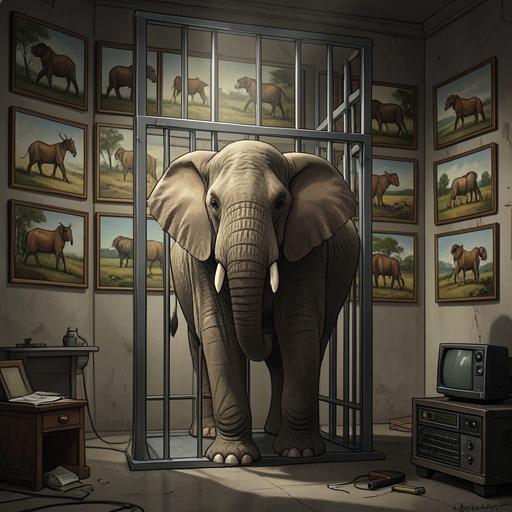
The One and Only IvanIvan beats his chest to get attention at the moment his private fear for Ruby becomes an unmistakable public display. The sound breaks through the ordinary quiet of the Exit 8 Big Top Mall and Video Arcade, startles the humans around him, and leads Julia to recognize that his scattered pictures form a puzzle. The action is both an eruption of anger and an attempt to make his pictures—and what they mean—impossible to overlook.
Fear for Ruby and the Meaning of the Display
The scene begins not with noise but with Ivan watching Ruby sleep. In that stillness, he suddenly sees her future as a repetition of Stella’s: Ruby will never leave the mall and will remain there forever. The thought becomes a personal obligation. Ivan says, “I can’t let Ruby be another One and Only.” The phrase links Ruby’s possible confinement to Ivan’s own isolation and gives his subsequent display a clear protective stake: he is not merely reacting to the mall or performing for its visitors; he has someone to protect.
That motive changes the meaning of chest-beating, a gesture the mall’s visitors already imitate. They strike their own chests to pretend to be Ivan, but their blows are “soundless as the wet wings of a new butterfly.” Their mimicry reduces the act to a harmless spectacle. Ivan’s account sharply contrasts it with the real thing: a mad gorilla’s chest-beating is terrifying even from miles away, and a genuine beat sends the jungle running as if danger has arrived. The gap between visitor imitation and Ivan’s actual display is the gap between watching a performance and hearing a warning.
The Outburst in the Mall
The action begins with a single beat: “Thump.” Ivan identifies its echo as “my sound,” which carries through the enclosed mall. George and Julia turn toward him; Julia drops her backpack, George drops his keys, and the pile of pictures flies apart. The sound therefore does more than fill the space. It interrupts the human activity around Ivan and makes the pictures, previously gathered into a pile, part of the visible commotion.
The single beat becomes a repeated assault. “Thump. Thump. Thump.” Ivan bounces off the walls, screeches and bellows, and beats his chest again and again. The sequence is physical and escalating: the beat is followed by movement, cries, and repetition, until his anger is legible as an event rather than a mood concealed behind glass. Bob responds by hiding under Not-Tag with his paws over his ears. George and Julia, too, have been made to stop and turn. The display forces attention through its volume and disruption, but its force is directed by the concern Ivan has just named: Ruby must not be left to share Stella’s fate.
The narration makes the emotional turn explicit: “I’m angry, at last.” The words mark anger as something newly admitted, not merely as the sound others hear. The action lets Ivan’s protective feeling take a form that the people in the mall cannot dismiss as another visitor’s imitation. Yet the outburst does not explain itself in speech; it creates the interruption in which his pictures can be seen.
From Scattered Pictures to Recognition
After the chest-beating, the pictures lie across the floor “like huge autumn leaves.” Their scattering initially looks to George like a mess, and he sighs over having swept that night. His response shows how easily the pictures can be mistaken for disorder. Julia, however, is still watching Ivan rather than accepting the scene as finished. She tells her father that Ivan remains upset and urges him to look at Ivan’s eyes. The adults do not immediately understand what the display means, but Julia recognizes that its aftermath deserves attention.
Julia begins sorting the pictures. She identifies an H, then an E, and realizes that the separate images can be joined into something larger. George first treats the marks as isolated letters, tracing their order in the air; Julia corrects him by pointing out that some marks are pictures—a real eye, a foot, perhaps a tree, and a trunk. The exchange shifts the focus from the apparent noise and disorder of Ivan’s actions to the pictures as a deliberately assembled message. Julia runs between the images, picks one up, and sets down another as she sees their relation.
Her recognition comes in stages, and Ivan waits behind his window while it develops. Julia calls it a puzzle and understands that it forms both a word, perhaps words, and a giant picture. She then runs to Ivan and asks, “what did you make?” Ivan stares back and crosses his arms. The pause matters: the display has secured attention, but understanding takes longer than the outburst itself. The chest-beating does not substitute for the pictures; it brings Julia to notice them and begin interpreting them.
Consequence and Narrative Significance
The scene connects Ivan’s physical voice to his attempt to communicate through art. The visitors’ chest-beating imitates his body while stripping the gesture of its danger; Ivan’s real beating, by contrast, interrupts the mall and scatters the images that Julia must then read. Sound compels the humans to look, while the pictures give that attention something to discover. The two forms of expression work in sequence: first an unmistakable bodily disturbance, then a visual pattern whose meaning is not immediately obvious.
The outburst also marks a change in the stakes of Ivan’s anger. Its force is not simply a reaction to his own circumstances: he has just imagined Ruby confined forever and explicitly refuses to let her become another One and Only. By the end of the scene, Julia has recognized that the scattered images form a puzzle and a giant picture, but Ivan’s crossed arms and patient waiting leave the process unfinished. The action succeeds in drawing attention; making the message understood remains the next step.