Ivan joins the gorilla troop
The One and Only IvanIvan’s entry into the gorilla troop is a hesitant, unfinished passage from solitary captivity toward social belonging. An open door offers him access to other gorillas, but not an immediate homecoming: he recoils from the encounter, fails the first test of the group, and is returned to his cage. Only through repeated attempts—imitating a silverback, joining Kinyani in play, and telling the troop about the life that shaped him—does contact become possible. The sequence makes integration a practice rather than a destination, with belonging emerging in gestures before it is secured in words.
The Door and the First Refusal
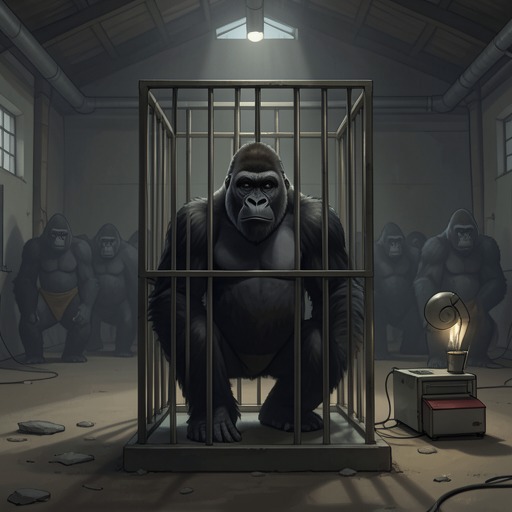
The transition begins with a door. Humans lead Ivan to it, while Kinyani and the others wait on the other side. The physical threshold separates the familiar enclosure from the possibility of life among gorillas, but crossing it also means entering a social world whose expectations Ivan does not know how to meet. He is not ready to be a silverback; he understands himself as Ivan, without the identity or authority that role implies. Instead of going through, he decides it is not a good day to socialize and postpones the attempt until tomorrow.
That refusal is not indifference to the group. The narration presents Kinyani as both frightening and beautiful, an image that captures the pull of the encounter as well as its danger. Ivan can see the others waiting, yet cannot make readiness follow from opportunity. His hesitation exposes the distance between physical access and social membership: a door can be opened for him, but the relationship on the other side cannot be supplied by the humans who lead him there.
When Maya asks whether he wants to try again, Ivan thinks of Ruby and tells himself it is time. Ruby’s imagined curiosity gives the threshold a different pressure. She would want to know what waited beyond it, and, in Ivan’s mind, she would already have gone through. Remembering her does not remove his fear; it helps him act despite it. The door opens, and the narration breaks into a rapid inventory of what he encounters outside: sky, grass, a tree, an ant, a stick, a bird, dirt, clouds, wind, flowers, rocks, and rain. The list registers an abundance of immediate surroundings, sharply unlike the confined, human-shaped world he has known.
A Failed Introduction and a Silverback’s Test
The abundance of the outdoors does not make the meeting welcoming. Ivan sniffs, approaches, and briefly struts, but the troop does not receive him with ease. Its members have sharp teeth and loud voices; their behavior makes the new setting feel threatening rather than instantly liberating. Ivan wonders whether he has done something wrong, a response that shows how little he can read the group’s social signals at first.
Kinyani pursues him, throws a stick, and corners him. Ivan interprets this not as random aggression but as a test: she is judging whether he is a true silverback, capable of protecting her family. The stakes are therefore more than whether he can endure an intimidating encounter. The troop’s challenge concerns a role defined by responsibility to others, precisely the role Ivan has already said he is not ready to occupy. Faced with Kinyani, he cowers and hides his eyes rather than answering the test with confidence or force.
Maya lets Ivan return to his cage. The retreat ends the first attempt without resolving whether he can belong among the others. His return also reverses the apparent promise of the open door: for the moment, access has led back to separation. The scene makes clear that a new environment alone cannot erase the effects of a life spent away from gorilla society. Ivan must encounter the group again, and must find some way to act within it, rather than simply be placed among it.
Practicing a Role
After the failed meeting, Ivan lies awake trying to remember what being a gorilla was like. The effort is obstructed by images of babies, motorbikes, popcorn, and short pants—the human surroundings that have crowded into his experience. He tries to imagine an Ivan who might have been different, his father’s son. These reflections do not restore a clear memory of his earlier life; they reveal how uncertain his sense of gorilla identity has become.
A later encounter with a hungry juvenile male gives that uncertainty an immediate test. The younger gorilla approaches Ivan’s food, and Ivan responds with a sequence of forceful behaviors: he grumbles, swats, swaggers, and beats his chest until the sound carries across the space. This time Kinyani and the others are watching. Ivan moves toward the young challenger, who retreats. The outcome is small but consequential: for a moment, Ivan’s display has the effect he intended, and the juvenile acts almost as if Ivan were the silverback he is pretending to be.
The performance is neither proof that Ivan has become a confident leader nor merely an empty imitation. Its importance lies in the gap between what he feels and what his actions can do. He does not begin by declaring an established identity; he tries out the bodily signs of authority in a situation where the troop can see and respond. The young gorilla’s retreat gives that experiment a result. Ivan has acted on behalf of a boundary, and the others have witnessed him do it, even though the text leaves his larger acceptance unsettled.
Play, Story, and Tentative Belonging
The relationship with Kinyani changes through a gesture far less confrontational than the earlier test. She ambles over, taps Ivan on the shoulder, and knuckle-runs away. Ivan watches with his arms crossed over his chest and stays careful not to make a sound; he is unsure what they are doing. The uncertainty lasts only briefly: they are playing tag, and Ivan is it. Kinyani’s touch and retreat invite him into an exchange whose terms differ from the pursuit with the stick. He is no longer simply the newcomer being assessed; he is a participant in a game.
The movement from chase to tag does not erase the earlier danger, but it changes what bodily contact can mean between them. In the first encounter, Kinyani’s pursuit cornered Ivan and exposed his fear. Here, her tap begins a playful pattern, and his uncertainty belongs to the discovery of shared activity rather than to a test he cannot meet. The scene offers no grand announcement of acceptance. Instead, a shoulder tap, a retreat, and the recognition that he is part of the game carry the change.
The troop also makes room for Ivan through storytelling. Gorillas are not chatty like humans, but they sometimes exchange stories under the sun. When it is Ivan’s turn, he tells them about Mack, Ruby, Bob, Stella, Julia, and George, as well as his mother, father, and sister. The story brings into the troop’s quiet gathering the people and family ties that have formed his life. When he finishes, the others look away and fall silent; the response is not explained as approval or rejection.
Kinyani then moves closer. Her shoulder brushes Ivan’s, and the two sit together while the sun warms their fur. That quiet physical nearness gives the episode its clearest sign of connection without turning it into a claim that every difficulty has vanished. Ivan has crossed the door, retreated, tried again through action, played with Kinyani, and shared a history the troop did not previously know. His movement into the group is thus measured less by a formal welcome than by the possibility of being near others without hiding, performing, or fleeing. The final image is not solitary triumph but company: a tentative place beside Kinyani and within the troop.