Ivan's Glass Enclosure
The One and Only IvanIvan's Glass Enclosure is the structure that makes Ivan's life at Exit 8 Big Top Mall visible, bounded, and difficult to mistake for freedom. It is called his domain, but its glass walls expose the limits of that word: visitors can look in and press their hands against the barrier, while Ivan remains on the other side. A crack in the glass gives Bob a way inside, and much later an open doorway offers Ivan a way out. Those breaches change what the enclosure can mean without making confinement disappear.
Setting and Construction
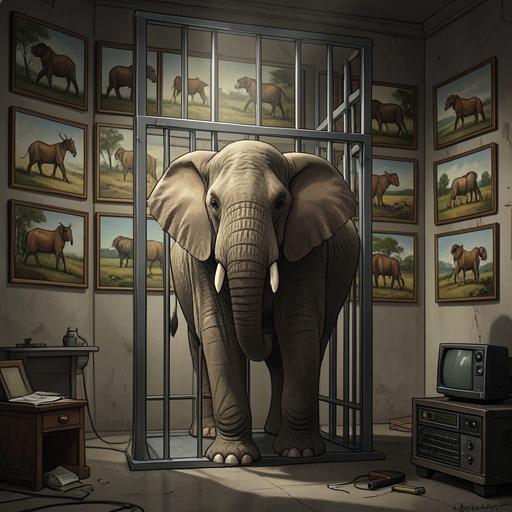
The enclosure stands at one end of the mall's central ring, among a carousel, shops, and the benches where visitors eat. The floor is covered with sawdust, described as made from dead trees. Ivan's domain is built of thick glass, rusty metal, and rough cement. Stella's neighboring domain is made of metal bars; the sun bears have wood, and the parrots live behind wire mesh. These differences make the animals' spaces part of the mall's visible arrangement, but the glass gives Ivan a particularly exposed position: the barrier separates him even as it lets the public see him.
Three of the enclosure's walls are glass, and one has a crack with a hand-sized piece missing from its lower corner. Ivan made the hole with a baseball bat Mack gave him for his sixth birthday. Mack took the bat away afterward but allowed him to keep the accompanying baseball. The small opening is therefore not simply wear in the structure: it records an action by Ivan and remains as a material trace of his childhood inside the enclosure. A painted jungle scene covers one wall. Its waterfall has no water, its flowers no scent, and its trees no roots; Ivan did not paint it, though he enjoys the way its shapes flow across the wall. The image supplies the appearance of a habitat without its living conditions.
Visibility and Separation
Through the windowed walls, Ivan can see the mall and some of the world beyond it: pinball machines, cotton candy, and a large, treeless parking lot. The view makes the enclosure visually open while leaving Ivan physically contained. His life there includes flashing lights, pointing fingers, and visitors who come close enough to flatten their hands against the glass. The barrier is not an occasional interruption but the everyday condition of his public life.
The visitors leave fingerprints, sticky with candy or slick with sweat, on the glass. Each night a weary man wipes them away. That repeated cleaning restores the surface for another day of looking, while the enclosure continues to separate those who look from the animal being watched. The glass thus performs two roles at once: it permits display and prevents ordinary contact. Its transparency can make the division seem natural or permanent, even though the cracked corner shows that the wall is a material thing, made and vulnerable rather than an absolute boundary.
The Broken Corner and Bob's Arrival
The missing piece becomes an unexpected opening when Bob, after spending cold nights outdoors, finds the corner of the enclosure where the glass is broken. Ivan wakes in the dark to discover a tiny puppy snoring on his belly. He has not felt another's warmth for so long that he is unsure what to do. Keepers, rats, and an occasional sparrow have entered before, but they never stayed. Bob's presence is different: the breach allows a visitor to cross the barrier and remain close to Ivan.
The incident reverses the enclosure's usual arrangement. Human visitors approach the glass from outside, visible to Ivan but held at a distance; Bob enters through a gap and shares Ivan's space. The hole, made years earlier with the birthday bat, becomes a point of connection as well as evidence of damage. It does not remove the enclosure or end Ivan's isolation, but it permits a friendship to begin in a place designed to keep lives apart.
The Open Door and a Narrow Route Out
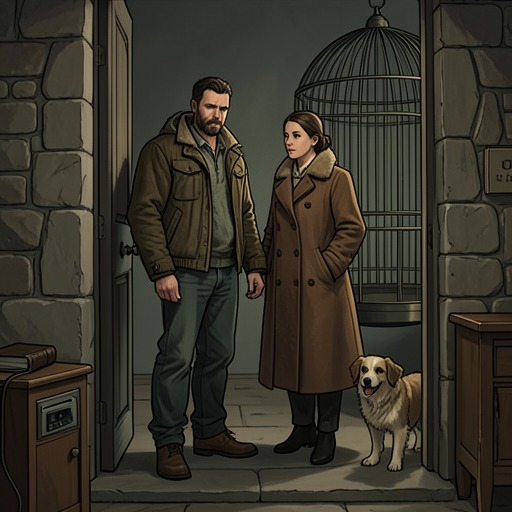
Later, Ivan finds the door to his cage propped open. A large box has also been moved and opened against the doorway, so that walking through the door would take him into the box. The zoo representative Maya is present, and Ruby watches from between the bars of her own cage. A ripe mango waits in the dark interior. Ivan understands the box as the way out and steps inside because Ruby is watching.
The open door changes the enclosure from an apparently fixed boundary into a threshold that Ivan can cross. Yet the route is carefully structured: the box stands at the doorway, and it is still part of the humans' arrangement for moving him. The scene makes departure possible without presenting movement as wholly self-directed. Ivan's decision is connected to Ruby's presence and to the prospect of leaving, while the enclosure's door and the transport box define the path available to him.
A Boundary That Changes, but Remains
At the zoo, Ivan later explores a hilltop while the others rest in the morning sun. A low-limbed tree recalls the kind his sister would have loved, and the earth is soft after rain. But the wall around the habitat stretches far down toward other habitats: it is clean, white, high, and wide, built to keep the animals in and others out. Ivan recognizes that this, too, is a cage. The contrast with the mall enclosure is real—the setting offers grass, dirt, and room to explore—but the wall preserves the fact of containment.
The enclosure's significance lies in this distinction between a visible opening and genuine freedom. Its cracked glass allows Bob to enter; its open door allows Ivan to enter a transport box and leave the mall. Neither breach makes the boundary meaningless. Across the changes in setting, walls and doors continue to shape who can approach, where an animal can go, and what kind of contact is possible. The glass enclosure is therefore not merely a backdrop to Ivan's captivity: its surfaces, damage, and openings give that captivity a physical form, while making its limits—and the possibility of crossing them—impossible to ignore.