Ivan’s integration into the gorilla troop
The One and Only IvanIvan’s integration into the gorilla troop is a gradual passage from solitary display to tentative social belonging. The move gives him what the mall could not: sustained contact with other gorillas, including the awkward, physical negotiations of joining a group. Yet the change does not erase the boundaries of captivity. Ivan goes from being watched through glass to watching a gorilla family through his window, and his eventual place among them is won through fear, play, and quiet companionship rather than instant welcome.
From the Mall to a New Social World
At the Big Top Mall, Ivan’s enclosure is called his domain, but the word disguises a life apart. He lives at one end of the performance ring because he is too much gorilla and not enough human, and he has no gorilla friends. Stella’s domain is beside his; she and Bob are his dearest friends, but neither can provide the company of his own kind. The glass wall makes that isolation visible: visitors press candy-sticky, sweat-slick hands against it, while Ivan is fixed on the other side as an exhibit. The division seems permanent, a rule imposed by the wall itself.
The change begins with inspection and removal. A man arrives with a clipboard and checks Ivan’s floor, Ruby’s hay, and the water bowls. A week later, he returns with a woman in a white coat, who watches Ivan and Ruby before speaking with the man and Mack. When she comes back with other people, they place a box sized for Ruby in the ring; Ivan understands that she has come to take Ruby away. Later, with Bob watching from his belly, Ivan sees men placing a metal box sized for him. The box is moved against his doorway, and his cage door stands open. Maya, the zoo worker, is present. The opening leads not to unbounded freedom but into another enclosure and, eventually, toward a different kind of life.
Watching the Troop
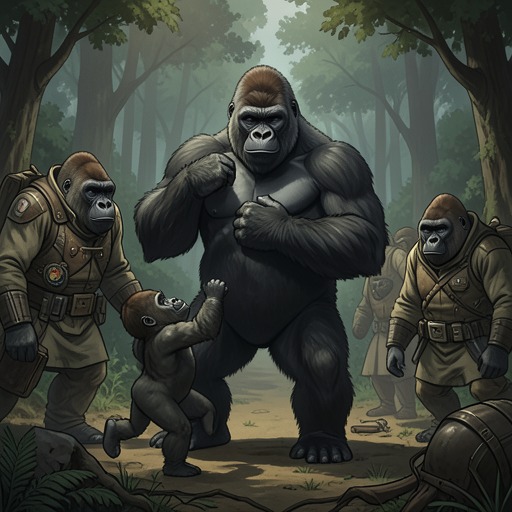
In the new setting, Ivan watches gorillas on television every day. The group on screen is small and unusual: three females and a juvenile male, with no silverback to protect them. They eat, groom, sleep, and play-fight; they are mostly placid and good-natured, though they bicker like a family. The repeated routine matters to Ivan. Their ordinary closeness offers a picture of gorilla life that differs sharply from his solitary existence at the mall.
His position as an observer reverses. At the mall, humans flattened their hands against the glass and watched him from inches away. Now Ivan watches the gorillas through his own window, following how they chase, groom, play, and sleep. The group also stares at him, heads tilted, pointing and hooting. Their reciprocal attention unsettles the old arrangement: Ivan is no longer only the spectacle, but neither is he yet part of the group. He wonders whether they are as fascinated by him as he is by them. Looking becomes the first form of contact, but it cannot by itself guarantee welcome.
Testing, Play, and Contact
When Ivan first approaches the others, he sniffs and struts, but they do not welcome him. Their sharp teeth and loud voices make the encounter threatening. Kinyani chases him, throws a stick, and corners him. Ivan understands her aggression as a test: she wants to know whether he is a true silverback capable of protecting her family. Faced with that expectation, he cowers and hides his eyes. The moment exposes the gap between the role the troop may need and the confidence Ivan has acquired during a life without gorilla companions.
The relationship changes through a smaller, more tentative exchange. Kinyani ambles over, taps Ivan on the shoulder, and knuckle-runs away. Ivan watches with his arms crossed and stays quiet, unsure what is happening. She returns, shoves him, and dashes past. Only then does he recognize the encounter as play: the two are playing tag. What began as a test of strength becomes a shared game, without any declaration or sudden transformation. The difference lies in the pattern of approach and response: Kinyani returns, Ivan remains present, and their contact becomes something they do together.
Play is followed by grooming, an intimate act that makes acceptance physical. Ivan delights in Kinyani pulling a dead bug from his fur. The smallness of the gesture is its significance: care is neither performed for visitors nor reduced to an image on a screen. It is another gorilla’s touch, offered directly to him. Later, Kinyani moves closer until her shoulder brushes his. They let the sun soak into their fur together. After the chase and the testing, this quiet proximity marks a different kind of security: Ivan can share space without being pursued or having to hide.
Family, Home, and the Remaining Wall
Ivan tells the troop about Mack, Ruby, Bob, Stella, Julia, and George, as well as his mother, father, and sister. When he finishes, the others look away in silence. The passage does not make their silence a verbal welcome; instead, the troop’s response remains difficult to read. Kinyani’s next action supplies a more tangible answer. She moves close enough for their shoulders to touch, and they sit together in the sun. Belonging develops through presence and bodily contact, not through an explanation of Ivan’s past.
The new habitat offers grass, dirt, trees, and room for exploration, but it is still bounded. At the far end of the grounds, Ivan finds an immense, clean white wall built to keep the animals in and others out. He recognizes that the place remains a cage. This limit complicates the meaning of his integration: the troop can give him relationships unavailable at the mall, but social belonging does not make confinement disappear. The changed enclosure matters because it changes who can share his world, not because it abolishes the boundary around it.
At the end, as the zoo lamps come on, Bob calls to Ivan from Julia’s backpack, and Ivan turns toward his family, his life, and his home. He whispers the name Mighty Silverback. The title answers the earlier encounter with Kinyani, in which Ivan cowered before the demands of a silverback’s protective role. Now the identity is joined to a troop and to a place he can recognize as home. His integration remains imperfect and his surroundings remain enclosed, but he is no longer the gorilla without gorilla friends: he has found companionship, a family, and a way to inhabit the name.