Ivan’s solitary captivity at the Big Top Mall
The One and Only IvanIvan’s solitary captivity at the Big Top Mall is a prolonged separation from gorilla life, not an absence of all companionship. For 9,855 days, he lives in a domain at the end of the mall’s central ring, with no gorilla friends. His bonds with Stella and Bob soften that isolation without changing its defining fact: the only gorilla in his immediate world is himself.
The enclosure and its setting
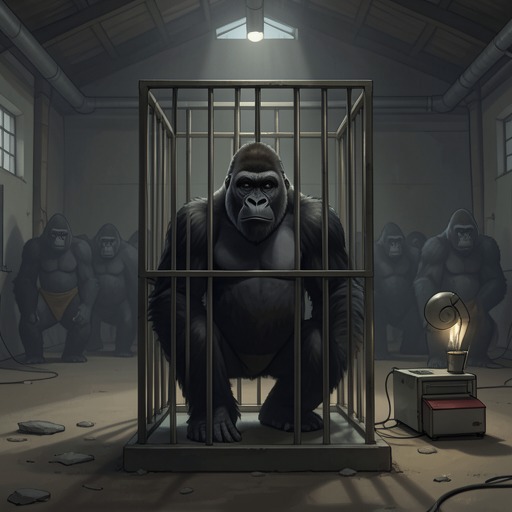
Ivan’s domain is made from thick glass, rusty metal, and rough cement. Three walls are glass; one has a crack, with a small piece missing near the bottom corner. That opening began when Ivan used a baseball bat Mack had given him for his sixth birthday. Mack took the bat away afterward but allowed him to keep the accompanying baseball. The hole is a mark Ivan made in the enclosure, but it does not end the separation the walls enforce.
His enclosure stands within a commercial spectacle organized for human visitors. A carousel turns through the day; merchants, monkeys, and parrots occupy the mall; and benches surround a ring where people eat pretzels. The floor is scattered with sawdust. The setting places Ivan close to human routines and entertainment while keeping his living space visibly distinct: his domain is bounded by glass and metal, unlike the nearby habitats made of bars, wood, or wire mesh. Proximity to people is not the same as belonging among them.
The word domain gives the enclosure the appearance of a territory, but its materials and limits reveal a space constructed for confinement. The glass makes separation especially legible: Ivan can occupy the same mall as its human visitors and still remain apart from them. The damaged corner complicates the enclosure’s apparent solidity, yet the evidence does not show that the gap gives him a way out. It remains a small alteration within an otherwise enclosing structure.
Companionship and isolation
Ivan’s closest relationships keep the word solitary from meaning wholly alone. Stella’s domain is beside his, and she and Bob are his dearest friends. Their closeness matters because it establishes that Ivan is capable of attachment and that his life contains durable social bonds. But neither friend is a gorilla. The companionship available to him therefore coexists with a species-specific absence that the narrative identifies directly: at present, Ivan has no gorilla friends.
That distinction gives his isolation its particular weight. Ivan is not portrayed as having no contact or affection at all; rather, the mall supplies relationships that cannot replace a shared life with other gorillas. His friendship with Stella and Bob stands beside, rather than cancels, his separation from his own kind. The social world around him can be warm and still be incomplete.
When he was young, Ivan believed for a time that he might be the last gorilla on earth. The thought made it difficult for him to remain hopeful, though he tried not to dwell on it. This remembered belief shows how confinement shapes not only where he lives but what he can imagine about his identity and place in the world. Without other gorillas present, the absence can seem universal: not simply that none are nearby, but that none may remain.
Duration and adjustment
The count of 9,855 days turns Ivan’s enclosure into a measure of time as well as a place. The number gives an exact scale to a condition that might otherwise be reduced to a vague sense of waiting. His later reflection that he did not realize he would stay so long makes the duration a consequence beyond his initial expectation. What once felt like a separate place becomes the setting of a life extended far past what he anticipated.
That change is set against his growth. Mack grows sullen as Ivan grows larger, until Ivan is too large for chairs, too strong for hugs, and too big for human life. Ivan tries to remain calm, move with dignity, and eat daintily, but human ways remain difficult for him to learn. The contrast is not simply between a small animal and a large enclosure: it is between expectations shaped around human life and a body that increasingly cannot fit them. His growing size makes the mismatch harder to ignore.
When Ivan first sees his new domain, however, he is thrilled. It has no furniture for him to break, no glasses to smash, and no toilets where Mack might lose his keys; it even has a tire swing. He is relieved to have a place of his own. These details preserve the complexity of the transition: the enclosure can offer relief from the difficulties of fitting into human spaces while still becoming a confinement of unexpectedly long duration. Initial welcome and lasting captivity are not mutually exclusive.
Identity and significance
The routine of Ivan’s later life—drinking Pepsi, eating old apples, and watching television reruns—places him amid familiar human objects and habits. Yet these routines do not resolve the question his situation raises. Many days, he forgets what he is supposed to be and wonders whether he is human or gorilla. The uncertainty follows from the same division that structures his home: he lives among human surroundings but without a place in ordinary human life, and he has no gorilla companions with whom to share his other identity.
His captivity therefore works through a double separation. The enclosure marks a physical boundary between Ivan and the surrounding mall, while his lack of gorilla friends marks a social boundary within his own experience. Stella and Bob make the first boundary less absolute in emotional terms, but they cannot remove the second. The glass, the damaged corner, the birthday baseball, the tire swing, and the unanticipated accumulation of days all give concrete form to a life at once adapted to its enclosure and estranged from the life it excludes.
The significance of Ivan’s solitary captivity lies in this unresolved condition. The mall can call his enclosure a domain, and Ivan can at first be relieved to have it, but neither description settles whether it is a home in the fuller sense. His long stay turns a place that seemed preferable to breaking human furniture into the setting of an identity crisis. Solitude here is not a simple lack of friends: it is the persistent absence of gorilla community within a life that has become entangled with human spaces, habits, and expectations.