Ivan's Zoo Painting of Ruby and “HOME”
The One and Only IvanIvan's Zoo Painting of Ruby and “HOME” turns the gorilla’s private, painstaking work into a message people can read: Ruby belongs in a zoo, not on display at the mall. Made from many separate sheets and assembled by Julia and George, it gives Ivan a way to address Ruby’s captivity when he cannot make the appeal by himself. The word at its center names both the future he wants for Ruby and the possibility that home can mean more than a place of confinement.
Making the Picture
Ivan begins the work after Stella’s words about humans surprise him and he recognizes how to keep his promise. The paintings take shape at night: he closes his eyes, dips his fingers into paint, finishes one sheet, and sets it aside to dry before moving to the next. In the daytime he waits, and the work makes him sleepy. His worry about Ruby grows as he watches Mack take her into the ring and sees that she no longer fights back, doing whatever Mack asks. The puzzle is therefore not an abstract exercise or a piece for Ivan’s own amusement. He makes every painting for Ruby.
Each sheet seems inadequate on its own. Ivan sees that it is only one small piece of a much larger task, and keeps making more until the floor is covered with paintings by morning. He hides them beneath the pool of dirty water before Mack can find them. The concealment matters: Ivan fears the work will be treated as merchandise, like his other paintings in the gift store, where they sell for twenty dollars each, or twenty-five with a frame. The hidden stack is at once an artwork, a plan, and something he is trying to protect from being turned into another mall product.
From Pieces to a Word
When Ivan prepares to show his work, he lays out sixteen pieces of poster board in four rows across and four down, a perfect square. The arrangement gives the separate sheets a shared frame, but the image is not immediately legible to the people who see it. At first they appear to be blobs and swirls. Julia begins to recognize letters, straightening and rearranging pictures; she identifies an H and an E, then understands that the pieces form a larger image as well as a word.
Julia and George carry the pictures to the ring, where there is room to spread them out. They spend an hour trying to assemble the puzzle while Ruby, Bob, and Ivan watch. Julia eventually spells H-O-M-E. The assembled work shows a zoo, which Ruby approves of, and joins that image to the word Ivan has been trying to make. The slow recognition is part of the picture’s force: what initially looks like disconnected marks becomes a legible request through attention, patience, and cooperation. Ivan has made the pieces, but humans must learn to see how they fit.
A Message Meant for the Public
The assembled picture gives Julia a proposal she can carry beyond the ring. She urges her father to help put it on the billboard, offering to get the ladder while George gets the glue. She argues that publicity could make people know about Ruby. George recognizes the unusual character of the appeal: it would show Ruby in a zoo with the word HOME in giant letters, and the sign would have been made by a gorilla. He also objects that putting it up without Mack’s permission could cost him his job. The painting’s intended audience is thus larger than Ivan’s immediate circle, but reaching that audience depends on people willing to risk acting on its message.
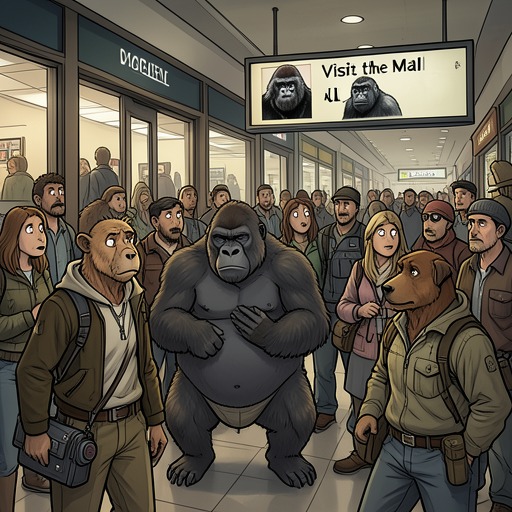
The picture’s public meaning differs sharply from the billboard that already advertises the mall and Ivan as its mighty silverback attraction. That existing publicity promotes the venue and its shows; Ivan’s puzzle redirects attention to Ruby’s future. Its proposed use is not simply to display a striking animal image but to make the mall’s treatment of Ruby visible as a problem and to present a different place for her to live. Later, inspectors return to the property, a white-coated woman arrives with other humans, and a Ruby-sized box is placed in the ring. Ivan understands that she has come to take Ruby away. The evidence establishes this sequence of inspection and preparation for Ruby’s departure, but does not make the painting alone its cause; the artwork supplies an appeal within a broader change in the animals’ circumstances.
Home and the Limits of the Image
The word HOME gathers together the practical hope of relocation and the question of what makes a place a home. Ivan lives at the mall because, in his words, he is too much gorilla and not enough human. His domain is bounded by glass: visitors press their hands against it, leaving candy-sticky and sweat-slick fingerprints that a tired man wipes away each night. From that enclosure, a zoo in the puzzle represents a different possibility for Ruby, one that Ivan cannot secure through painting alone but can make visible to others.
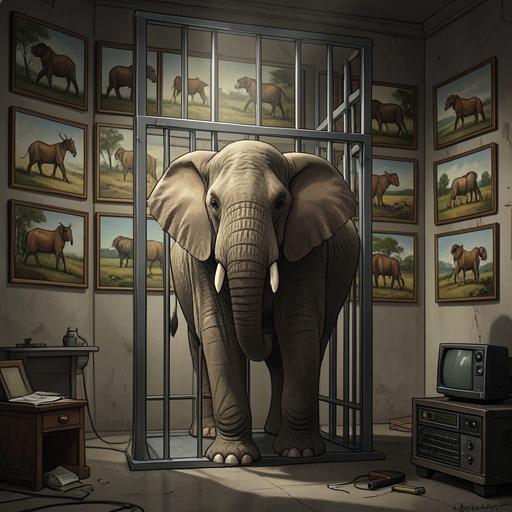
Ivan’s later experience complicates any simple equation between a zoo and freedom. At the zoo, he looks across an immense, clean white wall, built to keep the animals in and others out, and recognizes that it is still a cage. The painting’s promise is therefore not that the word HOME abolishes boundaries. Rather, its force lies in insisting that Ruby’s present confinement need not be permanent and in directing human attention toward a more suitable place. As the pieces become a word, Ivan’s private promise becomes communicable; as the word becomes a proposed billboard message, the painting turns into a bid for action, while leaving the meaning of home open to the realities of life inside any enclosure.