Kinyani
The One and Only IvanKinyani is a member of the gorilla troop Ivan joins at Zoo Atlanta, and her first encounters with him make belonging something he must face rather than simply receive. She is at once a formidable presence and, later, a companion: she tests whether he can protect the troop, then moves toward a quieter closeness with him. Her changing relation to Ivan marks his transition from an isolated animal entering an established group to one who can share space and history with others.
Identity and First Impression
Kinyani’s name is given as Ivan begins to encounter life among the gorillas. The first details are physical and immediate. Her hoots hurt his ears, and he admires her intact canines from a distance. She is faster and spryer than he is, and Ivan suspects she may be smarter, though he notes that he is twice her size. That comparison sets up a distinction between sheer bulk and the forms of capability that matter in the troop: speed, alertness, and confidence are not measured by size alone.
Ivan’s description holds fear and attraction together. Kinyani is terrifying to him, yet beautiful, like a moving painting. The image does not make her harmless; her beauty is part of the same vivid presence that intimidates him. Because readers meet her through Ivan’s perceptions, her first portrait also records his uncertainty. He can recognize her strength and grace before he understands what she expects of him.
The Test of Belonging
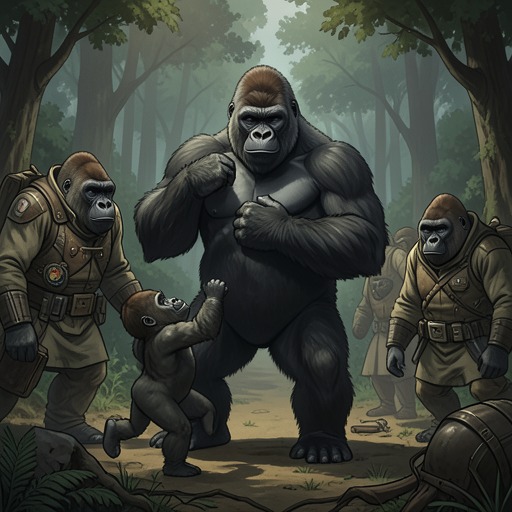
When Ivan first approaches the other gorillas, he sniffs and struts, but they do not welcome him. Their sharp teeth and loud voices make the encounter feel threatening, and he wonders whether he has done something wrong. Kinyani then chases him, throws a stick at him, and corners him. Ivan comes to understand that she is testing whether he is a true silverback, one who can protect her family.
The test puts Ivan’s imagined role against his behavior in the moment. He is twice Kinyani’s size, but he cowers and hides his eyes rather than meeting the challenge. The contrast makes clear that being physically large does not by itself establish him as a protector. Kinyani’s actions are consequential: this is not a welcome that Ivan can mistake for acceptance, but a direct encounter with the responsibilities attached to the group’s expectations. After he retreats, a keeper lets him back into his enclosure. His first attempt at joining the troop ends in withdrawal, not in a settled place among them.
From Confrontation to Contact
Later, Kinyani approaches Ivan again. She taps him on the shoulder and knuckle-runs away. The gesture is brief and playful in its movement, but the change from the earlier chase is striking: now she initiates contact without cornering him. Ivan watches with his arms crossed over his chest and is careful not to make a sound. He does not answer her with words or a display of force; his stillness becomes his response to a contact he has not yet learned how to meet openly.
The relationship shifts further after Ivan tells the troop about the people and animals from his life, including Mack, Ruby, Bob, Stella, Julia, George, and his parents and sister. When he finishes, the gorillas look away and remain silent. Kinyani, however, moves closer. Her shoulder brushes his, and the two let the sun soak into their fur together. The movement is modest, but it changes the emotional temperature of their earlier encounters: the gorilla who once chased and cornered him now shares space with him after hearing about the losses and connections that formed his past. The scene offers no claim that the troop’s silence has been resolved by speech. Instead, Kinyani’s bodily nearness supplies a form of acknowledgment without explanation.
Change and Significance
Kinyani’s role in Ivan’s story is defined by this progression from challenge to companionship. She does not simply confirm Ivan’s importance because he is large; her first test exposes his retreat and the difficulty of becoming a protector within a group. Their later gestures do not erase that failure, but they show a different possibility for relation, one built through proximity rather than a declaration of status. The tap on the shoulder and the shared warmth of the sun make the change legible in action.
The book’s afterword also identifies Kinyani as a real gorilla who lives with Ivan and other gorillas at Zoo Atlanta, where Ivan is described as content. This real-world note distinguishes the animal from the fictional situations of the novel while connecting her presence to Ivan’s actual life in a gorilla group. Within the story, she is not merely a reward for Ivan’s arrival at a new home: she is an independent presence whose initial resistance and later approach give his integration a measure of uncertainty, effort, and companionship.