Mack and Stella
The One and Only IvanMack and Stella’s relationship is shaped by ownership, performance, and uneven care: he keeps an injured elephant working, depends on her when he needs her, and acknowledges her worsening condition without consistently placing her needs first. The account does not establish that Mack caused Stella’s original injury or personally used a claw-stick against her. Instead, it shows how the consequences of her circus career persist under his care, while his own choices reveal the limits of that care.
Origins and the Circus Past
Stella’s history with Mack begins after a serious injury at a famous circus. For her most difficult trick there, she had to balance on a pedestal; when she fell and injured her foot, she became lame and lagged behind the other elephants. The circus then sold her to Mack. The sequence matters to their relationship: he acquired her after the injury had already changed what she could do, rather than as an uninjured animal embarking on a new career. Her damaged foot is part of the history he inherits, though the text does not say that he caused it.
Her circus training also supplies the terms through which Stella continues to perform. She still does some tricks for the show, including standing on her hind legs while Snickers jumps on her head, a difficult feat for an animal weighing more than forty men. The account describes a wider coercive rule for circus elephants: perform the trick and receive a treat; refuse, and the claw-stick comes swinging. Its sharpness can pierce even thick elephant hide. That practice frames the world in which Stella has worked, but it is presented as a general training rule, not as proof that Mack himself struck her. The distinction keeps her history of coercion visible without assigning an act to him that the narrative does not establish.
A Body Carrying the Cost
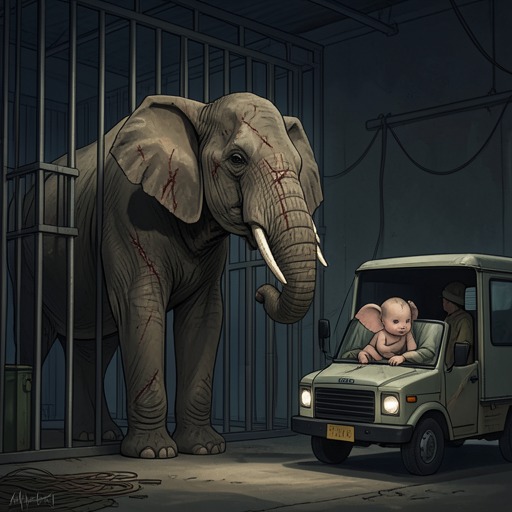
Stella’s old foot injury makes the effects of her earlier work an ongoing part of life with Mack. The scars around her legs, left by chains she wore when young, are wryly called her bracelets. Her foot never heals fully: she limps, and standing in one place for too long can lead to infection. These are not merely traces of a past stunt; they continue to shape her movement and health in the present.
The severity becomes unmistakable last winter, when the foot swells to twice its normal size and Stella develops a fever. She lies on the damp, cold floor of her domain for five days. The episode gives the chronic injury a prolonged, concrete cost: her condition confines her to the floor, and recovery remains uncertain even afterward. Stella does not complain, so the people around her cannot easily judge how much better she is. Her silence does not mean the injury has ended; it makes the burden harder to assess.
Care Under Financial Constraint
George directly alerts Mack when Stella’s foot appears infected again. Mack recognizes the recurring problem, remarking that it never heals properly, and says he will keep an eye on it. But he also says money is tight and that he cannot call the vet every time she sneezes. His response combines acknowledgment with deferral: he knows the injury is persistent, yet frames veterinary attention as a cost that must be weighed against the mall’s finances.
Later, George tells Julia that Mack says the vet will come in the morning if Stella is not any better. He adds that Mack says he will not let her die, especially after all the money he has put into her. This is a conditional promise of care, but its stated rationale is entangled with investment. Stella’s life matters within Mack’s account, while the money spent on her is made equally explicit. The resulting relationship is not reducible either to indifference or to uncomplicated affection: he says he will not let her die, but the narrative places that assurance alongside the economic terms through which he speaks about her.
Practical Dependence
Mack’s reliance on Stella is especially visible when Ruby refuses to come out of the truck. Hearing the scrambling and pounding inside, he says he is getting the “big one” because she might coax the “stupid brat” out. He opens Stella’s door and unties the rope attached to the floor bolt. Stella pushes past him and hurries, as best she can, toward the truck’s open back door, limping heavily. Her swollen foot catches on the ramp; she winces, and blood trickles down.
The scene places Mack’s immediate objective beside Stella’s physical cost. He turns to her as a useful, familiar animal whose presence may solve the problem with Ruby, while Stella acts despite the injury that already limits her. The text does not state that Mack orders her to endure the pain or explain what he does after seeing the blood. What it does show is the asymmetry of the moment: Mack identifies what he needs from Stella, and her damaged body bears the consequence of rushing to help.
Loss and the Limits of the Bond
The account of Stella’s body after death comes indirectly: Bob says he heard from a rat he considers reliable that her body was thrown into a garbage truck. It took five men and a forklift. The report does not identify Mack as the person who arranged or carried out the disposal, so it cannot establish his role in that act. Its starkness nevertheless completes the material history surrounding Stella: she has been bought, trained, used in performances, and treated through the practical language of upkeep and expense; after her death, the reported removal of her body is described in terms of labor and equipment.
Taken together, the episodes make Mack and Stella’s bond consequential but unequal. Mack depends on her performance and, when Ruby is trapped, on her ability to coax the younger elephant. He recognizes that her foot is chronically damaged and says he will not let her die, yet financial pressure governs when he will seek veterinary help. Stella’s persistent limping, infected foot, and bloody stumble at the truck’s ramp keep the bodily cost of that arrangement in view. The relationship is therefore defined not by a single declaration of feeling but by the repeated gap between Mack’s reliance on Stella and the care her injuries require.