Names and identity
The One and Only IvanNames and identity in Ivan’s story turn on a difference between being labeled and being known. People call him the Freeway Gorilla, the Ape at Exit 8, and the One and Only Ivan, Mighty Silverback, but none of these titles exhausts who he is. His insistence on being simply Ivan sets a private sense of self against the names imposed by public attention, while his family’s account of how he was named offers a more intimate model: identity observed through a particular creature’s habits.
Public Titles and Private Self
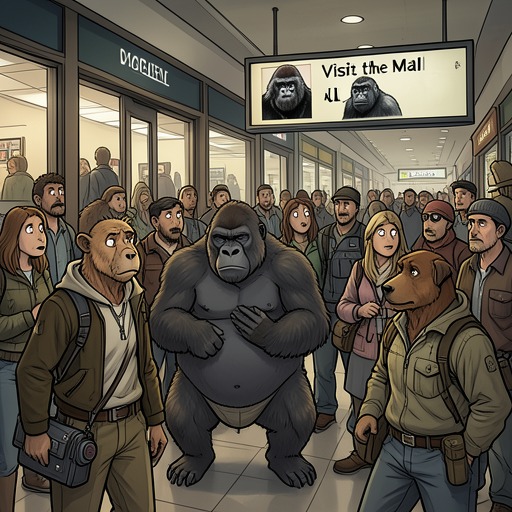
The names people give Ivan are tied to what they can see and use. The Freeway Gorilla and the Ape at Exit 8 identify him by his conspicuous presence at the mall; the grander One and Only Ivan, Mighty Silverback makes that presence sound singular and formidable. The titles belong to him, but Ivan distinguishes possession from definition: they are his names, not the whole of him. His claim to be Ivan, just Ivan, only Ivan strips away the advertising and spectacle without replacing them with another elaborate description.
That distinction gives naming a double edge. A name can acknowledge a person, but it can also reduce that person to a role that others recognize. Ivan’s public labels say where he is and what he is made to represent; his chosen plainness refuses to let those descriptions stand for his entire identity. The contrast matters especially because the names are not simply false. He is the gorilla at Exit 8, and he is presented as a mighty silverback. The problem is that these visible facts are made to do the work of a complete account.
Ivan’s dry observation that humans waste words sits beside his awareness that names can be useful to the people who bestow them. His own labels circulate as readily as the words he thinks humans toss away. The recurring contrast is not between a true name and wholly meaningless ones, but between a name that opens onto a life and one that stops at a public image.
A Name Discovered in the Forest
The story of Ivan’s first name offers a sharply different kind of naming. Gorillas do not name newborns immediately; they get to know their babies and wait for signs of what they may become. Ivan’s parents name his twin sister Tag after watching her chase him around the forest. The name arises from their shared play: Tag is nimble, and when Ivan gets close, she leaps onto their unsuspecting father. Ivan joins her, and the twins bounce on their father’s belly until his grunt tells them to stop. The name records an observed disposition and a recurring relationship, rather than a label made for strangers.
Ivan’s own name grows from a different pattern. He spends his days making pictures on rocks, bark, and his mother’s back, using sap, fruit juice, and, most often, mud. His parents call him Mud because of what he repeatedly does. To a human, the name might sound slight; to Ivan, it means everything. The mismatch between human judgment and gorilla understanding echoes the book’s broader concern with who gets to assign significance. Mud is not an insult or a public gimmick in this account. It is a family’s recognition of a child’s persistent creative impulse, distilled into a name.
The forest naming stories also make identity relational. Tag’s name holds the game between the twins, while Mud joins Ivan to his earliest pictures and to the parents who watched him make them. These names do not explain every aspect of either young gorilla, but they arise from close attention to particular behavior. Set against the mall’s promotional titles, that attention supplies a measure of what public naming lacks.
The Long Interval and the Missing Word
After Ivan has been confined for many years, his ordinary routines are described through Pepsi, old apples, and television reruns. The items are concrete and familiar, but they do not settle the question of what he is supposed to be. He wonders whether he is human or gorilla, then recognizes a gap in human language: humans have many words, yet no name for what he is. The passage does not resolve the uncertainty by assigning him a new category. Instead, it makes the absence of a fitting word part of his experience.
The count of nine thousand eight hundred and seventy-six days places duration beside that unsettled identity. At this point in the narrative, Ruby is asleep and Bob is snoring while Ivan watches Ruby’s chest rise and fall. The quiet scene anchors the large question in a specific present: after all that time, Ivan remains a watcher and companion, but human naming has still not provided a term that captures his condition. The number measures days, not a transformation into a different being.
This uncertainty complicates the earlier insistence on being Ivan. A personal name can secure continuity without answering every question about species, role, or belonging. The story therefore treats identity as more than a choice between human and gorilla: Ivan can know the name that is his and still find that the available human categories do not describe what he is.
The Artist’s New Names
Later, as Mack and George add Ivan’s new pictures to the billboard each afternoon, drivers slow down, honk, and wave. His gift-shop pictures now cost sixty-five dollars with a frame, and people call him the Ape Artist and the Primate Picasso. These names grow out of a real ability that has become publicly visible. Unlike the earlier attraction labels, they identify Ivan through the art he makes; yet they, too, turn an aspect of him into a title for visitors to consume.
The change is visible in the scale of attention around him. Ivan has visitors from morning till night, and so does Ruby. The contrast with the solitary force of his earlier claim to be simply Ivan gives the new names a different weight: he is no longer described only by the place where people see him, but also by the work that draws their attention. Still, the titles remain names people call him, not a final definition supplied by the narrative.
Across the forest, mall, and billboard, naming shifts from family observation to commercial display and then to public recognition of artistic skill. The continuity underneath those shifts is Ivan’s making of pictures: mud first, later pictures that attract visitors and appear on a billboard. The changed setting and changed audience alter what people call him, but they do not originate the creative impulse that his first name already recorded. The book’s treatment of names thus holds two truths together: other people’s words can recognize something real, and no collection of titles can replace the individual who bears them.