Public support helps bring about the animals' departure from the mall
The One and Only IvanPublic support changes the campaign around the Exit 8 Big Top Mall billboard from a display that draws customers into a demand for Ruby’s freedom, and it coincides with inspection and preparations to move animals out of the mall. The shift is visible in the people gathering outside, the checks made inside, and the transport boxes placed in the ring; it opens a route away from Mack’s coercive show, even though it does not make captivity disappear.
From billboard to public spectacle
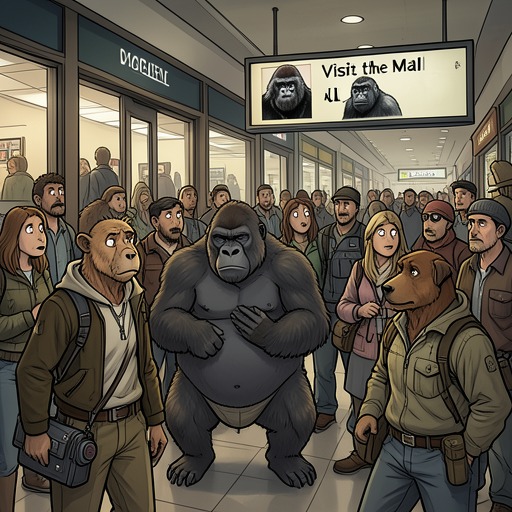
The billboard’s visibility first produces a commercial kind of attention. After a photograph of it appears in the newspaper, Mack tapes the story to Ivan’s window. Each day brings more curious visitors: they park in front of the billboard, point, shake their heads, take photographs, then enter the mall and buy Ivan’s paintings. Ivan paints for the gift shop and for the billboard, including trees with birds and a newborn elephant with glittering black eyes. His pictures attract people, but the attention they generate begins to carry a message beyond the mall’s sales floor.
The change becomes unmistakable when people arrive carrying signs on sticks. One sign shows a gorilla cradling a baby elephant, putting the relationship between Ivan and Ruby into an image that can be read from outside the ring. More protesters follow. Some want Ruby freed; others also want Mack to close the mall. The demonstrations therefore challenge both Ruby’s confinement and the commercial setting that depends on animal performances. What had been a billboard campaign now has a visible public constituency, with the mall itself becoming the focus of dispute.
Protest and the mall’s response
The protests make the conflict harder for Mack to contain as ordinary business. He tells George that the protesters are targeting the wrong person and will ruin everything, then stomps away. George watches him go with his mop in hand and rubs his eyes. The exchange exposes a divide inside the mall: Mack treats the demonstrations as a threat to his livelihood, while the protesters treat the animals’ conditions as the central issue. George’s worried reaction places the dispute inside the working life of the mall as well as outside it.
A separate form of public attention arrives with cameras and bright lights. People sometimes shout, “Free Ruby! Free Ruby!” Ruby asks Ivan why they are yelling her name and whether they are angry at her. Ivan tells her that they are angry, but not at her. The exchange makes the protest’s intended distinction plain: Ruby is its subject and beneficiary, not its target. It also shows how difficult that message is for Ruby to interpret when the crowd’s noise reaches her through the very space that confines her.
Inspection and a change in direction
As demonstrations continue, a tall man arrives with a clipboard and pencil, saying he is there to inspect the property. He makes numerous check marks, looking at Ivan’s floor, Ruby’s hay, and the animals’ water bowls. The inspection brings their material conditions into view as things to be examined rather than merely as background to a show. Bob hides near the Dumpster because he does not want to become a check mark, an anxious, comic response that also makes clear how exposed the animals are to the visitor’s scrutiny.
A week later, the inspector returns with a woman in a white coat. She watches Ivan for a long time, then watches Ruby, and speaks with the inspector and Mack. Mack receives a sheet of paper and retreats to his office, slamming the door. The narrative does not disclose what the paper says, so the precise decision-making remains out of view. But the sequence has changed: scrutiny is followed by a meeting with Mack and then by preparations that point toward removal, rather than another round of performance or training.
Boxes, training, and imminent removal
The woman returns with other people, who place a large box in the center of the ring. It is Ruby-sized. Ivan recognizes that she has come to take Ruby away. Instead of forcing Ruby straight into it, the woman coaxes her toward the box with an apple, speaks kindly, and uses a small piece of metal to make a clicking sound. Each time Ruby touches the box, she receives a click and a piece of carrot. The procedure turns the box from an unknown object into something Ruby can approach through repeated, rewarded contact.
That patient method stands in stark contrast to Mack’s earlier training. He had looped Ruby’s feet with rope so she could not run, hung a heavy chain from her neck, and presented her with Stella’s ball, pedestal, and stool as he worked her through tricks. Obedience brought sugar or dried apple; disobedience brought yelling and kicks at the sawdust. The box-training scene gives Ruby a different immediate experience of human direction: it is still a managed process, but the woman uses food and gradual contact rather than restraint and punishment. Julia watches Ruby closely during Mack’s training; here, the practical work is directed toward getting Ruby into a transport container.
The preparations extend to Ivan. Four men bring a large metal box into the ring, sized for him. Later his cage door is propped open, and the box has been moved against the doorway with its own opening accessible from inside. The arrangement makes the next step physically legible: crossing the open cage door would mean entering the human-provided box. The scene does not record the animals’ departure itself, but it marks the transition from public demand and inspection to concrete preparations for transport.
Consequences and limits
The episode’s force lies in the convergence of different kinds of agency. Protesters make Ruby’s situation publicly visible; the inspector examines the property; the white-coated woman returns with a plan embodied in a box and a careful training method. The narrative does not state that any single group controls the whole process, or spell out the formal grounds for the decision. It does show that the public campaign is accompanied by attention from people positioned to arrange a move, and that the animals’ future begins to change through these overlapping actions.
The later scenes preserve an important limit to that change. Ivan watches a nature program showing gorillas eating, grooming, playing, and sleeping, experiences unlike the performances and isolation of the mall. Yet at his later habitat, he encounters an endless white wall built to keep the animals in and others out, and recognizes that it is still a cage. The move away from the mall matters: it makes new surroundings and forms of animal life possible. But the wall prevents the story from treating relocation as the same thing as freedom. Public support helps bring an end to the mall setting; it does not erase the larger boundary between the animals and the world beyond it.