Tag
The One and Only IvanTag is Ivan’s twin sister, whose playful name came from the game she loved and whose death during their capture became a lasting wound in his memory. Her brief life is known through Ivan’s recollections: a childhood of forest games, a shared capture, and the loss he carries into captivity and dreams.
Identity and Naming
Tag and Ivan were twins born in the dense rainforest of Central Africa. Their parents did not name newborns immediately; gorillas, Ivan explains, first get to know their babies and wait to see what they might become. Tag’s name came from a defining habit: she loved to chase Ivan around the forest, and her parents named her after seeing how much she enjoyed it. The name preserves the motion of their childhood bond. Tag was not simply Ivan’s companion in play; the game itself supplied the name by which he would remember her.
Forest Life with Ivan
Ivan recalls Tag as nimble and quick to evade him. When he got close, she would leap onto their unsuspecting father, and Ivan would join her, the twins bouncing on their father’s tolerant belly until he made a grunt that meant enough. The scene gives their family life a specific, physical shape: Tag’s chase turns into a shared game with Ivan, and their father becomes an affectionate participant who sets its limit. Ivan says the game never grew old, making the recollection a picture of repeated delight rather than a single adventure.
That remembered forest is especially vivid because it is so unlike the confined life that follows. The twins’ play takes place among family and familiar surroundings, with Tag able to run, dodge, and choose where to go. The account offers no later actions by Tag in the forest; instead, it holds her in the lively motion of the game, just before the human arrival that ends it.
Capture and Death
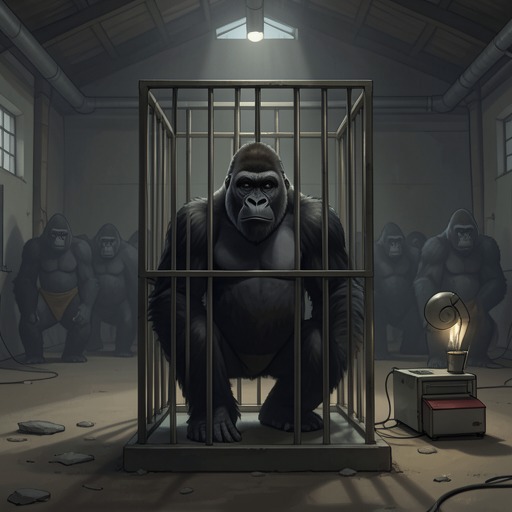
One still day, when the hot air hummed, humans came and captured Tag and Ivan. They were put together in a cramped, dark crate that smelled of urine and fear. Ivan remembers understanding that he had to let his old life die in order to live, while Tag could not let go of home. He describes that attachment as a vine extending across the miles, at once comforting and strangling. The image makes the separation more than a change of place: the home that had held their family life remains emotionally present, even as the crate carries them away from it.
Still inside the crate, Tag looked at Ivan without seeing him. He understood from that look that the vine had finally snapped. Later, when faced with another huge, shadowy box, Ivan recognizes that he does not want to enter it because the last time he was in a box, his sister died. That explicit recollection establishes Tag’s death and connects the early capture to Ivan’s later fear: the box is not an ordinary container to him, but the setting in which he lost his twin.
Memory and Afterlife in the Story
Tag remains present in Ivan’s life through objects and dreams rather than through further shared action. Julia gives Ivan a stuffed toy gorilla with empty eyes and floppy limbs; he sleeps with it every night and calls it Not-Tag. The name marks both attachment and absence: the toy offers a gorilla-shaped companion, but Ivan’s name for it insists that it is not his sister. The account does not claim that the toy replaces Tag; its importance lies in how plainly it keeps her loss close.
Later, Ivan dreams that he is with Tag again, swinging from vines while Stella watches. In the dream, sunlight cuts through the thick canopy and the breeze tastes of fruit. This imagined reunion restores the forest’s movement and sensory richness, but it does not undo the crate or Tag’s death. Instead, the dream places her back in the landscape and companionship Ivan remembers, making the contrast between his lost home and his present life visible through her return. Tag’s narrative role is therefore brief but decisive: her fate explains the grief attached to Ivan’s memory of captivity, while the play, the toy, and the dream preserve the sister he cannot recover.