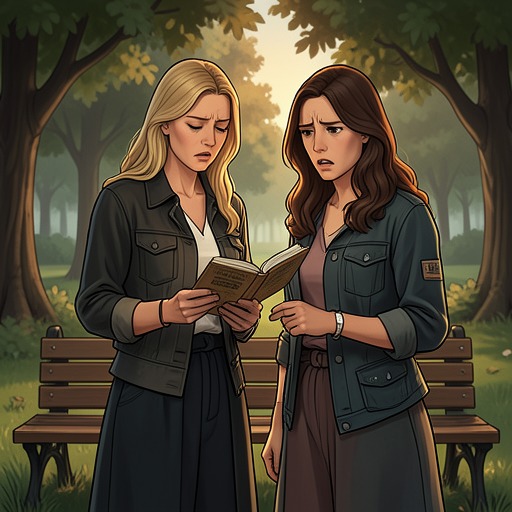
Burning Heart
The Other Black GirlBurning Heart is Diana Gordon’s novel about a young Black woman who refuses the limits placed on her, and a pivotal book whose success reshapes the lives of its author and editor. For Nella Rogers, it is both a formative work of literature and the reason she seeks a place at Wagner Books; for Diana and Kendra Rae Phillips, its achievement is inseparable from the editorial partnership that made it possible and the personal history that followed.
The Novel and Nella’s First Reading
Burning Heart follows Evie, a headstrong young Black teenager who runs away from her conservative parents in a small New England town and falls in love with a rough-and-tough Black Panther Party member. Nella first encounters the novel at fourteen, when her parents give it to her for her birthday, the summer before she starts high school. The book captures her from its epigraph. She recognizes something of herself in Evie: Nella’s parents have taught her to speak up when something is wrong and not to accept being treated as lesser, but she has not had to wield those lessons as a teenager. Evie’s desire to experience life and reach beyond the world immediately available to her gives Nella a powerful point of connection.
Nella reads the roughly five-hundred-page novel three times in rapid succession during August. In September, she writes about it for a freshman summer-reading project. Nearly eight years later, it becomes the backbone of a senior thesis that she never manages to publish. Her academic argument places the book’s social impact alongside the fact that it was both written and edited by Black women. She compares it with two other books written and edited by people of the same race, a pairing she has come to understand as rare. The book thus matters to Nella not only as a story she loves, but as evidence of what Black women can create together within a publishing culture where such collaborations are unusual.
Editorial Partnership and Publication
Diana’s account of the book’s making shows that Kendra Rae Phillips’s contribution went beyond routine editing. Richard Wagner says he had read and loved an early draft, but stepped aside when he learned Kendra Rae wanted to work on it. He believed she would be the better editor for Diana. Diana initially doubts that choice. She has only recently started writing, while Kendra Rae has edited just three books; Diana imagines that working with Richard, already influential in publishing, might help her rise and eventually bring Kendra Rae along with her. She also worries about how the arrangement will look. In retrospect, she recognizes that she and Kendra Rae did not merely manage well without Richard: their work together proved extraordinary.
Kendra Rae’s editorial notes help redirect the manuscript. She tells Diana that the draft is playing the short game and needs to play the long one: Diana should write for herself, hold nothing back with Evie, and give the character more room to breathe. Diana follows that counsel through several further revisions. The resulting book brings together story, publicity, and positioning in ways she had not initially imagined. Her account emphasizes the particular force of the partnership: Kendra Rae takes the novel somewhere beyond the limits Diana had set for it, and their shared work gives Evie a fuller presence.
Reception and Cultural Reach
After publication, Burning Heart becomes difficult to find in libraries and bookstores. High schools ban it for its explicit and occasionally gruesome content, a response Diana places in the context of the Reagan era. The controversy does not confine the novel to a single audience: comparisons with Native Son help prompt book clubs in unexpected settings, from white suburban homes to Black lower- and middle-class households. Diana reflects that the novel’s appeal crossed boundaries partly through the achievement of two Black women—one light-skinned and one dark-skinned, both college graduates—whose collaboration captured the country’s attention.
The book reaches number one on the New York Times bestseller list. Richard later recalls celebrating that milestone with Diana and Kendra Rae at Antonio’s; a photograph from the occasion is especially precious to him because Kendra Rae rarely allowed herself to be photographed. Hazel-May McCall also invokes Burning Heart when speaking to supporters of YBL. She calls it a light in a landscape of whiteness, praises its willingness to confront difficult subjects, and uses the careers of Diana and Kendra Rae as examples for the young people she hopes to support. The novel’s influence therefore extends beyond sales: it becomes a public reference point for Black literary achievement and for the possibility of young people finding a vocation in writing.
Nella’s Career and the Book’s Uneasy Legacy
Burning Heart helps determine Nella’s professional direction. She applies to Wagner Books because it published her favorite novel and wants to walk the halls where Diana and Kendra Rae worked and sit at the desk where they discussed edits. At her new-hire tea with Richard, she abandons her rehearsed explanation of why she entered publishing and admits that she is fascinated by Kendra Rae and the book. She tells Richard that Burning Heart made her fall in love with reading. His revelation that he had declined to edit it corrects Nella’s assumption that Kendra Rae had discovered Diana, while confirming the importance of the editorial choice she has long studied.
Nella’s admiration also gives way to questions. Kendra Rae disappeared from public view the year after the novel set the country alight, following a media spectacle, and Nella has difficulty verifying what happened. The theories circulating on Black Twitter do not satisfy her. She wonders how Diana could continue publishing year after year while the Black woman credited with an invaluable role in shaping Evie remained absent. A photograph Richard shows her—Diana, Kendra Rae, and Richard together at the bestseller celebration—makes that history tangible, but does not explain the disappearance.
For Diana, the book’s success cannot erase the doubts that preceded it. At a celebration shortly after publication, she remembers the limited resources Richard provided: he let Kendra Rae edit the book, gave them little money, and arranged only a two-week author tour. Diana believes those decisions were precautions against a possible flop and says she had to fight him at each step. The novel’s triumph makes those early calculations look especially stark: a book dismissed as a possible failure becomes a national sensation, and its creators suddenly face months of interviews and the prospect of a major weekly magazine cover.
The achievement is also bound to what Diana later believes she has sacrificed. After learning that Kendra Rae is alive, Diana thinks of the years in which Kendra Rae may have seen her dilute her work for comfort and financial security, as well as the made-for-television adaptation of Burning Heart that Diana regrets approving. She remembers publicly describing Kendra Rae as having severe mental-stability issues in the year after her disappearance, a statement she now understands Kendra Rae may have read. The novel remains a landmark, but it is not a simple emblem of success: its lasting brilliance sits beside the friendship’s rupture, Diana’s compromises, and the unresolved consequences of Kendra Rae’s disappearance.