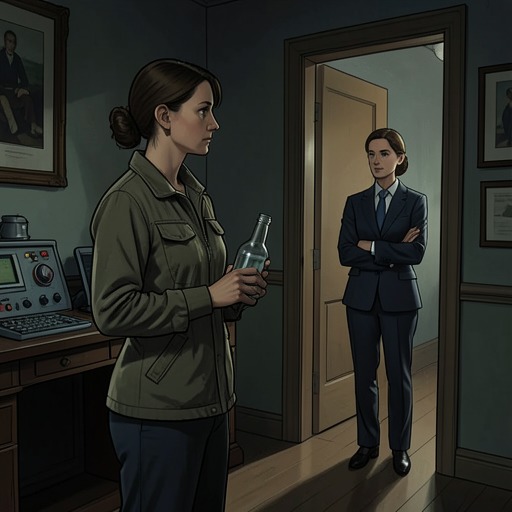
Hazel’s Files
The Other Black GirlHazel’s Files are a collection of photographs, notes, and personnel-like records that turn private suspicion into evidence of organized surveillance at Wagner Books. Found by Nella Rogers while she searched through a folder in a cabinet, the papers include information about other Black women, a detailed page devoted to Nella, and records concerning the missing editor Kendra Rae Phillips. Their significance lies not only in what they document, but in the dates and handwriting that unsettle the assumption that the monitoring began with Hazel-May McCall.
Contents and Form
The folder is not made up entirely of conventional files. As Nella was about to put it away and close the cabinet, she noticed a non-glossy page and then another. Closer inspection showed that about a quarter of the folder consisted of ordinary letter-sized sheets. Their presence among the other materials led her to look more carefully rather than dismissing the folder as a collection of photographs alone.
Those sheets included rows of wallet-sized photographs of women Nella recognized. The pictures were accompanied by city names, three-digit numbers that might have served as a labeling system, and handwritten notes. The combination of faces, locations, numbers, and evaluations gives the archive the character of a system for identifying and classifying people, although the exact meaning of the numbers is not established.
Nella recognized photographs of Kiara, Ebonee, and Camille, each accompanied by written assessments. When Malaika later read some of those notes from Nella’s phone, the assessments touched on the women’s writing, social awareness, speech, workplace presence, and reactions to how they were treated. The entries convert individual colleagues into subjects of appraisal, recording both perceived strengths and judgments about their behavior. The notes’ language also reveals a sharp imbalance: the women are documented and interpreted, while the archive’s evaluators remain largely out of view.
Nella’s Record and the Archive’s Timeline
The folder contained more than a row for Nella. She had an entire page, which she photographed along with the page bearing Kendra Rae Phillips’s image. The fuller record distinguishes Nella’s file from the entries Nella saw for the other women, though the evidence does not explain why she received more space. Beneath her photograph was a hot-pink sticky note with a brief assessment and an instruction for eight jars to be ordered, dated for October 20. The note links observation to a concrete planned action rather than leaving the file as passive documentation.
When Nella and Malaika examined the images, Nella found an entry dated September 26 stating that she had accepted grease without asking questions. A smaller note referred to a mystery note that seemed to have unsettled her, raised the possibility that Kendra Rae was involved, and suggested considering an alternative plan. Together, the entries show the archive tracking Nella’s responses and registering changes in her state of mind. They also connect the written records to the hair grease at the center of the plot, without by themselves spelling out every mechanism behind its use.
Nella recognized the handwriting on these notes as Richard Wagner’s, comparing it with the signature she had seen on contracts and holiday cards. Her identification gives the archive a direct link to Wagner Books’ publisher rather than leaving its authorship wholly anonymous. The discovery is especially consequential because Malaika pointed out that Nella’s entries went back to her first months at the company, well before Hazel arrived. The files therefore complicate any account that treats Hazel as the origin of the monitoring: at least some records predate her presence, and Richard’s handwriting appears on material concerning Nella.
Kendra Rae Phillips and Shani Edmonds
Behind another photograph, Nella found an unmistakable image of Kendra Rae Phillips. She photographed it, then photographed her own page, preserving evidence before returning to the folder. Her response combines the urgency of securing a record with the desire to read everything on the page; the notes were alarming enough that she also wanted to destroy the folder. She nevertheless skimmed the material before putting it back.
The Kendra Rae page carried a longer timeline. Nella judged from the small photograph that it might date from around the publication of Burning Heart, one of the last public photographs Kendra Rae had taken. Richard’s handwritten notes beside it stretched from the 1980s to the present. Among the entries Nella read were a possible sighting upstate in 1986 and a 1992 note speculating that Kendra Rae had moved to Paris. The record thus presents her not simply as a former colleague but as someone whose whereabouts had been tracked over many years, though the notes themselves include uncertainty.
The latest entry Nella noticed was dated October 20, 2018. It described a confirmed sighting of Kendra Rae near the intersection of 100th Street and Broadway, stated that she had taken Shani Edmonds’s phone, and said that she had gone underground. This brief entry joins a current event to the older trail of sightings and speculation. The files therefore offer a possible explanation for how the organization connected Kendra Rae’s movements to Shani, while also showing that the archive retained records across decades.
Discovery and Significance
The papers become actionable evidence because Nella and Malaika inspect them together. Malaika reads the assessments of Kiara, Ebonee, and Camille; Nella draws attention to the dated notes about herself and recognizes Richard’s handwriting. This exchange moves the discovery beyond Nella’s private suspicion: the two women compare what the archive says about others with what it records about Nella, and identify a continuity that predates Hazel’s arrival.
The files also echo Nella’s earlier attempts to understand the risks of her workplace. She had worried about navigating a homogeneous and rigid Manhattan office, and later, while keeping her head down, she recorded the times and words of colleagues who stopped at her desk. Those acts of watching and recording are not equivalent in scale or power to the archive’s dossiers, but the contrast clarifies why the folder matters: Nella’s notes were a cautious effort to protect her own understanding, while these records classify multiple women and preserve information about their conduct and whereabouts.
The archive’s implications extend beyond a single workplace dispute. Wagner employees had voiced resentment about hiring nonwhite people, and Nella knew that an outsider might dismiss subtle workplace behavior as harmless. In that setting, the files make scrutiny visible as an institutional practice with personal consequences. Their contents also stand in tension with the company’s public commitments to diversity: women appear in the records as objects of assessment and intervention, not merely as colleagues whose experiences are being heard. The discovery does not answer every question about who assembled the folder or how every note was used. It does establish that Nella, Malaika, and Kendra Rae were being documented, that Richard’s handwriting appears in the records, and that the surveillance associated with Nella began before Hazel joined Wagner Books.